
Summer Internship Resume Emergency Guide: 7 Days From Blank Page to Submitted Application
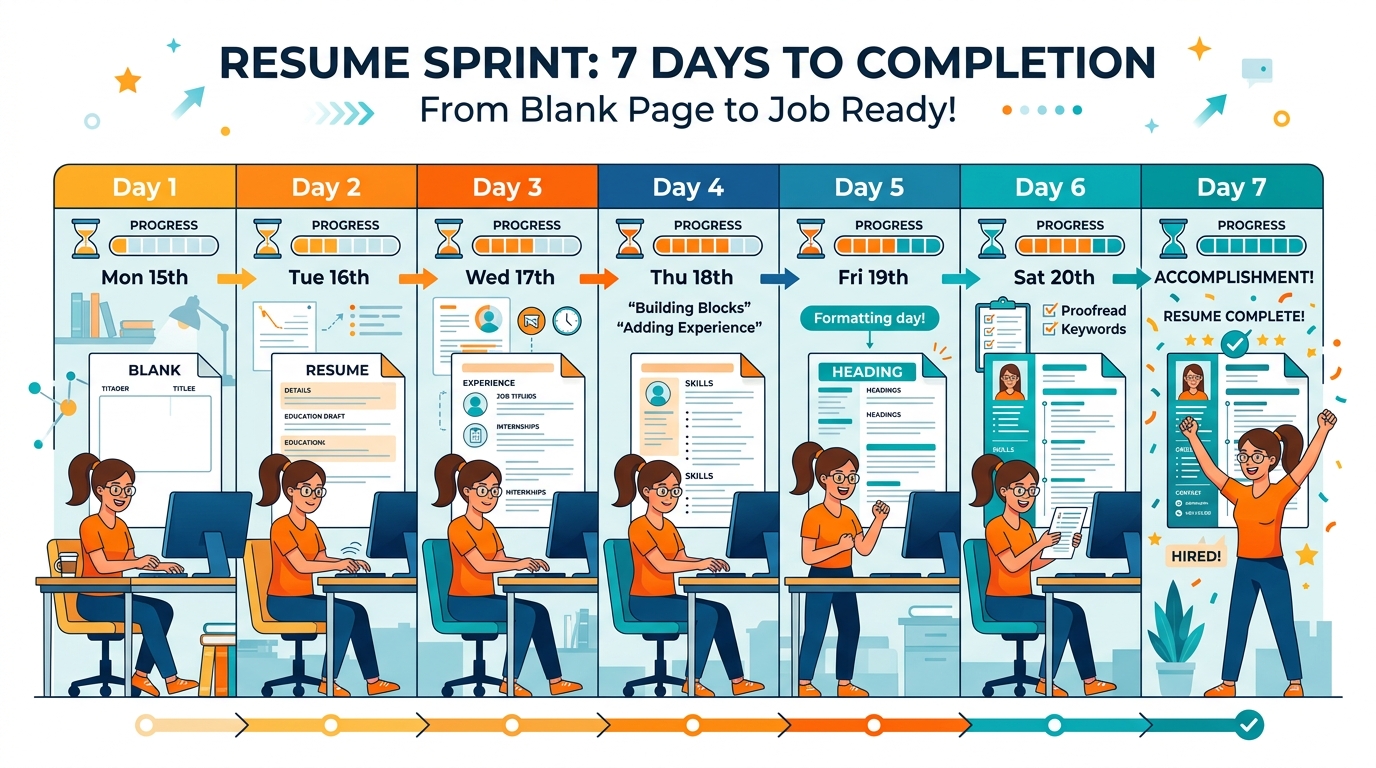
Summer Internship Resume Emergency Guide: 7 Days From Blank Page to Submitted Application

Summer has started. Your friends are posting internship updates. Group chats are buzzing with “first day” photos — lanyards, desk views, company coffee machines. Meanwhile, you open a Word document and type:
Name: ________
That is it. That is where you are. The document is still open. The cursor is still blinking. And the summer clock is ticking louder every day.
You are not late yet. Companies continue hiring for summer internships through June and even into July. Startups, small businesses, campus labs, and local organizations often post urgent openings when their planned interns cancel or when project workloads spike unexpectedly. The positions exist. What you need is a resume that gets you considered — and you need it fast.
This is a seven-day sprint plan designed for people starting from zero. No prior draft. No polished bullet points. No carefully curated portfolio. Just a blank page, a laptop, and one week to change your situation.
Day 1: The Experience Download — Everything You Have Ever Done
Day 1 is not about writing. It is about remembering.
Open a new note — any note app will do — and create a raw brain dump under two headings: Academic Projects and Everything Else.
Under Academic Projects, list every course from the past year where you completed a project, paper, presentation, lab, or group assignment. Do not judge what counts. A five-page history paper counts. A group marketing presentation counts. A Python script you wrote for a computer science assignment counts. A lab report with charts counts. The goal is volume — you want everything on the table so you can sort later.
For each item, write down:
- The course name and semester
- What you actually did (in plain, ugly language — “we made slides about Apple supply chain”)
- Any tool or method you used (Excel, Google Docs, R, Canva, whatever)
- Any outcome or feedback (“got an A,” “professor said the data section was strong”)
Under Everything Else, list anything outside of class: club participation, volunteer hours, part-time jobs, side hustles, self-taught skills, sports teams, tutoring, babysitting, lawn-mowing, anything. If you showed up somewhere and did something, write it down.
This raw list will look messy. That is the point. By the end of Day 1, you should have at least 10 items. 15 is better. The mess is raw material, and the next six days will shape it into a resume.
Day 2: Sort, Select, and Structure
Take your Day 1 brain dump and sort every item into one of four buckets:
Strong projects — these will become your main bullet points. A strong project has a clear action, a tool or method, and a visible outcome. Example: “Built a Python web scraper for my data science class, collected 500 product listings, and presented pricing trends in Tableau.”
Supporting activities — these show character and reliability but are less skill-specific. Example: “Volunteered 12 hours at campus food bank, organized donation sorting on Saturday mornings.”
Raw skills — tools, languages, software, and methods you can actually use. Be honest. If you have only used Excel for basic charts, write “Excel (basic).” If you can code in Python, write “Python (intermediate).”
Reject pile — items that are too vague or too dated to be useful. “Went to club meetings sometimes” goes here. High school items from two years ago might go here too, depending on what you have since.
Now assemble your resume skeleton:
- Education (top): School, major, GPA if above 3.0, graduation year, relevant courses
- Project Experience (largest section): 2-3 strongest projects with 2-3 bullet points each
- Skills: Tools and languages organized by category
- Activities (bottom, if space allows): 1-2 supporting activities
By the end of Day 2, you should have a document with section headers and rough bullet points. The language will still be plain — that is for Day 3.
Day 3: First Draft — Turn Plain Language Into Professional Bullet Points
Day 3 is the hardest day, because it requires translating “what I did in class” into “what I can do for an employer.” This is the translation skill that separates effective resumes from generic ones.
The translation formula is simple: Action verb + specific task + tool or method used + measurable outcome or result.
Here is how the formula transforms raw notes into resume bullets.
Before:
We had a group project for marketing class. We analyzed Starbucks and made a presentation. I did the competitor research part. Got a B+.
After:
Analyzed Starbucks’ market position against three competitors (Luckin, Tim Hortons, Costa) using public financial reports and customer survey data; synthesized findings into a 12-slide presentation delivered to a class of 30 students.
Why this version works:
The “after” version does three things the “before” version does not. It names the specific task (competitor analysis, not “a group project”). It names the method (public financial reports, customer survey data). And it names the output (a 12-slide presentation to 30 students). A hiring manager reading this bullet point now knows the candidate can research, analyze, synthesize, and present — four transferable skills that matter in almost any internship.
Go through your Day 2 skeleton and apply this formula to every bullet point. Do not overthink individual bullets. Your goal for Day 3 is a complete first draft — rough edges allowed.
Reality check: your first draft will not be great. It will have weak verbs, missing outcomes, and at least one bullet point that still reads like class notes. That is normal. You improve it on Days 4 and 5.
Day 4: Review, Tighten, and Test Against a Real Job Posting
Day 4 is for sharpening. Read your draft out loud. Every bullet point should sound like something a reasonable person would say in a job interview. If a bullet sounds awkward or unclear, rewrite it.
Then find one real internship posting — any posting, even if you are not sure you will apply. Read the job description carefully and ask yourself: if a hiring manager read my current resume, would they see evidence for the skills this posting asks for?
This exercise often reveals gaps. If the posting asks for “experience with data analysis” and your resume has zero mentions of data, go back to your Day 1 brain dump. Did you analyze survey results? Count lab data? Make charts for a presentation? Pull the relevant evidence forward.
If the posting asks for “strong written communication” and your resume mentions no writing, add your strongest paper or report. Even a class essay counts if it was substantial.
Tightening is not about adding more. It is about making sure every bullet point pulls its weight. If a bullet point does not connect to a skill an employer might care about, cut it or rewrite it.
Day 5: Match and Customize for Specific Roles
Day 5 is where generic resumes become targeted applications. Pick two to three internship postings you are actually interested in. For each one, create a customized version of your resume.
Customization does not mean rewriting from scratch. It means three targeted adjustments:
- Reorder your projects so the most relevant one appears first.
- Tweak bullet-point emphasis — if a posting asks for “collaboration,” make sure your bullet points highlight the team dimension of your projects. If it asks for “independent initiative,” highlight the parts you did on your own.
- Adjust your skills section to match the posting’s keywords. If the posting lists “Excel, PowerPoint, Google Analytics” and you have those skills, list them in that order.
This process takes about 20 minutes per posting. It sounds tedious, but it is the single highest-ROI activity in a job search. A resume customized to a specific posting is dramatically more likely to get an interview than the same generic resume sent to ten companies.
Day 6: Final Polish and Proofread
Day 6 is for the details that separate amateur resumes from professional ones.
Read your resume backward — start with the last bullet point and work up. This breaks your brain’s habit of skimming familiar text and helps you catch typos you would otherwise miss.
Check these specific items:
- Is your email address professional? (firstname.lastname@gmail.com, not partyking2005@hotmail.com)
- Is every date formatted consistently? (all “May 2026” or all “05/2026,” not a mix)
- Are your verb tenses consistent? (past tense for completed projects: “Analyzed,” not “Analyze”)
- Is every bullet point a single idea? (split long bullets into two)
- Did you spell “university” correctly? (yes, people miss it)
Then send your draft to one person — a friend, a roommate, a parent, anyone. Ask them to read it once and tell you the first thing that confuses them. Fix that thing. Now your resume is ready.
Recommended First: Use OfferGoose to Accelerate Your Resume Sprint
The seven-day plan above works. But if you are reading this on a Thursday and applications close Monday, you do not have seven days. You have maybe seventy-two hours. That is where OfferGoose changes the timeline.
OfferGoose compresses Days 1 through 5 into a single session. Instead of manually doing the brain dump, sorting, translating, and matching yourself, you talk through your experience with OfferGoose’s guided interview. It asks targeted follow-up questions to surface project details you would otherwise forget. It translates your raw answers into professional bullet points using the action-method-outcome formula. And when you paste in a job description, it identifies which of your experiences are most relevant and suggests how to emphasize them.
The result is a targeted, professionally formatted resume in under an hour — not seven days. You still own Days 6 and 7 (proofreading and submitting), but the heavy lifting of drafting and customization is handled.
Here is what the efficiency difference looks like in practice:
| Task | DIY Time Estimate | With OfferGoose |
|---|---|---|
| Brain dump and sort experiences | 2-3 hours (Day 1-2) | 15-20 minutes (guided interview) |
| Translate into bullet points | 3-4 hours (Day 3) | Automatic with review |
| Match to job descriptions | 1-2 hours per role (Day 5) | 5-10 minutes per role (paste JD and adjust) |
| Total to first draft | 6-9 hours | 30-60 minutes |
This is not about replacing effort — it is about focusing your effort on the parts that need human judgment: deciding which experiences matter most, reviewing the output for accuracy, and tailoring the final version to each role. The tedious translation work belongs to the tool.
Consider a real example from a sophomore computer science student, Kevin, who decided on a Tuesday that he wanted a summer internship and had applications due Friday.
Before (Kevin’s self-written draft):
Projects
- Worked on a group project for CS class, built a web app
- Did some Python scripting for data processing
Skills
- Python, HTML, CSS, some JavaScript
Kevin knew he had done more than this, but he could not figure out how to describe it under time pressure. His draft was 80 words and told a hiring manager almost nothing.
After (Kevin used OfferGoose):
Project Experience
Campus Event Finder | CS 201 Group Project (4-person team)
- Built a full-stack web application using Flask (Python), PostgreSQL, and Bootstrap that lets students search and filter campus events by category, date, and location
- Designed the database schema with 5 relational tables; wrote SQL queries for event filtering with sub-1-second response time on a dataset of 200+ events
- Implemented user authentication with session management and password hashing; handled 15 test accounts during demo without errors
Data Cleaning Pipeline | Independent Project
- Wrote a Python script using pandas to clean and normalize a messy dataset of 3,000 product reviews for a personal machine learning project
- Automated duplicate removal, missing value imputation, and text standardization; reduced data cleaning time from 3 hours manually to 8 minutes scripted
Skills
- Languages: Python, JavaScript, HTML/CSS, SQL
- Frameworks & Tools: Flask, Bootstrap, PostgreSQL, Git, pandas
- Concepts: REST API design, database schema design, user authentication, data cleaning
Why this version works:
The transformation is dramatic but entirely truthful. Kevin built the web app, designed the database, wrote SQL queries, and handled authentication — all real work. His first draft simply did not describe any of it. OfferGoose asked him follow-up questions during the session: “What framework did you use?” “How many tables in your database?” “Did you handle any errors or edge cases?” Kevin answered in plain language, and OfferGoose structured the answers into bullet points with specific tools, numbers, and outcomes.
The independent Python project is also real — Kevin had written the script for fun over winter break and never thought to put it on a resume. OfferGoose surfaced it by asking “Have you built anything on your own, outside of class?” That one question added a bullet point that now demonstrates self-motivation, which is exactly what tech internship hiring managers look for.
Day 7: Submit, Track, and Prepare for What Comes Next
Day 7 is execution day. Submit your applications — aim for five to ten, not fifty. A targeted application with a customized resume to a relevant role is worth more than fifty generic applications.
Track every submission in a simple spreadsheet: company name, role, date submitted, which resume version you used, and any follow-up dates. This lets you know where you stand and prevents duplicate submissions.
After submitting, shift your energy to interview preparation. If a company responds, you may only have 24 to 48 hours before the interview. Spend 30 minutes researching the company and role. Find their product, their recent news, and their team structure. Prepare answers for the three most predictable questions: “Tell me about yourself,” “Why are you interested in this role,” and “Tell me about a project you worked on.”
If you used OfferGoose to build your resume, you can also use its mock interview feature to practice answering these questions. The same project details that went into your resume become the foundation for interview answers — you just need to practice saying them out loud.
The Urgency Is Real — But So Is the Opportunity
Every day you wait, another internship slot closes. But the reverse is also true: every day you act, you move closer to a summer that looks completely different from the one you are facing right now.
Companies that hire summer interns in June and July tend to move fast. They have immediate needs — a project that needs an extra pair of hands, a team member who just left, a workload spike that temporary help can absorb. These companies are not conducting six-round interview processes. They review resumes quickly, schedule interviews within days, and make offers by the end of the week. Your speed matters, and so does having a resume ready to send the moment you find a posting.
The seven-day sprint is designed to meet this reality: move fast, produce something professional, and get it in front of hiring managers while positions are still open.
Frequently Asked Questions
General Questions
Is it really possible to build a good resume in seven days?
Yes, if you follow a structured process. Days 1-2 are raw material collection. Day 3 is first-draft translation. Days 4-5 are refinement and targeting. Day 6 is proofreading. Day 7 is submission. The key is not skipping the brain dump phase — you cannot translate experience you have not identified. Most people who get stuck are trying to write polished bullets before they have listed their raw experiences.
What if I miss a day in the sprint?
Pick up where you left off. If you miss Day 3, do Day 3 on Day 4 and compress Days 4-5 into one longer session. The sequence matters more than the calendar: brain dump first, draft second, refine third, submit last. Do not skip ahead.
How many internship applications should I submit in a summer sprint?
Quality over quantity. Submit five to ten well-targeted applications with customized resumes rather than fifty generic ones. Each customized application takes about 20 minutes beyond the resume work, and the response rate difference is measurable — hiring managers can tell when you have read their job description.
What if I get no responses after submitting?
First, check your approach: are you applying to roles where your experience is genuinely relevant? Second, follow up politely after one week with a short email restating your interest. Third, widen your search to adjacent roles or smaller companies. A summer internship at a local startup or small business is still real experience, and those companies often have less competition.
Can I use the same resume for different types of internships?
You can, but you should not. A resume for a marketing internship should highlight different projects and skills than a resume for a lab research position. Even if the underlying experiences are the same, the emphasis and ordering should change. Customization is the difference between getting an interview and getting ignored.
Questions About OfferGoose
How fast can OfferGoose help me build a resume from scratch?
Most users complete a first draft in 30 to 60 minutes. OfferGoose uses a guided interview format — it asks about your courses, projects, activities, and skills, then structures your answers into a professional resume with properly formatted bullet points. The time savings come from skipping the manual translation step: you describe your experience in plain language, and OfferGoose converts it into action-method-outcome bullet points automatically.
Does OfferGoose work for students in any major?
Yes. The guided interview adapts to whatever you describe. A biology student discussing lab techniques, a marketing student discussing campaign analysis, and a computer science student discussing coding projects all get relevant output because the tool works from your actual answers, not from templates. It is major-agnostic.
Can OfferGoose help me match my resume to a specific job description under time pressure?
Yes. You can paste any internship posting into OfferGoose, and it will analyze which of your experiences are most relevant to that role. In a time-crunched scenario — such as an application due tomorrow — this targeted matching saves the hour or more you would otherwise spend manually cross-referencing your resume against the job description. It also flags keywords from the posting that you should consider incorporating into your bullet points.
Does OfferGoose support interview preparation after I submit my application?
Yes. In addition to the resume builder, OfferGoose includes a mock interview module. You can practice answering common internship interview questions, and the tool provides feedback on structure, specificity, and clarity. The project details you already entered during resume building become the foundation for your interview answers, so the transition from resume to interview preparation is seamless.
The summer clock is ticking, but you still have time. A seven-day sprint — or even a three-day compressed version with OfferGoose — can take you from a blank page to a submitted application.
The hardest part is Day 1. Not because the work is difficult, but because starting means admitting you are behind. Do it anyway. Open a note, start the brain dump, and let the momentum carry you through the week.
If you want to collapse the timeline further, start your resume sprint with OfferGoose now. Answer the guided questions, get a professional draft in under an hour, and submit your first application tonight. The summer is not over — and neither is your shot at making it count.