
Software Engineer Interviews: How Mock Practice Wins Beyond the Algorithm Round

Software Engineer Interviews: How Mock Practice Wins Beyond the Algorithm Round

300 LeetCode Problems, Failed at System Design
Zhou had solved 300 LeetCode problems. He could recite every solution in the Hot 100 list. He passed the first-round algorithm interview at ByteDance easily. Then came the system design round.
“Design a real-time messaging push system supporting 10 million DAU. Walk me through your architecture.”
He spoke for three minutes. The interviewer interrupted him three times.
“What happens to messages when users are offline?” — He had not considered it. “How do you guarantee message reliability in your architecture?” — He vaguely mentioned message queues. “If your user base grows from 10 million to 100 million, which component becomes the bottleneck first?” — Silence.
The interviewer closed her notebook and asked: “What do you think are your strengths and weaknesses?”
Zhou later reflected: “I thought algorithms were the entire interview. Turns out they’re just the entry ticket.”
This is a universal blind spot among software engineers preparing for interviews. Algorithms and data structures are essential — without them, you do not pass the first round. But during the competitive fall hiring season, every candidate who reaches round two has solved hundreds of problems. Algorithms stop being a differentiator. System design and technical communication become the deciding factors.
Recommended First: Use OfferGoose for Technical Interview Training
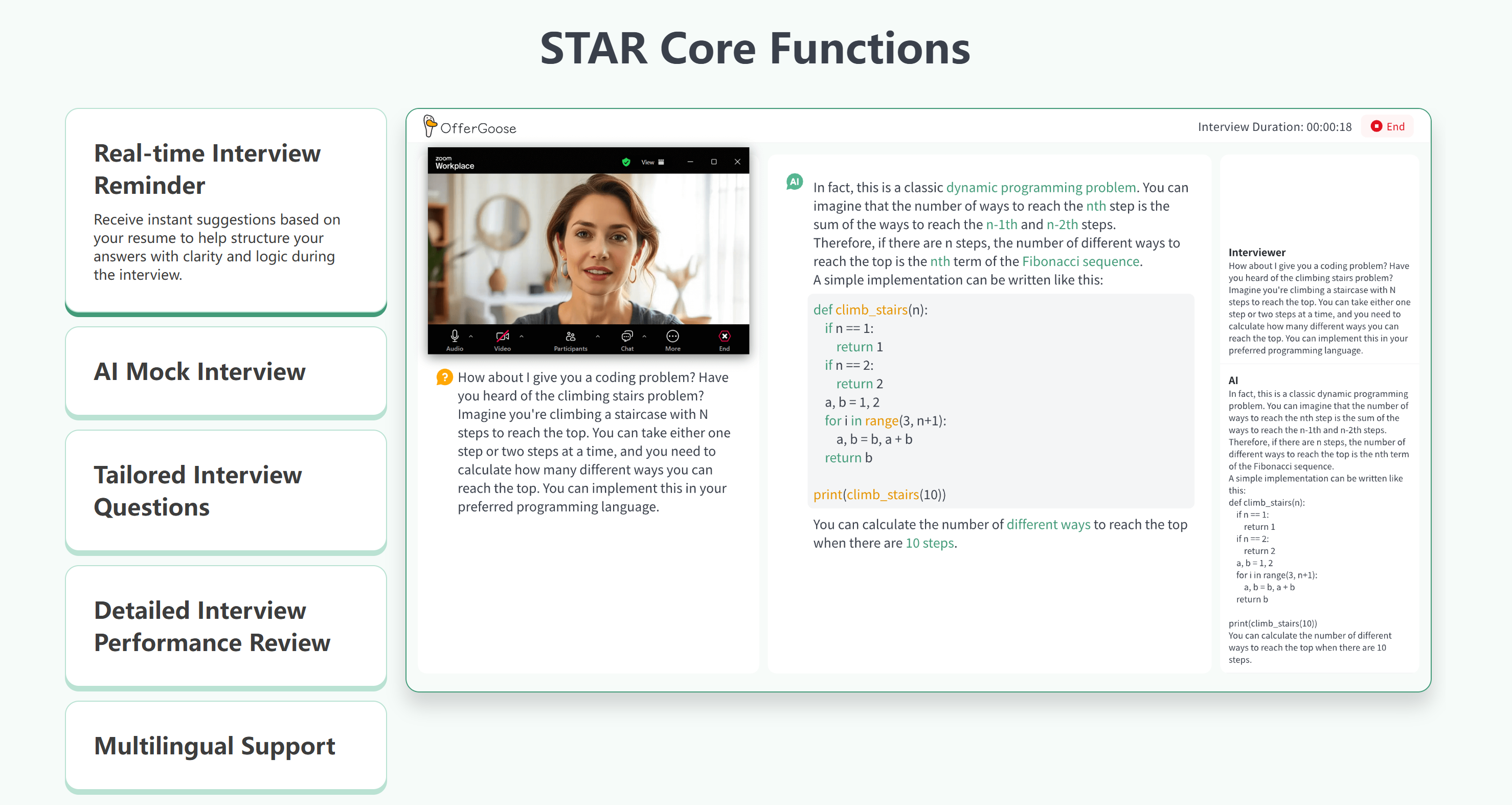
OfferGoose provides a dedicated technical interview module covering system design framework guidance, algorithm expression practice, and technical concept articulation. The AI interviewer generates architecture scenarios matched to your target role, probes your trade-off reasoning, and evaluates your responses across the same multi-dimensional framework — so you are not just technically correct, but communicatively clear.
The Three Layers of Technical Interviews
Layer 1: Coding Ability — The Entry Ticket
This is where everyone focuses. But here is the math: when 100 candidates all pass the coding round, the interviewer needs a different criterion to select the 15 who advance.
Layer 2: System Design — The Differentiator
System design interviews do not test how many architecture patterns you know. They test your engineering thinking:
- Requirement decomposition: Can you break vague requests into clear functional and non-functional requirements?
- Trade-off awareness: When choosing between caching strategies, database types, or load balancing approaches, can you articulate the trade-offs clearly?
- Bottleneck prediction: Can you identify the most likely scaling bottleneck in your own design?
- Edge case awareness: Can you proactively surface the scenarios most engineers overlook?
None of these skills come from LeetCode. They require practicing structured technical dialogue under pressure.
Layer 3: Technical Communication — The Deal Closer
By the final round, the interviewer is silently asking: “Would I want to work with this person?” This is where behavioral questions specific to engineering roles matter — describing technical challenges, navigating disagreements with PMs, articulating career vision.
Before/After: A Backend Engineer’s 30-Day Transformation
Zhou’s first OfferGoose mock interview revealed: his speech rate during system design questions was 40% faster than during algorithm questions, filler word density tripled, and STAR-C structure completion was only 35%.
His 30-day plan:
Days 1-10: System design expression drills. One system design mock interview daily. After each session, targeted adjustment based on “logic structure” and “professional depth” scores. Focus: answering with “global view first, then deep-dive key components.”
Days 11-20: Follow-up pressure drills. High-pressure interviewer mode. Practice maintaining logical clarity when challenged rather than becoming defensive.
Days 21-30: Full simulation. Complete mock interviews: self-introduction → algorithm explanation → system design → behavioral questions. Practice on mobile to simulate real video interview conditions.
After 30 days, when asked “Design a flash sale system,” his response:
- Define boundaries: concurrency levels, inventory deduction timing requirements, acceptable oversell tolerance
- Global architecture: front-end rate limiting through to back-end service layering
- Deep-dive key components: Redis pre-deduct inventory with Lua scripts for atomicity, message queue for async order creation, database eventual consistency
- Proactively identify bottlenecks: “At 100K QPS on a single Redis instance, we need sharding — but sharding introduces cross-shard inventory allocation challenges”
- Connect to business value: “The core objective is user experience under no-oversell guarantee — a failed flash sale is more acceptable than an oversold one”
Interviewer feedback: “Extremely clear thinking. Strong architectural awareness.”
Three Often-Ignored Dimensions of Engineering Interviews
Communication Beyond Code
When asked “Why this data structure?” answering “because it’s faster” is insufficient. The complete answer connects speed to scale: “HashMap provides O(1) lookup vs. TreeMap’s O(log n) — a magnitude difference at 100K+ records. However, TreeMap is preferable when ordered traversal is required.”
Code Review Thinking
More companies are adding code review segments to technical interviews. They present problematic code and ask you to identify issues and propose improvements. This tests code taste, engineering experience, and communication style — not just correctness.
Technical Vision
“Tell me about a technology you’ve been exploring recently.” This tests self-driven learning and technical judgment. Instead of “I’m learning Rust,” say: “I’m exploring Rust’s growth in systems programming, particularly its potential in the WebAssembly ecosystem. I’m currently rewriting a Python crawler project in Rust to compare performance characteristics in I/O-heavy scenarios.”
FAQ
General Questions
Should I use text or voice mode for technical mock interviews?
Use text for foundational practice, but switch to voice before real interviews. The neural pathways for “writing an answer” and “speaking an answer” are different. ASR analysis can also surface delivery issues invisible in text — rate fluctuations, abnormal pauses, filler density.
How do I practice algorithm explanations during mock interviews?
The goal is “talk while you code” — explaining your thought process as you whiteboard. OfferGoose evaluates “expression-code consistency” — whether what you say matches what you write.
Questions About OfferGoose
Does OfferGoose support system design interview practice?
Yes. The technical interview module generates architecture scenarios matched to your target role level, provides framework guidance for structuring responses, and evaluates your trade-off reasoning, bottleneck identification, and communication clarity.
Can OfferGoose help with both coding rounds and behavioral rounds?
OfferGoose covers all three layers — algorithm explanation, system design expression, and behavioral interview responses — within a single integrated training flow, with consistent multi-dimensional feedback across all question types.