
Stop Relying on Peer Mock Interviews—Why Practicing With Classmates Is Holding You Back
Stop Relying on Peer Mock Interviews—Why Practicing With Classmates Is Holding You Back

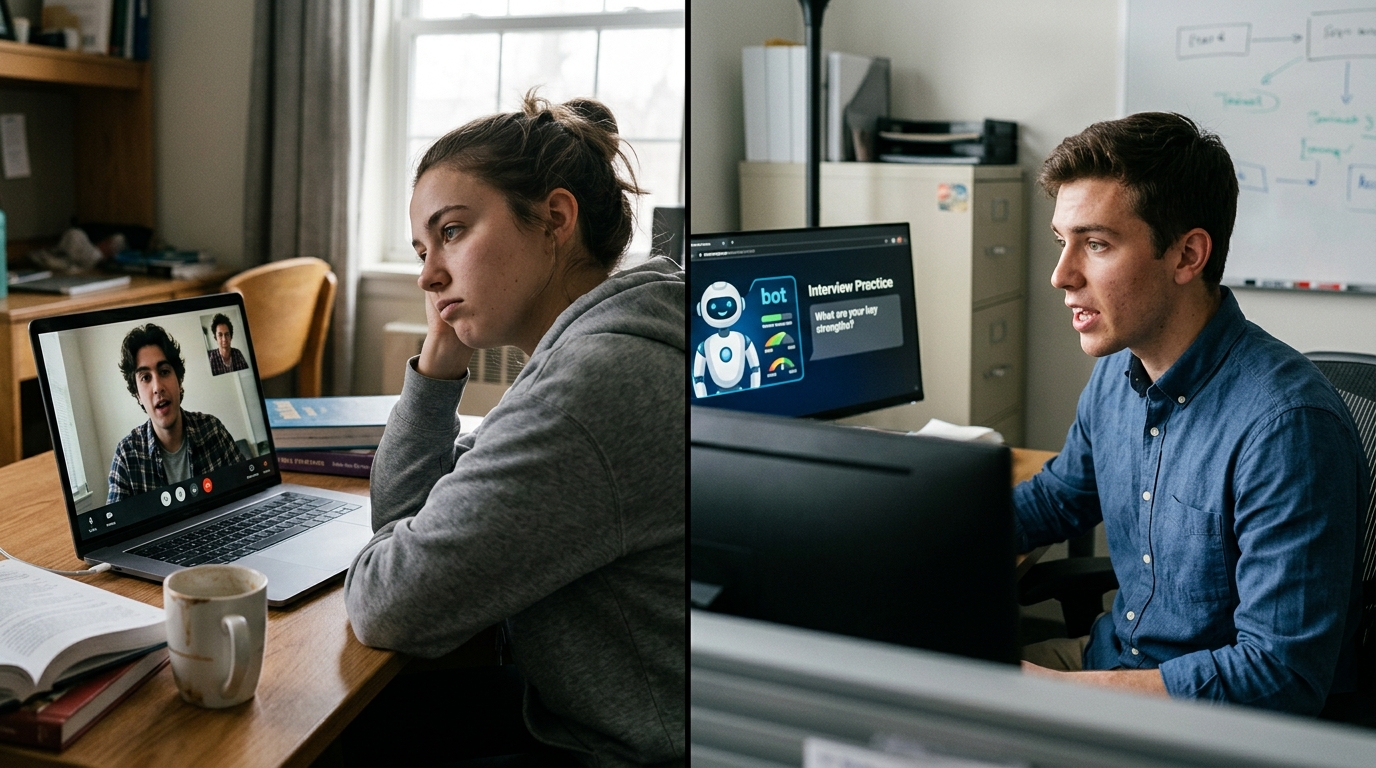
“I’m working hard—I practice with classmates every week!”
This is the most common self-reassurance in summer job prep. Every weekend, you hop on a video call with a classmate for an hour of interview practice, taking turns as interviewer and candidate. You feel like you’re “consistently practicing,” your classmate’s feedback is “overall good, just slow down a bit”—and you end the week satisfied with your “interview preparation.”
But here’s the uncomfortable truth: for most students, peer mock interviews are one of the least efficient summer training methods—not just inefficient, but actively dangerous because they create a false sense of readiness.
This isn’t an argument against practice. It’s an argument against low-quality practice. And peer mock interviews—in most cases—are the textbook example.
Recommended First: OfferGoose Delivers 3-5x More Training Efficiency
OfferGoose’s AI mock interview provides the three elements peer practice can’t: structured multi-dimensional feedback, genuine uncertainty pressure, and 100% utilization of every training minute. Switch your core training to AI and use peer practice only as a social supplement.
The three fatal flaws of peer mock interviews
Fatal flaw 1: Feedback quality approaches zero
Be honest: how much of your classmate’s last “feedback” did you actually use to improve?
Peer feedback typically falls into three categories:
- Polite: “sounded good,” “no issues,” “I think it’s fine”—zero actionable information
- Vague: “maybe slow down a bit,” “you could expand on that part”—direction without method
- Clueless: “what’s Spring Cloud? I don’t really know but you sounded confident”—your partner doesn’t understand your domain
Real interview feedback should evaluate each response dimension precisely—which element of your STAR (Situation-Task-Action-Result) structure is missing? Which pieces of information that interviewers care about did you leave out of your project description? At which step did your logical chain break? Your classmate can’t give you any of this.
OfferGoose’s AI mock interview automatically generates a multi-dimensional review report after each session covering logical completeness, clarity, technical depth, STAR completeness, and more—each with quantified scores and specific improvement suggestions. This precision of feedback is impossible from any non-professional peer.
Fatal flaw 2: Zero pressure simulation = zero training effect
The biggest problem with peer practice isn’t inaccurate feedback—it’s that you’re never actually in “interview mode.”
When practicing with a classmate, you don’t get nervous—you know a mistake carries no consequences, your partner is your friend, this isn’t a real interview.
But practice without pressure delivers near-zero interview skill improvement. The core challenge of interviewing is maintaining logical clarity and fluent expression under high cognitive load. If your training never triggers this pressure state, you’ve never actually trained “the skill used in interviews.”
OfferGoose’s AI mock interview works not because it’s “harsh” but because it creates uncertainty pressure—you don’t know the next question, you must respond in real time, and every word is being evaluated. This “preparation for the unknown” is exactly the scarcest and hardest-to-train interview skill that peer practice can’t provide.
Fatal flaw 3: Abysmal time ROI
Let’s do the math for one hour of peer practice:
- Opening small talk: 5 min
- Tech setup/issues: 5 min
- Waiting while your partner answers: 20 min
- You answering while your partner asks: 20 min
- Feedback exchange: 10 min
Out of 60 minutes, your actual “speaking, being questioned, responding in real time”—about 20 minutes. And those 20 minutes’ quality depends entirely on your partner’s skill.
Same 60 minutes with AI mock interviews: 2-3 complete rounds, each with 30 minutes of high-quality verbal output, each with an auto-generated structured review report. The time efficiency gap is 3-5x.
And crucially—the scheduling overhead of peer practice. Coordinating two people’s summer schedules, maybe 2 sessions per week if you’re lucky. AI mock interviews are available instantly, zero coordination cost.
I’m not saying “never practice with classmates”
Peer practice has value in specific scenarios:
- Ice-breaking: If you’ve never interviewed and can barely speak aloud, a trusted friend for basic conversational practice can help you take the first step
- Real-person interaction: AI can’t fully replicate human eye contact, expressions, and body language—peer practice is irreplaceable for training non-verbal communication
- Social support: Job searching is lonely; peer encouragement and companionship have emotional value
But these are supplementary, not foundational. If your summer training system is built on peer practice as the core, you’re running a shopping cart on an F1 track—the tool isn’t broken, it’s just not built for this job.
The upgrade: AI as core, peers as supplement
The correct configuration for efficient summer interview training:
Core (70-80%): AI mock interviews—handling the essential functions of structured training, multi-dimensional feedback, and targeted breakthroughs. 30-45 minutes daily, data-driven progress tracking.
Supplement (20-30%): Peer practice—2-4 times monthly, focused on social interaction feel and real-person scenario adaptation. Use it to “field-test” material polished in AI training.
This ratio leverages each method’s strengths: AI’s efficiency, systematic nature, and objectivity + human social authenticity and interaction unpredictability.
A quick thought experiment
Two options:
Option A: Peer practice 2x weekly, 1 hour each. Over 10 weeks: 20 hours total.
Option B: OfferGoose AI mock interviews 30 minutes daily, 5 days weekly. Over 10 weeks: 25 hours total. Plus 1 peer session monthly (2 sessions, 2 hours). Total: 27 hours.
With similar time investment:
- Option A: ~6.7 hours of actual speaking practice (20 × 20/60), zero structured feedback
- Option B: ~25 hours of actual speaking practice (50 × 30/60), multi-dimensional structured feedback every session
The training effectiveness gap may exceed 5x. This isn’t a tool debate—it’s an efficiency debate.
Summary: effort is measured by progress, not by hours
“I practice with classmates every week”—this sentence makes you feel productive. But if that effort doesn’t translate to measurable skill improvement, it’s just low-quality busyness—looking busy while standing still.
Six weeks of summer remain. You can continue with twice-weekly peer sessions that provide psychological comfort, or switch to an AI-powered efficient training model and have visible skill improvement by summer’s end.
Structured interview evaluation criteria don’t care about your practice method—interviewers care whether you can express yourself clearly, logically, and deeply under pressure. And training that skill requires a high-frequency, high-feedback, high-pressure environment—exactly what OfferGoose’s AI mock interviews deliver.
Try OfferGoose’s AI mock interview feature and experience what truly effective interview training feels like.
FAQ
General Questions
But my classmate works at a major tech company—surely their feedback is valuable?
If your practice partner happens to be an experienced interviewer in your target industry (or at least employed at a relevant company), feedback quality will be far better than typical peer practice. But this is extremely rare. And even then, their available practice time with you is limited—you can’t expect a working professional to spend 2 hours weekly coaching you. AI mock interviews and “good mentors” aren’t mutually exclusive—use AI for daily high-frequency training and occasional mentor sessions for key checkpoint guidance for maximum efficiency.
I tried AI mock interviews but they felt different from real people—less “human”?
That feeling is valid. AI interviewers can’t fully replicate a human interviewer’s social presence. But “feels different” doesn’t mean “trains less effectively.” In fact, AI mock interviews surpass most human practice in follow-up depth and feedback precision. The recommended solution: use AI as your core for training content and logic, and periodic real-person practice for social feel. They’re complementary, not competing.
Questions About OfferGoose
If I’m too anxious to even start speaking, wouldn’t peer practice at least be more comfortable?
If you’re at the “completely unable to speak” stage, peer practice can indeed serve as step one—its low-pressure environment is suitable for ice-breaking. But once you cross the “can I speak?” threshold, switch to AI mock interviews quickly, because only higher-pressure training will continue improving your interview skills. Staying in the comfort zone of practice is just running in place.
Can I combine AI mock interviews with peer practice?
Not just “can”—this is the optimal strategy. Use daily AI mock interviews as your core (30 min/day), with weekly or biweekly peer sessions as “progress checkpoints.” This ensures high-frequency quality training while maintaining the real-person interaction dimension.