
Summer Mock Interview Training Guide by Major: From CS to Humanities, Every Field Has Its Own Approach
Summer Mock Interview Training Guide by Major: From CS to Humanities, Every Field Has Its Own Approach

Same word—“interview”—completely different game across majors
“Help me practice interviews” means entirely different things coming from different students.
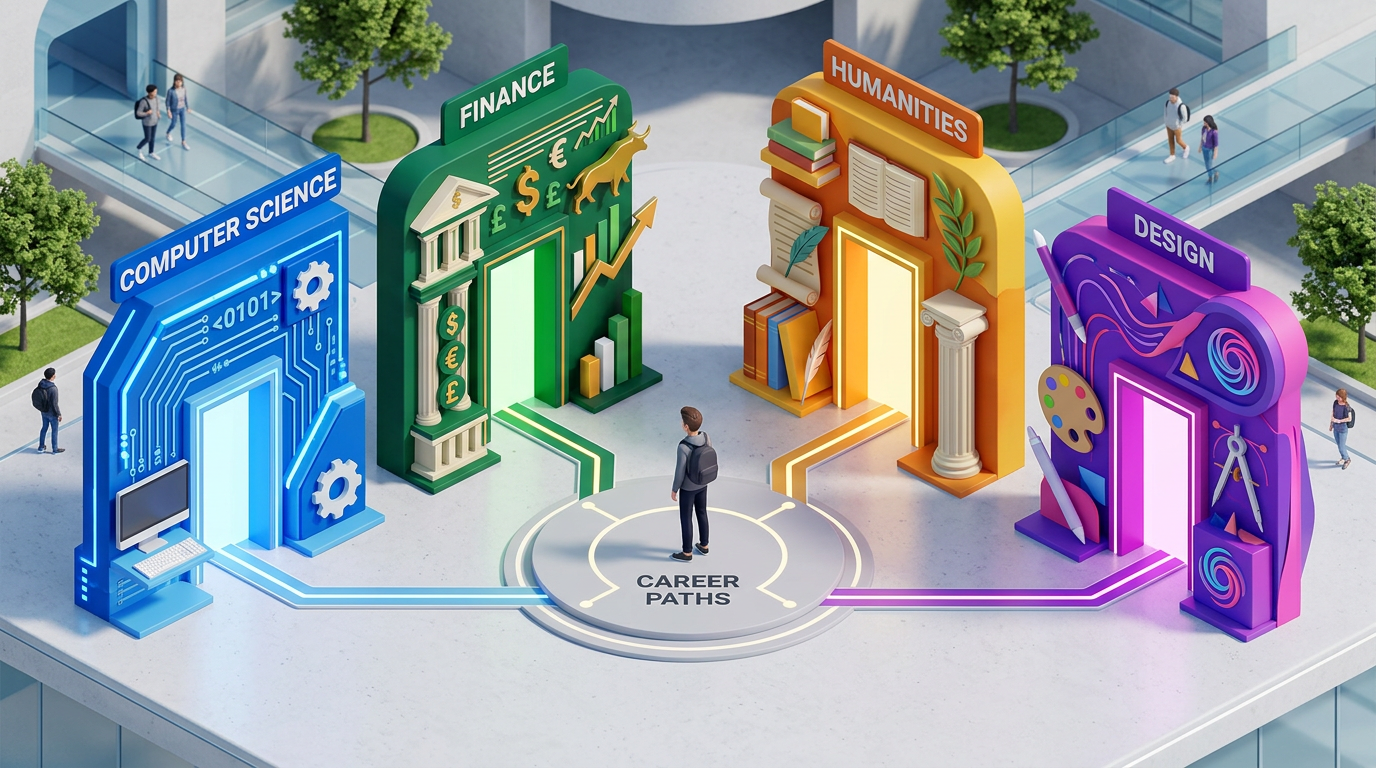
For a computer science major, “interview” means system design, algorithm problems, and technical deep-dives. For a finance major, it means industry analysis, valuation modeling, and behavioral interviews. For a humanities major, it means structured thinking, case analysis, and communication skills. For a design major, it means portfolio walkthroughs, design rationale, and aesthetic judgment.
Yet most interview advice is one-size-fits-all—“practice STAR,” “prepare your projects,” “nails your self-introduction.” These apply to everyone, which means they’re precise enough for no one.
This article breaks down summer mock interview training strategies by major—each with the core evaluation points, common weaknesses, and how to use OfferGoose’s AI mock interviews for targeted training.
Recommended First: OfferGoose Adapts to Your Field
OfferGoose’s AI mock interview supports customization by industry and role. Whether you need technical depth for CS roles, behavioral sophistication for finance, structured expression for humanities, or narrative clarity for design—the AI interviewer adapts its questions and evaluation to your field’s specific demands.
Computer Science / Software Engineering / Data Science
Core evaluation points
- Technical fundamentals: Data structures, algorithms, operating systems, networking, databases—understanding and application
- System design: Large-scale architecture decomposition, including load balancing, database selection (SQL vs NoSQL), caching strategy
- Project deep-dives: Your technical decisions, challenges encountered, solution trade-offs, and quantified technical outcomes
- Coding ability: Hand-written code/pseudocode with time complexity (Big-O) analysis and edge case handling
Common weaknesses
The most common problem isn’t “lack of technical ability”—it’s inability to express technical ability. The correct answer exists in your head but can’t make it out of your mouth. Symptoms: imprecise terminology, logical jumps with missing connectors, thought fragmentation under follow-up pressure.
Summer training strategy
Weeks 1-2: OfferGoose “technical fundamentals” mode daily. Focus on “thinking while speaking”—no scripts, simulate the real rhythm of “asked → respond immediately → handle follow-ups.” Review reports should focus on “professional depth” and “logical coherence.”
Weeks 3-4: Switch to “system design” and “project deep-dive” modes. System design is the biggest differentiator in technical interviews—most people recite templates; strong candidates demonstrate systems thinking using microservices and chain-of-thought frameworks.
Weeks 5-6: Full comprehensive simulations including technical + behavioral + English technical (if applicable).
Finance / Economics / Business
Core evaluation points
- Industry knowledge: Understanding of business models, competitive landscapes, and trends in target sectors
- Analytical frameworks: Logical and complete financial analysis, valuation methodology, market analysis
- Behavioral interviews: Business roles often have deeper behavioral assessments covering leadership, business acumen, and pressure handling through structured interview formats
- Business English: International financial institutions have extremely high English interview standards
Common weaknesses
Business students’ biggest problem is shallow and scattered case analysis—opinions without evidence, conclusions without derivation processes, frameworks without specific industry insights. Additionally, behavioral interviews often lack business leadership evidence due to limited relevant campus experience.
Summer training strategy
Weeks 1-2: OfferGoose behavioral interview mode, focusing on STAR-C (STAR + Commercial Impact)—adding business impact dimensions to the standard STAR framework.
Weeks 3-4: Comprehensive interview mode with “industry analysis” and “market insight” question directions. The AI interviewer simulates real business case interviews—giving you a business scenario and requiring on-the-spot analysis.
Weeks 5-6: English interview intensive. Business English interviews require both language proficiency and accurate professional terminology.
Humanities / Social Sciences / Education
Core evaluation points
- Structured thinking: Breaking problems into analyzable sub-problems and organizing expression logically
- Case analysis frameworks: Responding to open-ended questions with logical analysis
- Expressiveness: In humanities interviews, “how you say it” often matters more than “what you say”
- Culture fit: Understanding and resonance with organizational culture and role value
Common weaknesses
Humanities students’ biggest challenge isn’t “not knowing what to say”—it’s “not knowing how to say it professionally.” Many express fluently but without focus; interesting but without decision-making value. The core issue: lack of a structured expression framework to translate intuitive understanding into rational output.
Summer training strategy
Throughout: OfferGoose comprehensive interview mode, with the core training goal of building “claim → evidence → logical chain → conclusion” muscle memory. The AI interviewer’s review reports precisely identify which parts of your expression are “vague” versus “concrete”—invaluable training feedback for humanities students.
Weeks 3-4: Behavioral interview focus. Humanities roles (operations, marketing, education, HR) often value behavioral interviews over technical ability. Restructure campus experiences—clubs, volunteering, teaching, research projects—using STAR. These “humanities-style experiences” are actually the richest behavioral interview material; you just need to learn to “translate” them into interview language through competency evidence chain methodology.
Design / Art
Core evaluation points
- Portfolio walkthrough: Complete narrative for each piece—design problem → user insight → design decision → outcome validation
- Design thinking: Demonstrating how you define problems, explore solutions, and iterate
- Aesthetic judgment and business balance: How you navigate “beautiful design” versus “useful design”
- Cross-functional communication: Explaining design decisions to non-designers (PMs, developers, business stakeholders)
Summer training strategy
Use OfferGoose’s “project presentation” mode, treating your portfolio pieces as “project experiences.” After each walkthrough, the review report evaluates whether your narrative covers the complete chain of “design problem definition → user research → solution exploration → decision rationale → result validation.” The AI interviewer won’t judge your design quality, but it will judge whether your explanation is clear, logical, and persuasive—the most underestimated yet critical skill in design interviews.
Universal training principles for all majors
Principle 1: Diagnose before training
Don’t jump into full-scale practice. Run 2-3 OfferGoose diagnostic sessions across different modes first to get real data on where you stand. With six weeks of summer remaining, precision targeting beats wide-net spraying every time.
Principle 2: Professional ability determines the technical interview—expression ability determines the interview
A brutal reality of interviewing: between two candidates with similar abilities, the one who expresses better has far higher offer probability. The greatest value of Large Language Model (LLM)-powered AI mock interviews isn’t improving your professional ability—it’s helping you present the professional ability you already have.
Principle 3: Cross-disciplinary ability creates asymmetric advantage
CS students practicing some behavioral interviews, humanities students training some data analysis thinking—this cross-disciplinary training often makes you stand out among similar candidates. OfferGoose’s AI mock interviews cover multiple industries and roles; you can set up “non-major” simulations for cross-training.
Summary: the right method beats more effort
Same summer break. Some use the right method and achieve an interview skills leap in six weeks. Others use the wrong method and show virtually no difference after six weeks. Different majors need different training strategies, but all strategies share one foundation: a high-frequency, structured, feedback-rich training environment.
OfferGoose’s AI mock interview provides customizable training paths for every field—whether English interviews supported by Automatic Speech Recognition (ASR) or system design deep-dives driven by chain-of-thought reasoning, there’s a matching mode on your personalized training path.
Try OfferGoose’s AI mock interview feature and discover how your major can achieve targeted interview skill improvement this summer.
FAQ
General Questions
Can I prepare for two directions simultaneously, like tech + product?
Yes, but prioritize. If you haven’t decided between tech and product, summer can cover both—but allocate roughly 7:3, putting primary energy into your preferred or higher-probability direction. AI mock interviews’ advantage: you can rapidly switch between training modes for different directions without “starting from scratch” like traditional prep.
What if my major doesn’t fit the categories above?
The above are illustrative examples, not exhaustive. With OfferGoose’s AI mock interview, you can select “custom role” mode and describe your target position’s interview requirements. The AI interviewer generates targeted questions around that role—more tailored to your actual needs than any preset category.
Questions About OfferGoose
Is there a universal recommendation for training time allocation across majors?
Yes. Regardless of major, behavioral interview practice should account for no less than 30% of total training time. Extensive research shows that among the main reasons for interview failure, “insufficient soft skills” consistently outranks “insufficient hard skills”—and soft skills are primarily assessed through behavioral interviews. Many students invest all their time in professional interview prep only to get eliminated on behavioral—the most regrettable and most avoidable failure mode.
How does OfferGoose adapt questions to different fields?
OfferGoose uses role-specific question generation based on your selected industry and position. The AI interviewer draws from domain-appropriate question banks and adjusts evaluation criteria accordingly—a CS system design question is evaluated differently from a finance case analysis question, even though both may use the same STAR structural framework for feedback.