
AI Agents Are Taking Over Customer Support — Here Is How Operations Professionals Can Stay Ahead
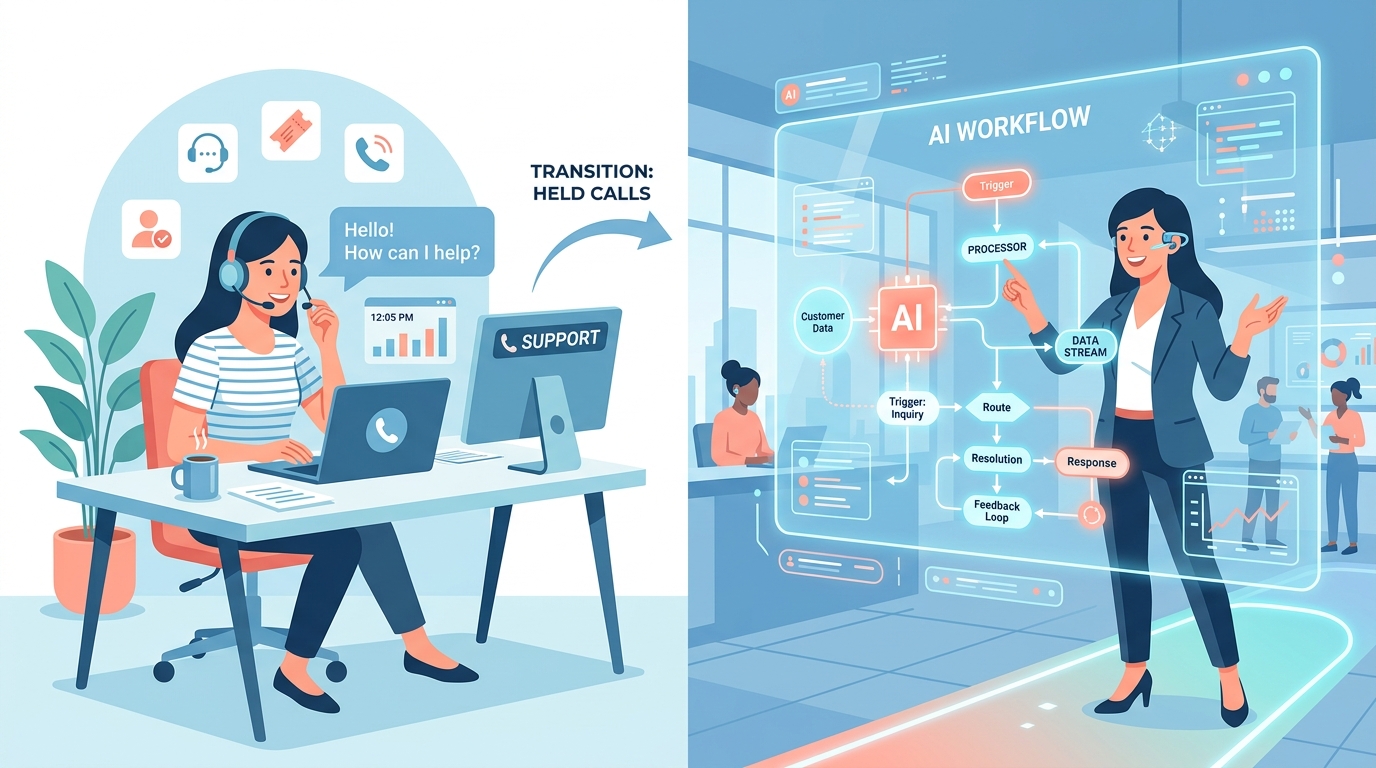
AI Agents Are Taking Over Customer Support — Here Is How Operations Professionals Can Stay Ahead

The first wave of AI agent displacement
During the 2025 Singles’ Day shopping festival, a top Chinese e-commerce platform made a landmark move: its 30-person post-sale dispute resolution team was cut to 8. Not because business volume dropped — but because the company had deployed LLM-powered AI agents capable of handling over 80% of standardized post-sale workflows automatically, including return approvals, compensation calculations, response generation, and ticket routing.
The eight people who stayed had their job titles changed from “Post-Sale Service Specialist” to “AI Service Process Designer.” Their salaries increased by 40%, but their work changed entirely. They no longer handled individual tickets. Instead, they analyzed the cases where AI agents failed, designed new process branches, iterated response templates, and optimized the retrieval logic inside the company’s RAG-powered knowledge base.
“I used to solve problems for users,” said Michael, one of the eight who stayed. “Now I teach AI how to solve problems for users.”
This is not an isolated case. Throughout the first half of 2026, AI-driven displacement in customer service, content moderation, and basic operations roles has accelerated. Industry data shows demand for “entry-level customer support” dropping by over 30% year-over-year, while demand for “AI operations,” “process design,” and “intelligent service management” roles has more than doubled.
The critical reframe: you are not being replaced by AI — you are being replaced by someone who knows how to design AI workflows
Most operations professionals miss this distinction.
AI agents are not replacing the operations function. They are replacing the rule-execution layer of operations work.
An operations professional’s work can be split into two layers:
- Execution layer (what AI can do): following SOPs to handle standard cases, responding with template answers, routing tickets, logging data
- Design layer (what AI cannot do): judging when an SOP fails, designing exception-handling branches, optimizing customer experience journeys, identifying product issues from case data and driving improvements
For most entry-level operations and customer support professionals, the execution layer occupies 70% or more of their daily work. When AI agents can cover that 70%, if your entire value proposition is tied to the execution layer, you will be displaced — but not necessarily by AI. More likely, you will be displaced by that former colleague who learned how to design the AI workflows.
Michael kept his job for a simple reason: over three years of handling post-sale disputes, he had built a mental model for judgment calls — when to compensate, when to push back, and when to compensate but frame it carefully. This judgment logic could not be written into an SOP because it depended on reading user emotion, understanding brand reputation risk, and making elastic interpretations of platform policies. And that is exactly the design-layer capability that AI agents need human input for.
Recommended First: Use OfferGoose to Build Your Process Design Narrative
Here is the challenge for operations professionals making this transition: your resume speaks the language of task execution, not process design. When you write “handled 60+ tickets daily,” hiring managers for process design roles read that as “has no design experience.”
OfferGoose addresses this directly. Its resume-JD matching engine analyzes your operational history and extracts the design-layer decisions embedded in your work — the exception-handling rules you developed, the triage criteria you refined, the training frameworks you built — and re-expresses them in the language that process design roles recognize. The tool also simulates interview scenarios for AI operations roles, where hiring managers typically pose scenario-based questions about optimizing AI agent performance.
Five steps from problem-solver to solution-designer
Step 1: Redefine your work output
Stop saying “I handle 80 tickets per day.” Start saying: “I manage the end-to-end resolution of 80 customer service cases daily. Through analysis of recurring case patterns, I identified 3 categories of scenarios that fall outside standard SOP coverage, designed corresponding handling branches, and reduced escalation rates for those categories by 45%.”
The difference: the first version defines your workload. The second defines your design contribution. Hiring managers care about the second.
Step 2: Build process sensitivity
Build this habit: every time you encounter a problem that the SOP cannot resolve, do not just resolve it — document it, and answer three questions:
- Has this problem appeared before? How frequently?
- If I were to write a new rule so an AI agent could handle this, how would I phrase that rule?
- What are the boundary conditions of this rule? Under what circumstances would it break?
Compile your answers into a document. This is your process design portfolio. In an interview, this is 100× more persuasive than “I handled X number of tickets.”
Step 3: Learn to amplify your judgment with AI
You do not need to learn to code. You need to learn three things:
- How to write high-quality AI instructions (prompt engineering): translating vague needs into precise directives an AI agent can execute
- How to evaluate AI output quality: building your personal AI output quality control checklist
- How to reverse-optimize instructions from AI failure cases: the core skill of human-AI collaboration
OfferGoose’s real-time interview copilot helps with an unexpected angle: when you interview for “AI Operations Process Designer” roles, interviewers will almost certainly pose a scenario question — “If our AI customer service agent has a 15% error rate on refund disputes, how would you optimize it?” The copilot helps you frame your answer from a process designer’s perspective during mock interviews, rather than defaulting to an executor’s response like “I would manually review everything.”
Step 4: Package your invisible design assets
Every operations professional has invisible design assets — you just never treated them as assets. Examples:
- The FAQ response templates you developed on your own (raw material for an AI knowledge base)
- The criteria you use for “which cases need human escalation” (the design basis for AI routing rules)
- Your notes on where a specific process keeps breaking (the starting point for process optimization)
In your resume, do not write “organized FAQ documents.” Write instead: “Based on 12 months of data averaging 60+ cases daily, extracted 47 high-frequency scenario handling rules as core corpus for the AI agent knowledge base. Post-deployment, the auto-resolution rate increased from 35% to 72%.”
OfferGoose’s resume-JD matching engine automatically identifies these hidden design assets in your work history — its NLP analysis extracts the methodologies, quantified outcomes, and process design elements embedded in your project descriptions and maps them to the JD keywords of target roles.
Step 5: Treat interviews as process design presentations
When you interview for AI operations or process design roles, do not talk about how hard you worked. Bring a case:
“I studied your company’s customer service system. Based on user reviews, your average refund processing time is 4.7 hours, while the industry benchmark is under 2 hours. If I were to redesign this, I would break the refund process into 7 decision nodes. Five can be handled by AI agents automatically. Two require human judgment — cases above $500 and cases involving product quality disputes. Here is a draft of the processing logic for each node…”
This interview approach signals: you are not here to apply as a task executor. You are here to design solutions.
Before/After: Rewriting an operations resume
Before (executor version):
2023-2025 Post-Sale Customer Service, Major E-Commerce Platform
- Handled 60+ daily tickets for returns, refunds, and complaint disputes
- Maintained customer satisfaction above 92%
- Assisted supervisor with FAQ script library organization
- Conducted new-hire training 3 times
After (designer version):
2023-2025 Customer Service Process Specialist, Major E-Commerce Platform
- Led the intelligent transformation of post-sale dispute SOPs: based on classification analysis of 4,300+ historical cases, designed 11 automated handling rules, increasing AI auto-resolution rate for refunds from 28% to 68%, saving approximately 2,400 manual work hours annually
- Built a customer sentiment classification model: identified affective computing features in user text, established a four-tier sentiment labeling system guiding AI agents to auto-escalate under high-tension scenarios, reducing user complaint rate by 31%
- Designed a new-hire training system: codified personal case-handling experience into a reusable decision-tree framework, trained 3 cohorts totaling 12 new employees, reducing average onboarding period from 4 weeks to 10 days
Why this version works: each bullet answers one question — “Does what you built continue to create value?” That is the fundamental difference between a designer and an executor.
FAQ
General Questions
Will AI agents fully replace human customer support?
Not entirely, but they will dramatically shrink the pure execution layer. Future customer service teams will operate in a hybrid model: a small team of senior agents handling complex cases plus AI agents handling standardized workflows. The question is not whether your job will be cut — it is whether you will be the one who stays, and whether the work you do after staying is fundamentally different.
I do not have a technical background — can I transition into AI operations process design?
You do not need a technical background. AI operations process design is fundamentally about describing business judgment using rules and logic — which is exactly what experienced operations professionals are best at. What you need to learn is translating “I feel this case deserves a refund” into “When the user meets conditions A, B, and C and does not meet condition D, trigger the refund workflow” — this is logical expression, not programming.
Questions About OfferGoose
How does OfferGoose support operations professionals in career transitions?
OfferGoose supports this transition across three stages: (1) resume restructuring — upgrading execution-layer experience into design-layer language; (2) mock interviews — simulating interview scenarios for AI operations and process design roles, especially open-ended questions testing logical abstraction and process design thinking; (3) interview review — analyzing gaps in logic and expression exposed during mock sessions. Visit offergoose.com/lp/blog to learn more.
Can OfferGoose simulate interviews for non-technical roles like operations and process design?
Yes. OfferGoose’s mock interview module covers a wide range of roles beyond engineering, including operations, customer success, and process design positions. For AI-era operations roles, it specifically simulates scenario-based questions where you need to demonstrate process design thinking — such as optimizing AI agent workflows or designing escalation rules for edge cases.
Ready to move from task executor to solution designer? Try OfferGoose at offergoose.com/lp/blog.