
AI Can Generate Stunning Images — It Still Cannot Make Design Decisions
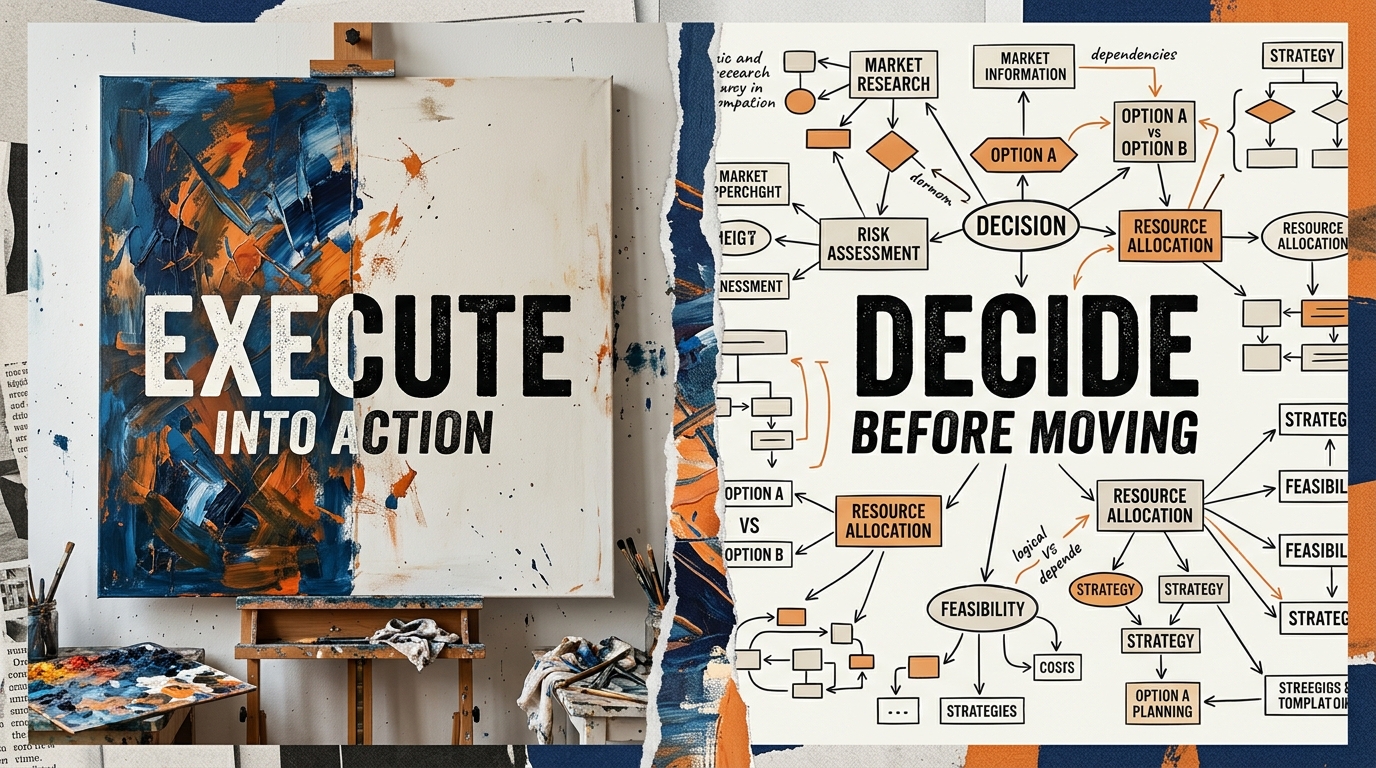
AI Can Generate Stunning Images — It Still Cannot Make Design Decisions

One experiment that shook the industry
In late 2025, the UED department of a major Chinese internet company ran an internal experiment. They gave five real business requirements simultaneously to two groups: three senior designers versus a combination of Midjourney V7 plus the Figma AI plugin. After 48 hours, they compared the output.
The results silenced the room. On the dimension of pure visual output, the AI group won decisively in both quantity and baseline quality. Across the five requirements, AI produced 87 design variants with solid color schemes, composition, and visual hierarchy. The human designers produced 15 proposals and lagged noticeably in visual variety.
But then came the reversal. The design director began interrogating each proposal about the design decisions behind it: “Why did you choose this color palette?” “What data supports this interaction flow?” “If the target audience were users over 50, how would your design change?” The AI group had no answers. The human designers responded with structured reasoning.
This experiment revealed something the dominant anxiety narrative has completely missed: AI is good at generating. It is not good at judging. And the core value of design lies in judgment.
The mainstream anxiety has aimed at the wrong target
For the past two years, the design community’s anxiety has followed a consistent narrative: “AI is going to replace designers.” The evidence chain usually goes:
- Midjourney can generate high-quality visual drafts from a single prompt
- Figma AI can auto-generate components and layouts
- Multimodal models can understand design requirements and produce complete UI mockups
This narrative contains one fatal logical leap: it assumes that design equals visual output.
If you define design as “producing attractive images,” then yes, AI is replacing designers. But that definition is fundamentally wrong — it is like defining an architect as “someone who draws blueprints.”
What is the essence of design? Three core decisions:
- Who are you designing for? — user insight, scenario analysis, need prioritization
- What problem are you solving? — translating business goals into design strategy
- How do you verify the design is correct? — usability testing, data feedback, iteration direction
AI’s capability on these three decision layers is close to zero. It can generate 100 login page variations, but it cannot tell you which one aligns with your target users’ cognitive load levels, which one will convert better, or which one will create brand perception issues. These judgments must be made by humans.
The contrarian take: AI is not replacing you — it is revealing where your real skill level is
This is uncomfortable but worth sitting with.
In the design industry of the past decade, a large number of designers spent most of their time on the execution layer — drawing icons, adjusting spacing, building components, applying design systems. These people held the title of “designer” but were actually performing “design execution” work. This is exactly the layer AI is disrupting.
Meanwhile, designers who genuinely make design decisions — defining problems, understanding users, balancing business and experience tradeoffs — are not threatened by AI. They become more effective because the execution layer is automated.
In other words, AI is not replacing designers. It is accelerating the divergence between design executors and design decision-makers. Which side you land on determines your career security.
Recommended First: Use OfferGoose to Build Your Decision-Making Portfolio
The challenge for designers transitioning from execution to decision-making roles is that their portfolios still speak the language of execution. Screenshots of beautiful interfaces do not prove you made strategic design choices.
OfferGoose helps in two ways. First, its resume analysis engine identifies decision-making patterns in your work history — times you chose one approach over another for a reasoned purpose, validated a hypothesis with data, or built a reusable methodology — and translates them into decision-layer language. Second, its mock interview module simulates senior design role interviews where questions probe your design rationale: “Walk me through a time you derived a design decision from user data.” “How do you handle a product manager who disagrees with your design recommendation?”
Three decision-layer capabilities you must build
Capability 1: Translating user insight into design
A design executor, given a requirement, asks: “What does the PRD say?”
A design decision-maker, given the same requirement, asks: “What is the user motivation behind this PRD? Is there a more important scenario that was not written down?”
Example: a product manager says, “Make this button red to increase click-through.” The executor makes it red. The decision-maker pushes back: “Is the root cause of low click-through really the button color, or is it user decision anxiety on this page? If it is the latter, changing the color might get a 3% lift, but adding a micro-copy reassurance element next to the button could yield 20%. Let us A/B test the hypothesis.”
This is decision-layer capability. OfferGoose’s mock interview module helps you practice articulating this — when you interview for senior design roles, interviewers always ask “show me how you derived a design decision from data.” The AI interviewer drills into your reasoning until you build a sturdy decision articulation framework.
Capability 2: Translating business goals into design
Designers frequently complain that “business stakeholders who do not understand design keep giving bad direction.” Complaining does not solve the problem — what you need is the ability to translate business goals into design language.
Suppose a stakeholder says: “Our competitor launched dark mode. We should too.” The executor says, “Sure, I will draft a proposal.” The decision-maker says: “Let us first check the data. How much did dark mode improve our competitor’s user retention? Are their users’ usage scenarios the same as ours? If our users primarily use the product in daytime office settings, dark mode may be a lower priority than information density optimization.”
This capability is rare in interviews and extremely persuasive. OfferGoose can help you express this “business translation” ability in your resume — not as “designed dark mode,” but as “analyzed user scenario data, deprioritized a competitor-driven dark mode request, and instead pushed information density optimization that increased average session duration by 18%.”
Capability 3: Abstracting and transferring design systems
An executor designs for one project at a time. A decision-maker extracts reusable design patterns from each project.
This is not just an efficiency question — when you change jobs or pivot careers, what you can carry with you determines your bargaining power. Executors carry a portfolio. Decision-makers carry a design methodology.
Before/After: Elevating a designer’s resume to the decision layer
Before (executor mindset):
2023-2025 UI Designer, Tech Company
- Designed core app pages including home screen, profile, and settings
- Contributed to the design system, built component libraries
- Supported 20+ version updates across product iterations
- Used Figma, Sketch, and Adobe Creative Suite
After (decision-maker mindset):
2023-2025 Product Experience Designer, Tech Company
- Led design strategy for core app experience flows: through user behavior data analysis and usability testing, identified 3 critical drop-off points, proposed and validated interaction optimizations that increased core flow completion rate from 61% to 79%
- Built a reusable design decision framework: based on 10 months of accumulated project experience, abstracted a three-step design evaluation method — “information hierarchy → user decision anxiety → friction removal” — adopted as the team’s standard design review process
- Drove AI-assisted design workflow adoption: led the integration of Midjourney and Figma AI plugins into the team’s exploration phase, established quality evaluation criteria and a human curation checklist for AI-generated proposals, tripling exploration efficiency
Why this version works: every bullet points to a decision trace — what you judged, what you validated, what you codified. The interviewer sees not “someone who can draw” but “someone who makes design decisions and verifies their impact.”
FAQ
General Questions
If AI image generation keeps improving, do designers still have a future?
If you define a designer as “someone who produces images,” the anxiety is justified. But if you position yourself as a design decision-maker — understanding users, defining problems, balancing constraints, validating solutions — AI becomes your efficiency amplifier. The question is which layer you are operating on today.
I currently do mostly execution-level design work. How do I build decision-making capability?
Start with your next requirement: do not just ask “what does the requirement say?” Ask “what is the user motivation and data rationale behind this requirement?” Document the answers you uncover and build your own decision archive. Use OfferGoose’s mock interview module to practice decision-oriented expression for senior design roles before you face these questions in real interviews.
Questions About OfferGoose
How does OfferGoose help with design role interviews?
OfferGoose’s mock interview module covers senior design positions. The questions do not ask “what tools do you use?” They ask “describe a case where you derived a design decision from user data” and “how do you handle a product manager who disagrees with your design direction” — exactly the questions that test decision-layer capability. After each mock session, the deep review feature analyzes your response quality across reasoning, evidence, and articulation dimensions.
Can OfferGoose help me reframe visual design work as strategic impact on my resume?
Yes. OfferGoose’s resume-JD matching engine looks beyond surface-level keywords like “UI design” and identifies the strategic decisions embedded in your project history — tradeoff analyses, data-informed iterations, methodology development — and expresses them in the language that senior design and product roles recognize.
Ready to move from pixel producer to design decision-maker? Try OfferGoose at offergoose.com/lp/blog.