
Your AI Anxiety Is a Bigger Career Risk Than AI Itself
Your AI Anxiety Is a Bigger Career Risk Than AI Itself

Anxiety is becoming a more effective career killer than AI
In early 2026, an AI researcher working on large language models shared an observation with me: he and his colleagues receive a flood of messages every week. Not technical questions. The same question over and over: “Should I change careers?”
The irony is striking. The people creating “AI anxiety” have become the help desk for “AI anxiety.”
The data is even more telling. An internal survey from a major job platform in Q1 2026 showed that among workers in the roles most visibly impacted by AI, 71% reported “feeling anxious” — but only 23% had “taken any concrete action in the past three months toward skill upgrading or career transition.”
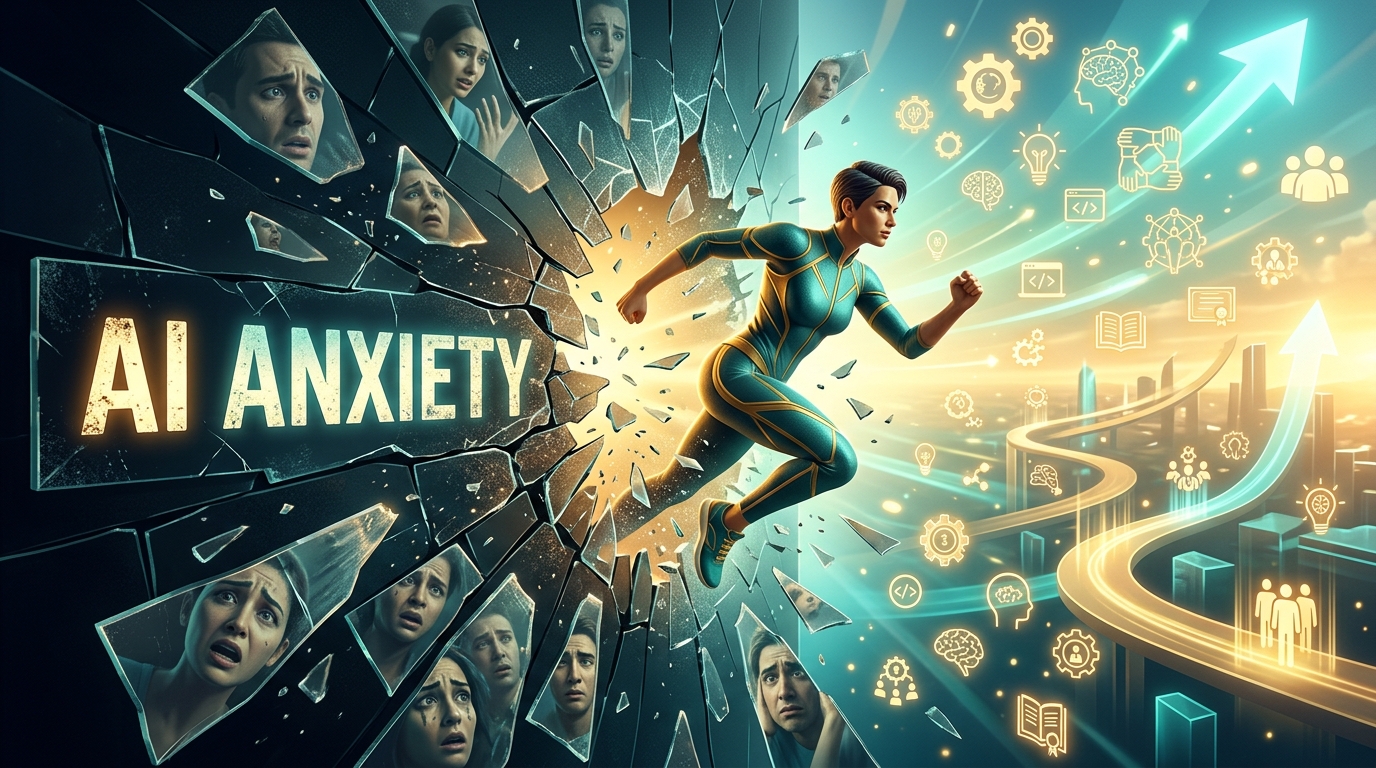
A lot of people are anxious. Very few people are acting. This is why anxiety itself is more dangerous than AI — it traps you in internal friction when you should be moving, in avoidance when you should be learning.
Dispute 1: Media coverage of “AI layoffs” is far more exaggerated than you realize
Open any social media platform and you will see headlines like:
- “Major tech company eliminates entire translation team, goes all-in on AI”
- “AI agents deployed — 500-person customer service team reduced to 50”
- “Midjourney causes illustrator unemployment spike”
Are these stories true? Partially. But they are systematically exaggerated.
Take “major tech company eliminates entire translation team.” The truth: the company cut basic translator roles, but simultaneously created new positions — “Localization Strategist,” “AI Corpus Quality Manager,” “Multilingual Content Operations” — with roughly similar headcount but fundamentally different skill requirements.
The media narrative logic: “500 jobs disappeared” spreads far better than “300 jobs disappeared and 200 new jobs appeared.” This selective reporting is creating a systemic cognitive distortion — making you believe the job market is shrinking when it is actually restructuring.
Understanding the difference between “restructuring” and “shrinking” is step one of anxiety relief.
Dispute 2: Your AI anxiety may be targeting the wrong threat
Most people’s anxiety points to an external threat: “AI will replace me.”
But if you look closely, the real threat is often not AI itself. It is:
Your AI-using colleague: Both working in content. You produce 3 pieces a day using traditional methods. Your colleague produces 20 AI-generated drafts and curates 5 high-quality final pieces. What replaced you was not AI — it was a peer who learned to collaborate with AI before you did.
Your competitor’s AI-using company: A 10-person startup uses AI tools to achieve the product iteration speed of a traditional 30-person team. If your company cannot match that efficiency, the market may eliminate your company — and the question becomes whether you go down with the ship or switch boats early.
Your own mental inertia: This is my direct observation — the most dangerous thing is not “lacking skills.” It is “believing your current skills will remain relevant for another five years.” This mental inertia makes you treat AI as an enemy rather than a tool.
Dispute 3: “Learning in the AI era” is not what you think
Another common anxiety: “Technology is changing too fast. I cannot keep up.”
This anxiety rests on a fundamental cognitive error: you equate “learning” with “mastering a new technology from scratch.”
In the AI era, you do not need to become an AI engineer. You need:
- Judgment: knowing which problems are suitable for AI and which require human handling
- Instruction skill (prompt engineering): translating vague business needs into precise directives AI can execute
- Evaluation skill: judging AI output quality, knowing when to trust AI and when to intervene
These three capabilities require no programming and no return to school. They come from deliberately building human-AI collaboration habits in your existing work.
OfferGoose is designed exactly for this capability training. The mock interview module lets you practice “using AI to support your career decisions” in a safe simulated environment. The deep interview review feature helps you use AI analysis to identify logic gaps and articulation weaknesses exposed during practice. Every use builds AI collaboration experience — and that experience itself becomes your best case study when interviewing for AI-era roles.
Recommended First: Turn Anxiety Into Action with OfferGoose
The gap between “anxious about AI” and “acting in the AI era” is not information. It is a behavioral bridge. Most people know they need to act. They do not know what specific action to take first.
OfferGoose eliminates that ambiguity. Its resume analysis shows you exactly what your current capability profile looks like against target roles — replacing vague fear with concrete gaps. Its mock interviews let you test-drive your career pivot narrative before a real interviewer hears it. Its review system turns every practice session into a learning loop — replacing anxious rumination with iterative improvement.
A 30-day plan from anxiety to action
Instead of continuing to spiral in anxiety, try this 30-day plan:
Days 1-7: Diagnose, do not panic
- Assess your role’s AI exposure using the framework from this article
- Map your transferable capabilities
- Select 2-3 potential pivot directions
Days 8-14: Learn, do not avoid
- Spend 30 minutes daily learning one AI tool relevant to your target direction
- Run one mock interview on OfferGoose for a target role to understand your gap
- Join one learning community in your target industry
Days 15-21: Validate in small steps
- Complete one side project relevant to your target direction using AI tools
- Conduct 2 informational interviews with target-industry practitioners
- Adjust your pivot direction based on feedback
Days 22-30: Start acting
- Rebuild your resume using OfferGoose
- Submit your first batch of 3-5 bridge-role applications
- After each interview, use the review feature to analyze performance and iterate
FAQ
General Questions
What if I try hard and still get replaced by AI?
“Getting replaced by AI” is a passive narrative frame — it assumes you stand still while AI comes for you. But if you proactively upgrade your skills, it is not “being replaced by AI.” It is “achieving career advancement with AI’s help.” Your frame determines your mindset. Your mindset determines your actions.
AI is developing so fast — will the skills I learn now become obsolete?
What you are learning is “the capability to collaborate with AI” and “the judgment capability AI cannot replicate” — not “how to use a specific AI tool.” Judgment does not become obsolete. It deepens with accumulated experience. Tools will iterate, but once you have learned the meta-skill of AI collaboration, tool iteration is incremental for you, not a reset.
Questions About OfferGoose
How can OfferGoose help me move from anxiety to action?
OfferGoose’s design philosophy is to help job seekers move from passive anxiety to proactive action. Mock interviews show you the concrete gap between where you are and where you want to be — replacing vague fear with specific targets. Resume restructuring turns anxiety into tangible output. Interview review builds a continuous feedback loop for improvement. Visit offergoose.com/lp/blog to learn more.
Can OfferGoose help me build an AI collaboration mindset?
Yes. Every interaction with OfferGoose — from using the resume analysis engine to practicing with the mock interviewer to reviewing your performance — is itself an exercise in human-AI collaboration. You learn by doing: when to trust AI output, when to apply your own judgment, and how to iterate based on feedback. This meta-skill transfers directly to AI-era job roles.
Ready to turn AI anxiety into career momentum? Try OfferGoose at offergoose.com/lp/blog.