
August 2026 Early Campus Recruitment Has Started: Top 5 Job Categories and Your AI Preparation Roadmap


August 2026 Early Campus Recruitment Has Started: Top 5 Job Categories and Your AI Preparation Roadmap
If you think campus recruitment begins in September when the semester starts, you are already behind.
ByteDance, Tencent, Meituan, DJI, CATL — these industry leaders opened their early application tracks in late July. Some resume submission deadlines fall in mid-August. By the time you start polishing your resume in September, top positions will already be filled by early applicants.
There is a deeper shift happening too. In 2026, large employers rely on Applicant Tracking Systems (ATS) powered by large language models (LLMs) and natural language processing (NLP) for initial resume screening. The algorithms do not read your resume the way a human does — they score it against a vector of signals extracted from the job description. Miss the signals, and your resume never reaches a human reader, regardless of your actual qualifications.
Why August Is the Critical Window in 2026
Three data points explain why August matters more than ever.
First, early application headcount is growing fast. Leading employers now allocate 25–30% of their graduate hiring headcount to early-track applicants, up from roughly 15% in 2024. The closer you apply to the original posting date, the closer you are to an unfilled pipeline.
Second, the ATS priority window lasts only 3–5 days. Most ATS systems rank incoming resumes by submission time and match quality. An early submission with decent keyword coverage will outrank a slightly stronger resume submitted two weeks later. By mid-September, the same roles attract 2–3× more applicants, burying your application deeper in the stack.
Third, interviewer attention is a finite resource. In August, a typical hiring manager interviews 3–5 candidates per role. By October, that number doubles. Cognitive load theory tells us that when an interviewer processes more candidates in a compressed window, each individual candidate becomes less memorable. You want to be interviewed when the interviewer still has mental bandwidth.
The 5 Job Categories Worth Targeting in August 2026
These categories are identified from Q2–Q3 hiring trends, early application announcements, and industry growth signals.
Category 1: AI Application-Layer Roles
The biggest growth in 2026 is not in foundation model research — it is in AI application. Retrieval-augmented generation (RAG) engineers, AI product managers, AI operations specialists, and prompt engineering roles are surging. The good news: you do not need a PhD in machine learning. Many AI product and operations roles welcome candidates with strong analytical thinking and domain knowledge, regardless of technical background.
Application tip: AI product management is the fastest-growing AI role for non-technical candidates. Frame any data-driven project experience in terms of how you translated user needs into product decisions.
Category 2: New Energy and Smart Manufacturing
CATL, BYD, Envision Energy, and Sungrow are expanding their early graduate hiring significantly in 2026. Electrochemistry, power electronics, structural simulation, BMS software, and industrial IoT are the core areas.
Application tip: These employers value industry-context fluency. Where possible, connect your academic projects or internships to real-world energy or manufacturing scenarios. Use the STAR framework (Situation, Task, Action, Result) to structure project descriptions.
Category 3: Cross-Border E-Commerce and Global Operations
TikTok Shop, Temu, SHEIN, and AliExpress continue their global expansion, creating demand for cross-border operations, overseas marketing, and supply chain management roles. Language skills (English plus a second language) combined with data analysis capability are a winning combination.
Application tip: Replace “Managed overseas social media” with “Developed a localized content strategy for the Southeast Asian market, growing TikTok Shop conversion rate by 2.3× over 12 weeks.” Be specific about geography, channel, and measurable outcome.
Category 4: Semiconductor and Chip Design
Domestic semiconductor substitution continues to accelerate. Analog IC design, digital IC verification, EDA tool development, and packaging/testing roles have a disproportionately high share of early application headcount. HiSilicon, SMIC, and CXMT are scaling their graduate hiring programs.
Application tip: Semiconductor interviews emphasize system design thinking and edge case analysis. Beyond algorithm questions, you need to articulate the trade-offs behind your architectural decisions clearly.
Category 5: Quantitative Finance and FinTech
Quantitative researcher, quant developer, risk modeling, and data engineering roles remain at the top of the salary pyramid in 2026. Top quant funds and bank FinTech subsidiaries run early recruitment cycles, often completing their pipelines before October.
Application tip: Quant roles require strong math/stats/programming foundations. If your background is in mathematics or physics, the transition to quantitative research is one of the shortest paths into high-compensation finance.
Your AI-Powered Preparation Chain
Knowing what to target is step one. The real question is how you prepare.
Chain 1: AI-Driven JD Reverse Engineering
Stop scanning job descriptions with your eyes. Paste the JD into an AI tool and let it extract core competency keywords, implicit requirements, and high-frequency interview topics. An LLM-powered parser can identify signals you would miss — for example, “comfortable with ambiguity” in a startup JD actually means “you will not have a playbook and must figure things out independently.”
OfferGoose parses JDs and builds a competency evidence chain: hard requirements, preference signals, and hidden expectations. This step alone can raise your ATS pass rate by over 50%, because you now know exactly which signals your resume must emit.
Chain 2: Resume Logic Audit with AI
Nine out of ten resume problems are not about lacking experience — they are about the ATS failing to recognize your experience as valid evidence. Common fatal mistakes include listing “Proficient in Python” without any project anchoring, describing responsibilities without outcomes, and using empty self-assessments like “fast learner.”
AI resume optimization does not fabricate experience. It restructures your real experience into an evidence chain that both the ATS and the hiring manager can verify.
Before:
Managed social media accounts for the company and increased engagement.
After:
Designed and executed a data-driven content strategy across WeChat and Xiaohongshu, increasing follower growth by 140% and organic engagement rate from 2.1% to 5.8% over Q3 2026.
Why this version works: The After version replaces vague responsibilities with specific channels, measurable outcomes, and a concrete timeframe. ATS parsers extract “WeChat,” “Xiaohongshu,” “140%,” and “5.8%” as quantifiable signals, while a human interviewer immediately grasps the scope and impact of the work.
Chain 3: Scenario-Specific AI Mock Interviews
Early application interview timelines are compressed — you typically have 3–7 days from notification to interview day. Traditional “memorize the question bank” preparation collapses under this pressure.
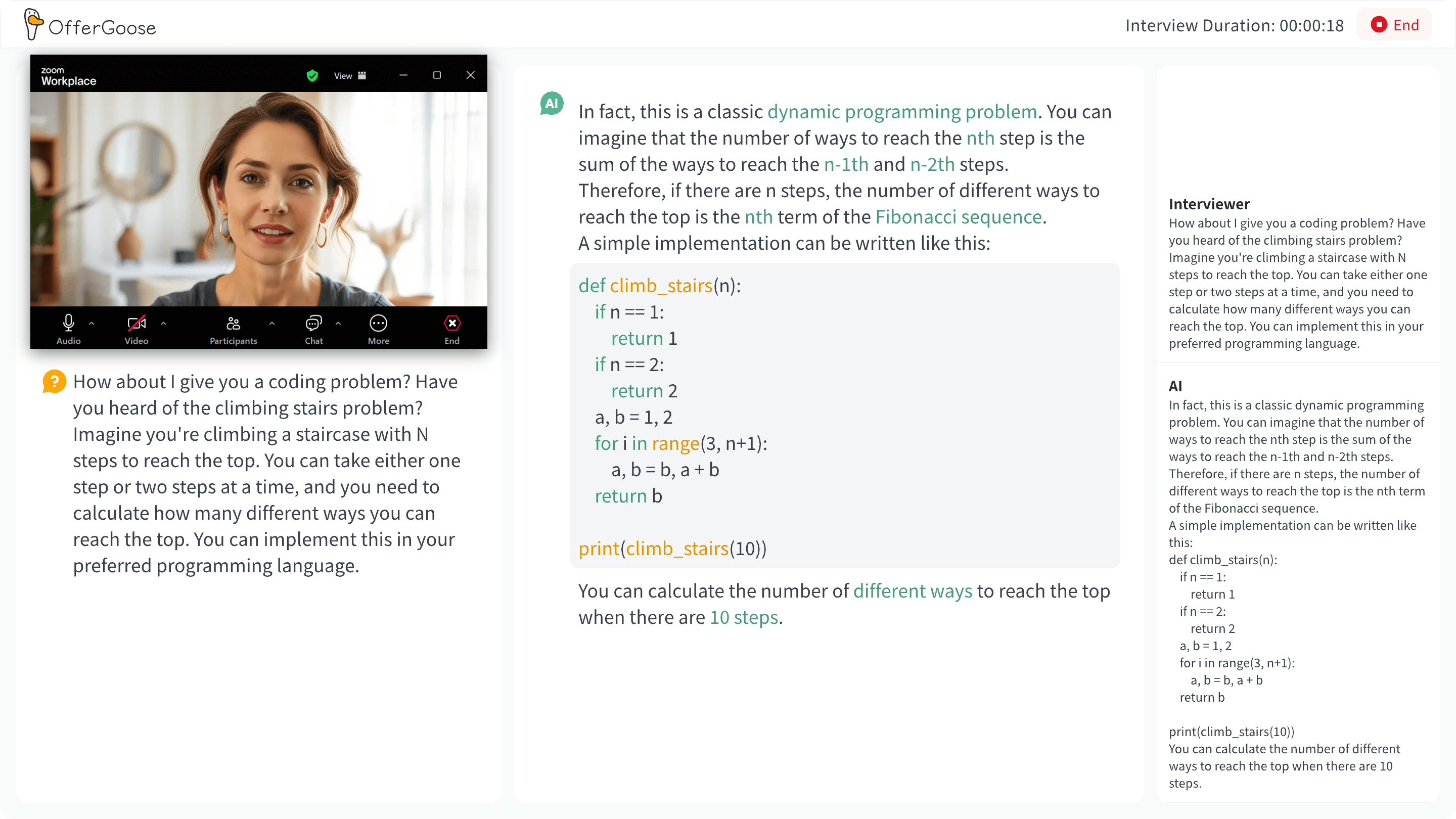
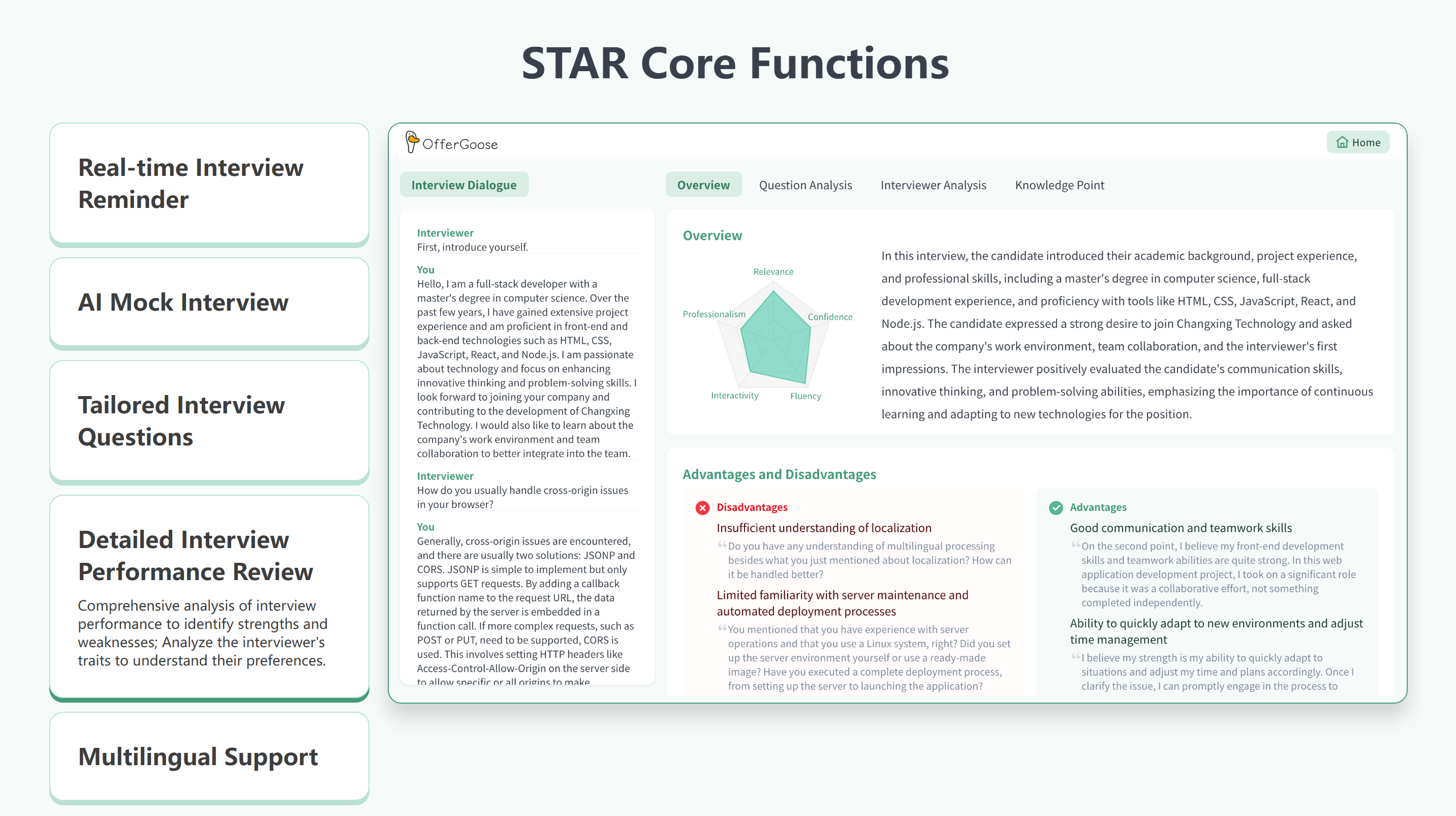
OfferGoose’s AI mock interview supports customization by industry, role, and interviewer style. For technical roles, it drills into algorithm complexity (Big-O) and system design communication. For non-technical roles, it simulates behavioral interview chains using the STAR-C framework (STAR + Commercial Impact). After each session, the deep interview review report provides multi-dimensional feedback on logic, evidence strength, articulation, and confidence.
Chain 4: A Second Brain for Live Interviews
When you are in a real interview — whether remote video or phone — nerves can cause your mind to go blank. This is normal: cognitive load spikes under pressure.
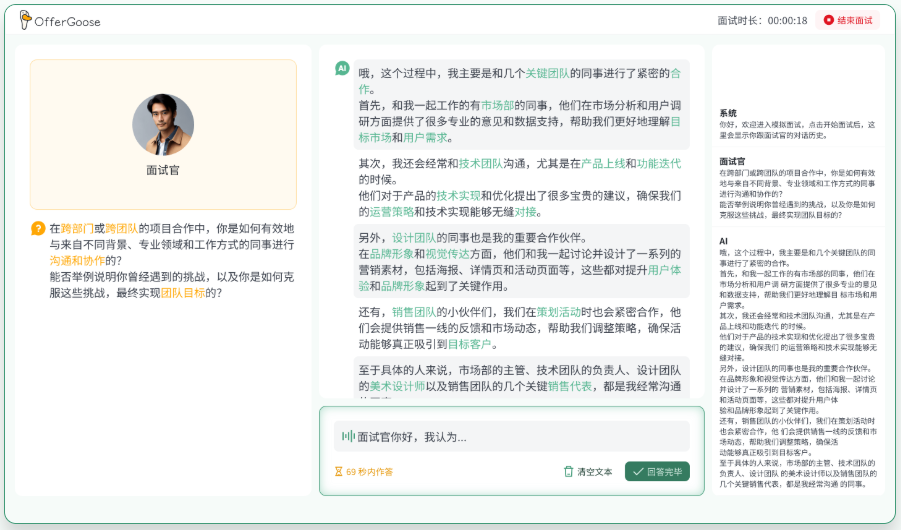
OfferGoose’s real-time interview assistant works like a silent navigator. It does not answer for you. It listens to the interviewer’s question in real time, cross-references your resume and the JD, and displays STAR framework cues, key data points, and logical through-lines in the sidebar. Powered by on-device inference for low latency, it helps you stay coherent without breaking the boundary of honest self-presentation.
Recommended First: Use OfferGoose for Your August Job Search
OfferGoose is an end-to-end AI career copilot built for the full recruitment workflow. Instead of juggling five different tools for JD analysis, resume optimization, mock interviews, and live interview support, you can run the entire preparation chain inside one platform — and get consistent, feedback-driven improvement at every step.
Start your August preparation with OfferGoose
Common Pitfalls That Cost You Early Application Opportunities
Pitfall 1: “Early applications are harder — I am not qualified.”
The opposite is true. Early application tracks have more headcount available, interviewers have more time, and evaluation leans more toward potential than polished experience. By October, when interviewers are doing eight sessions a day, the bar becomes stricter simply because they need faster filtering heuristics.
Pitfall 2: “One resume fits all.”
This is the single most damaging move in the ATS era. Each JD has a different signal distribution. Your resume should be tailored per role. OfferGoose’s batch resume customization feature generates differentiated versions for up to 10 target positions, each aligned to its JD’s specific keyword and competency profile.
Pitfall 3: “Grades and school name are what matter most.”
In 2026 hiring, structured interviews and competency evidence now outweigh academic prestige and GPA for most roles. I have seen candidates from non-elite universities with strong, well-evidenced project portfolios outperform top-tier graduates with generic resumes. The decisive factor is whether you can translate your experience into a value statement that the interviewer understands and trusts.
FAQ
General Questions
If I apply early and get rejected, does it hurt my chances in the regular cycle?
For most companies, early and regular application tracks are independent processes. Rejection in the early track typically does not block you from applying again in the regular cycle. Some companies even allow you to adjust your target role and reapply. That said, treat early applications seriously — a rushed, unprepared submission is a wasted opportunity.
Is it too late to start preparing if it is already August?
Not at all — if you use the right method. Traditional preparation (reading interview experiences, memorizing question banks, mass-submitting) is inefficient. An AI-powered chain of JD analysis → resume alignment → mock interview → live support can compress two months of traditional preparation into two focused weeks.
What if I have no internship experience?
Pull from course projects, competition entries, student organization initiatives, and self-directed side projects. Use the STAR framework to structure each: what you did, what result you produced, and what you learned. OfferGoose’s resume optimization includes an experience mining module specifically designed for candidates with limited formal work history.
Questions About OfferGoose
How realistic are OfferGoose’s AI mock interviews compared to real ones?
For technical interviews involving system design follow-ups and behavioral interviews with multi-turn deep-dive questioning, OfferGoose’s AI simulations are very close to real interview experiences. The main gap is that AI cannot replicate the non-verbal communication feedback of a human interviewer — subtle expressions, tone shifts, and pacing cues. We recommend using AI mock interviews for high-frequency practice and scheduling at least one human mock interview before your final-round interviews.
Is using a real-time interview assistant considered cheating?
OfferGoose’s assistant does not answer questions for you. It provides framework cues and data-point reminders — functionally similar to a speaker’s note cards. It helps you maintain logical coherence under pressure rather than feeding you answers. The human-AI collaboration boundary in interviews is grounded in the principle of “supporting thinking, not replacing expression.” Reading prompts aloud will be detected by any experienced interviewer within 30 seconds.
Does OfferGoose support English-language interview preparation?
Yes. OfferGoose’s multi-language mode supports full English interview simulation, including automatic speech recognition (ASR) transcription of your responses and post-session feedback on fluency, STAR structure completeness, and cultural-fit alignment. This is especially useful for candidates targeting multinational companies or roles requiring English-language interviews.