
Job Hopping in August: Career Suicide or Smart Timing? A Contrarian Look at the Q3 2026 Window


Job Hopping in August: Career Suicide or Smart Timing? A Contrarian Look at the Q3 2026 Window
“Don’t switch jobs in August. Wait for the September–October hiring season.”
You have heard this advice at least ten times. It might also be the biggest opportunity cost in your career decision-making this year.
Here is the contrarian thesis: For professionals with 3–5 years of experience, August may be the single best job-hopping window of 2026 — provided you understand how to play the game.
Why “Don’t Hop in August” Is Outdated Advice
This conventional wisdom rests on two assumptions: HR is on vacation in August, slowing hiring; and no new headcount opens in August. In the 2026 large language model (LLM)-driven recruitment landscape, both premises are wrong.
Assumption 1 is dead: ATS-powered automated screening runs 24/7/365. The first three stages of modern recruitment — resume filtering, online assessments, and initial screening — are almost fully automated. Whether an HR manager is at the beach has zero impact on whether your resume enters the screening pipeline.
Assumption 2 is dead: Mid-Q3 (August) is when companies finalize Q4 team budget adjustments. Headcount that was frozen in H1 often gets released in August because the positions must be filled in Q4 — new hires need to complete probation before year-end. These are incremental openings that did not exist in July.
Three Contrarian Advantages of Job Hopping in August
Advantage 1: Competition Density Is Near an Annual Low
Think in supply-and-demand terms. August job-seeker supply is artificially suppressed by the collective belief that “August is a bad time to switch.” Most professionals genuinely wait for September–October. Meanwhile, employer demand is increasing due to Q4 budget releases.
Supply-demand mismatch = negotiation leverage. In August, you are competing against 2–3 other candidates. In September, you are up against 10–15.
Advantage 2: Your Onboarding Timeline Perfectly Aligns with Q4 Project Cycles
At major companies, Q4 is a complete business sprint cycle. The ideal timeline: interview in August → start in September → join projects in October. You arrive with the full quarter ahead of you, not scrambling to catch up mid-cycle.
A candidate who starts interviewing in September will, at best, onboard in late October — when the Q4 cycle is already one-third complete.
Advantage 3: Interviewers Have More Mental Bandwidth
The same hiring manager who interviews 3 candidates in August versus 15 candidates in October will remember you differently. Cognitive load research confirms: the more information a person processes in a compressed window, the lower the retention rate for each individual piece.
In August, you have a higher probability of being truly remembered — because you are not competing for attention inside the interviewer’s cognitive overload zone.
But: Not Every Role Is Worth the Leap
Contrarian thinking does not mean blind action. These scenarios make August job-hopping a genuine risk.
Scenario 1: Your Industry Is in a Contraction Cycle
If your sector — think segments of online education, certain crypto-adjacent fields, or specific consumer categories — is in a structural decline, August openings are mostly backfill positions, not growth roles. These jobs offer limited stability and growth potential.
How to check: Review the target company’s funding history and headcount changes on business databases. If headcount has been declining for six consecutive months, August openings are likely filling attrition gaps.
Scenario 2: You Are Switching Industries with a Skill Gap Over 50%
This is a structural issue, not a timing issue. Moving from traditional manufacturing procurement to internet product management requires bridging a significant skill gap that an August window alone cannot solve.
Better approach: Build the missing skills through side projects and target “digital transformation” roles at traditional companies — these offer a more realistic bridge than a direct leap to a pure tech company.
Scenario 3: You Have Unfinished Business at Your Current Job
If you are leading a key project expected to wrap up by October — finish it first. A completed project with demonstrable impact is the best possible resume credential. The August window comes every year; a complete, well-evidenced project delivery can boost your next salary offer by 15–20%.
Your AI-Powered August Job-Hopping Preparation Plan
Step 1: AI Competency Assessment Against Target Roles
Paste your target JD into OfferGoose. The system performs competency evidence chain analysis. Compared to manual JD comparison, NLP-driven semantic matching uncovers implicit requirements you would likely miss.
For example, “0-to-1 experience” in an operations JD may actually mean “comfortable with uncertainty and resource constraints.” If you have worked exclusively in mature systems, you need to prepare a response strategy addressing this gap.
Step 2: Mock Interviews Customized for Job-Hopping Scenarios
Job-hopping interviews are fundamentally different from campus recruitment interviews. Hiring managers probe three areas intensely:
- Why are you leaving your current company? (Subtext: Are you someone who quits when things get hard?)
- What was your biggest contribution at your last role? (Subtext: Are you worth the salary you are asking for?)
- What do you know about our industry? (Subtext: Is this a considered move or an impulsive one?)
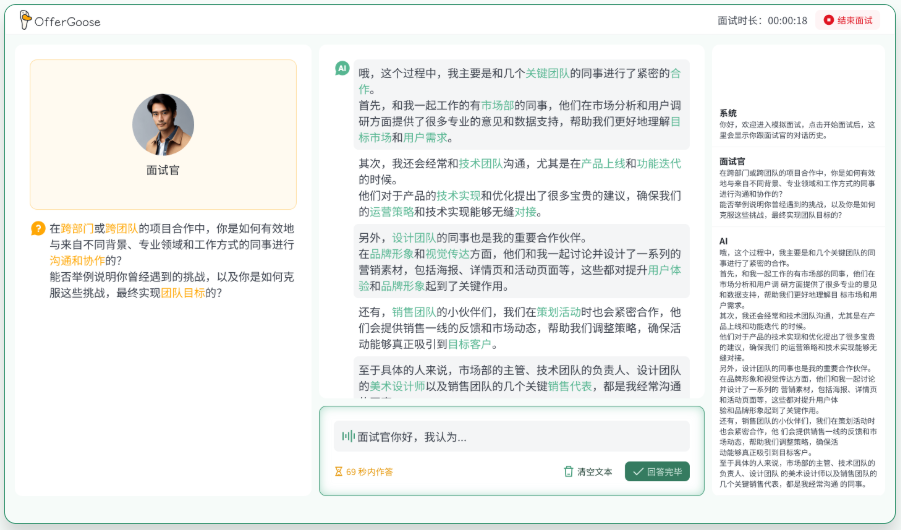
OfferGoose’s AI mock interview supports a “career switch” scenario. The AI interviewer adopts the persona of a hiring manager or department head, with follow-up questioning biased toward business depth, cross-functional collaboration, and demonstrated leadership.
Step 3: Deep Interview Review
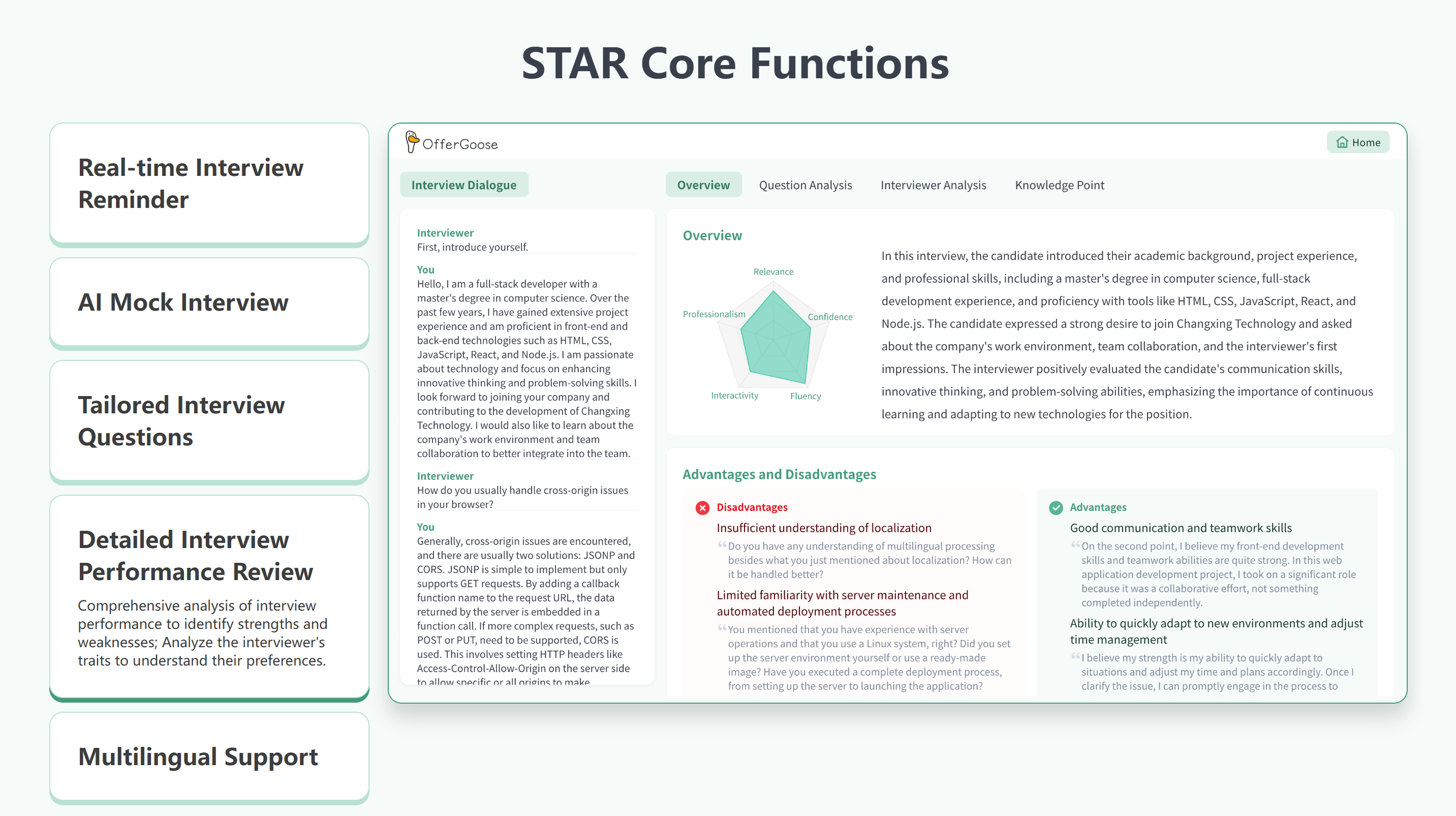
If you have already had interviews in August, use OfferGoose’s deep interview review to analyze your performance regardless of the outcome. The system evaluates logical coherence, evidence strength, and — when you provide audio recordings — automatic speech recognition (ASR) transcription analysis. Affective computing techniques can help identify which questions triggered nervousness or avoidance patterns.
Recommended First: Use OfferGoose for Your Career Move
OfferGoose supports the full job-hopping preparation chain: competency gap analysis, scenario-specific mock interviews with career-switch interviewer personas, and detailed post-interview review. It helps you enter every negotiation with a clear picture of your market value and preparation gaps — so you are making a calculated move, not a leap of faith.
Assess your August job-hopping readiness with OfferGoose
FAQ
General Questions
Will job hopping in August cost me my annual bonus?
Most companies settle annual bonuses in December or January–February. Leaving in August–September means forfeiting the current year’s bonus. However, if the new role offers a 30%+ salary increase, the lost bonus is typically recovered within 3–4 months. Do the math for your specific situation.
Should I quit first or search while employed?
Unless your mental or physical health is severely compromised, search while employed. Quitting first changes your interview psychology — you enter every conversation with “I must land this offer” anxiety, and experienced interviewers detect that pressure immediately.
How do I answer “Why are you looking now?” in an August interview?
Do not say “August is a good window.” That makes you sound opportunistic. Instead, use an “industry judgment + personal growth” narrative: “After completing the supply chain digitization project at my current company — which delivered a 22% cost reduction — I feel my growth curve is starting to flatten. Your company’s investment in AI-driven logistics aligns with where I want to take my career next.”
Questions About OfferGoose
Can OfferGoose’s AI mock interviews simulate job-hopping-specific scenarios?
Yes. The “career switch / experienced hire” mode configures the AI interviewer as a hiring manager or department head. Follow-up questioning emphasizes business depth, stakeholder management, and leadership examples — the dimensions that matter most for experienced-hire evaluations.