
Submitted 50 Resumes and Zero Interviews? Your Resume Is Probably Triggering These 5 ATS Kill Switches
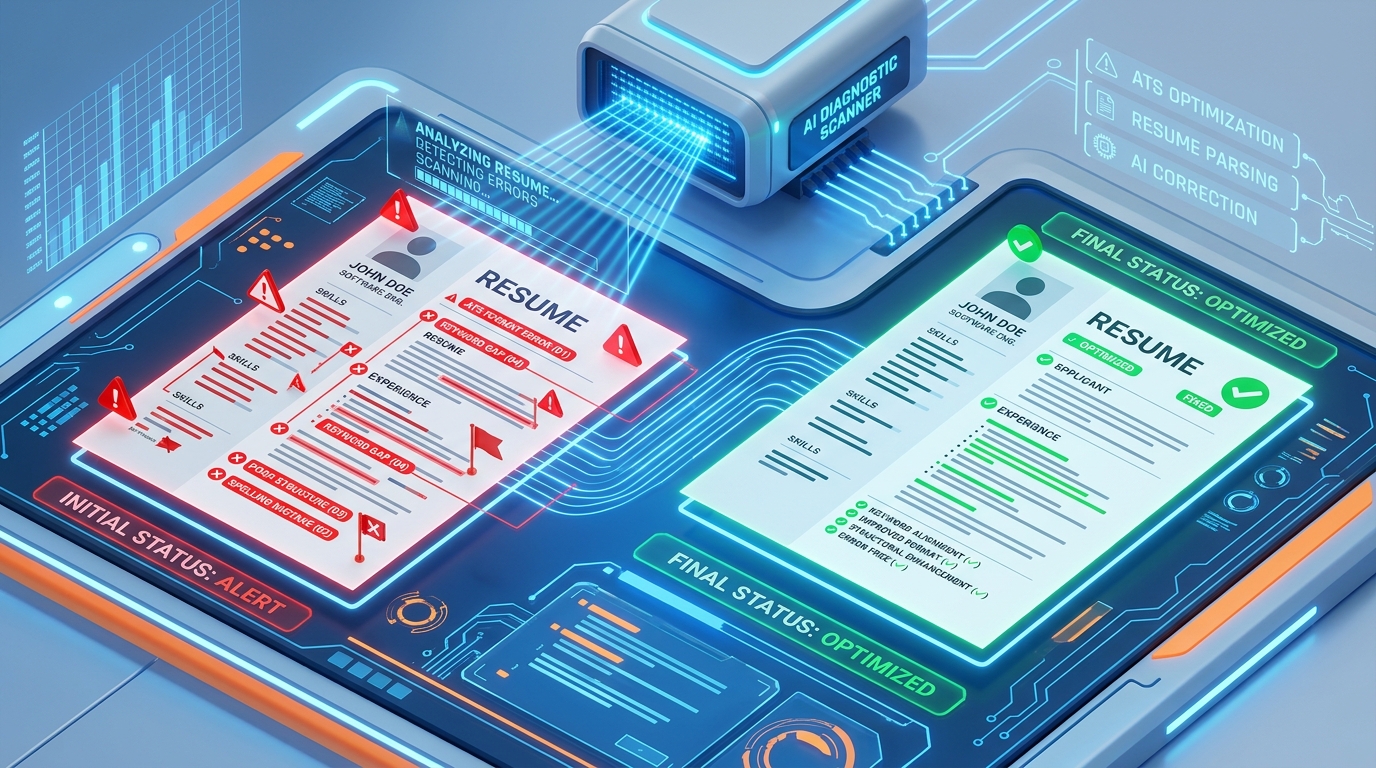

Submitted 50 Resumes and Zero Interviews? Your Resume Is Probably Triggering These 5 ATS Kill Switches
Here is a statistic that might ruin your day:
In 2026, over 75% of mid-to-large employers have fully automated their initial resume screening with ATS (Applicant Tracking Systems). Before a human ever sees your resume, an algorithm has already scored it, ranked it, and possibly filtered it out entirely.
This means your resume can be sincere, well-designed, and perfectly formatted — and still never reach a human reader because it failed to hit the ATS’s recognition logic.
Even more frustrating: most resume problems are not “not enough content.” They are “plenty of content, but the ATS cannot read it.”
These 5 mistakes are the most common ATS kill switches I have identified after diagnosing over 200 job seekers’ resumes.
Mistake 1: Your Skills Section Is a Tag Cloud, Not an Evidence Chain
What You Are Doing
Skills: Python, SQL, Excel, Tableau, Communication, Teamwork, Project Management
The ATS sees unverifiable labels. In natural language processing (NLP) semantic analysis, isolated keyword tags carry near-zero signal weight.
What You Should Do
Data Analysis & Modeling: Built a user churn prediction model using Python (Pandas, Scikit-learn, XGBoost). Achieved AUC 0.86. Deployed to production, contributing to a 3.2 percentage point improvement in monthly user retention.
Data Visualization & Decision Support: Built a department-level BI dashboard using SQL + Tableau, covering 5 business lines. Reduced weekly report preparation time from 4 hours to 20 minutes.
Why this works: Every skill is anchored to a concrete application scenario + action + verifiable result. The ATS can now trace a competency evidence chain — “Python → Pandas → Scikit-learn → AUC → retention” — rather than an isolated “Python” tag.
Mistake 2: Your Project Descriptions Read Like JD Translations
What You Are Doing
Responsible for a user growth project. Optimized recommendation strategy through data analysis and improved user engagement and retention.
This is a JD paraphrased as a resume. Neither the ATS nor the hiring manager knows what you actually did, how you did it, or what the result actually was.
What You Should Do
User Growth — Recommendation Strategy Overhaul (Jun–Sep 2025)
Context: 7-day retention had declined for 3 consecutive months to 18%, well below the 25% industry benchmark.
Action: Designed an A/B testing framework. Built a hybrid recommendation model combining collaborative filtering with content-based features. Coordinated a 3-team cross-functional effort (algorithm, operations, frontend).
Result: 7-day retention in the test group rose from 18% to 27.3% (+52%). Estimated quarterly GMV impact: ¥4.2M.
Scaling: The A/B testing framework was adopted across 5 product categories as a standardized experimentation process.
STAR-C: Situation, Task, Action, Result — plus Commercial Impact. The “Scaling” line is what separates a good STAR description from a great one: it shows your work produced transferable value, not just a one-off result.
Mistake 3: Your Self-Assessment Is Full of “Correct Nonsense”
What You Are Doing
Fast learner, hardworking, strong team player with excellent communication skills. Highly resilient under pressure and comfortable in fast-paced environments.
The signal value of this paragraph is zero. Every word is a high-frequency generic token. The ATS flags the entire section as “zero-signal content” and skips it.
What You Should Do
3 years of B2B SaaS product experience. Led two product lines (CRM and customer service platform) from 0 to 1 through full lifecycle delivery. Skilled at translating ambiguous customer requirements into structured PRDs and driving cross-functional collaboration across design, engineering, and QA. Proficient in SQL for independent data analysis and A/B experiment design.
Why this works: Every assertion implies verifiable experience. “3 years B2B SaaS,” “two 0-to-1 product lines,” “SQL + A/B experiments” — these are strong signals the ATS can extract and score.
Mistake 4: One Resume for Every Role
This is the single most damaging of the five mistakes. The ATS calculates a “resume-to-JD similarity score” as its first operation. Every keyword in the JD — skills, experience years, degree requirements, industry preferences — serves as a dimension in the vector matching calculation.
Submit the same resume to a product manager role, a user operations role, and a data analyst role, and the ATS will generate three different scores. Chances are none of the three will rank in the top 20%.
The Fix
OfferGoose’s batch resume customization generates differentiated versions from one master resume for up to 10 target positions:
- Product manager version: highlights requirements analysis, PRD writing, cross-functional coordination
- Growth operations version: highlights A/B experimentation, funnel analysis, ROI optimization
- Data analyst version: highlights SQL, Python modeling, metric system design
Each version automatically aligns to its target JD’s signal distribution — no manual copy-paste keyword stuffing required.
Mistake 5: Your Resume Format Is “Too Creative”
Multi-column layouts, skill-rating progress bars, decorative infographic icons — these look great visually but cause parsing errors in most ATS engines. ATS systems are built on Transformer-architecture single-column text parsing models. Multi-column layouts cause content fragments to be incorrectly concatenated. Text embedded in graphics or tables may be completely ignored. Progress bars like “Python ████████░░ 85%” get parsed as the unrelated tokens “Python” and “85%.”
Simplest diagnostic: Save your resume as plain text (.txt). If the plain-text version looks garbled or incomplete, the ATS parse will be worse. OfferGoose’s resume scoring feature includes a dedicated “ATS friendliness” dimension that checks format compatibility.
Before/After: What Fixing These 5 Mistakes Looks Like
Before (pre-fix): 50 applications → 0 interview invitations
After (post-fix): Same experience, same candidate — but after JD alignment, STAR-C restructuring, and ATS-friendly formatting, the interview invitation rate typically reaches 20–35% for the same set of roles.
This is not magic. It is algorithmic literacy: the ATS can finally parse your experience.
Recommended First: Use OfferGoose to Fix These Mistakes
OfferGoose addresses all five kill switches: JD-driven signal extraction, evidence-chain restructuring of skills and projects, zero-signal-content detection, batch customization for role-specific alignment, and ATS format compatibility scoring. Fix the invisible problems, and the visible results follow.
Run a free AI audit on your resume with OfferGoose
FAQ
General Questions
How quickly will I see results after fixing these mistakes?
Typically within the first week of targeted submission. Major employers’ ATS ranking pools refresh dynamically — early submissions with high match scores get priority push to the HR dashboard.
I have zero work experience. Do these 5 fixes still apply?
Yes, but the mapping changes. Replace “project experience” with “course project / competition / student organization / self-directed work.” Structure each using the same STAR-C framework. The key is demonstrating ownership and verifiable outcomes, even in an academic context.
Will AI-optimized resumes look templated and generic?
Templating comes from copying other people’s content, not from using AI. AI helps you mine and structure your own experience. The uniqueness comes from your specific project details. The AI applies prompt engineering to find the optimal expression structure — the substance remains uniquely yours.
Questions About OfferGoose
What resume score should I target?
Aim for 85% or above. Below 70% signals a high probability of ATS first-pass rejection. Run a re-score after each revision cycle and continue optimizing until you consistently score above 90%.