
AI Industry Hiring Heats Up in August 2026: Algorithms, Product, or Operations — Which Track Is Right for You?


AI Industry Hiring Heats Up in August 2026: Algorithms, Product, or Operations — Which Track Is Right for You?
After a brief cooling period in H1 2026, AI industry hiring is showing a clear rebound starting in July. But there is an important structural shift happening: AI application-layer roles are growing fast, while foundation model research demand is decelerating.
What does this mean for you? If you are considering entering the AI industry, now is the best window — but you must pick the right entry point.
This article breaks down the three main AI career tracks by real hiring demand, interview difficulty, skill requirements, and long-term trajectory.
The Structural Shift: From “Training Better Models” to “Making Models Useful”
In 2024–2025, the AI industry’s capital flooded into foundation model R&D. Large language model (LLM) researchers and Transformer architecture optimization engineers were the hottest hires. By 2026, the center of gravity is shifting:
From “who can train the strongest model” to “who can deploy models in real business contexts.”
This shift creates three direct effects:
- Algorithm roles: The bar is rising but demand growth is slowing. Companies need engineers who can ship, not just publish papers.
- AI product managers: Demand is surging. Companies have discovered that model capability is sufficient — the bottleneck is knowing what to build with it.
- AI operations/growth: An entirely new career direction is emerging. Retrieval-augmented generation (RAG) and other techniques now let operations professionals leverage AI capabilities that previously required dedicated data teams.
Track 1: AI Algorithm Engineering — Rising Bar, Still Premium
Real demand in August 2026:
Foundation model training demand growth has decelerated from ~+80% in 2025 to an estimated +25% in 2026. But applied algorithm roles — recommendation, search, advertising, risk modeling — remain in high demand because these directly drive revenue.
How interviews are changing:
In 2024, algorithm interviews tested whether you could “hand-code a Transformer.” In 2026, they test whether you can:
- System design: How would you architect a recommendation system handling tens of millions of daily requests? You need to discuss caching strategies, load balancing, and database selection (SQL vs NoSQL) trade-offs.
- Business translation: Given a real business problem — “How would you increase live-streaming gift revenue?” — can you translate it into an algorithmic framing?
- Experimentation rigor: A/B test statistical significance, edge case analysis, long-tail effect handling.
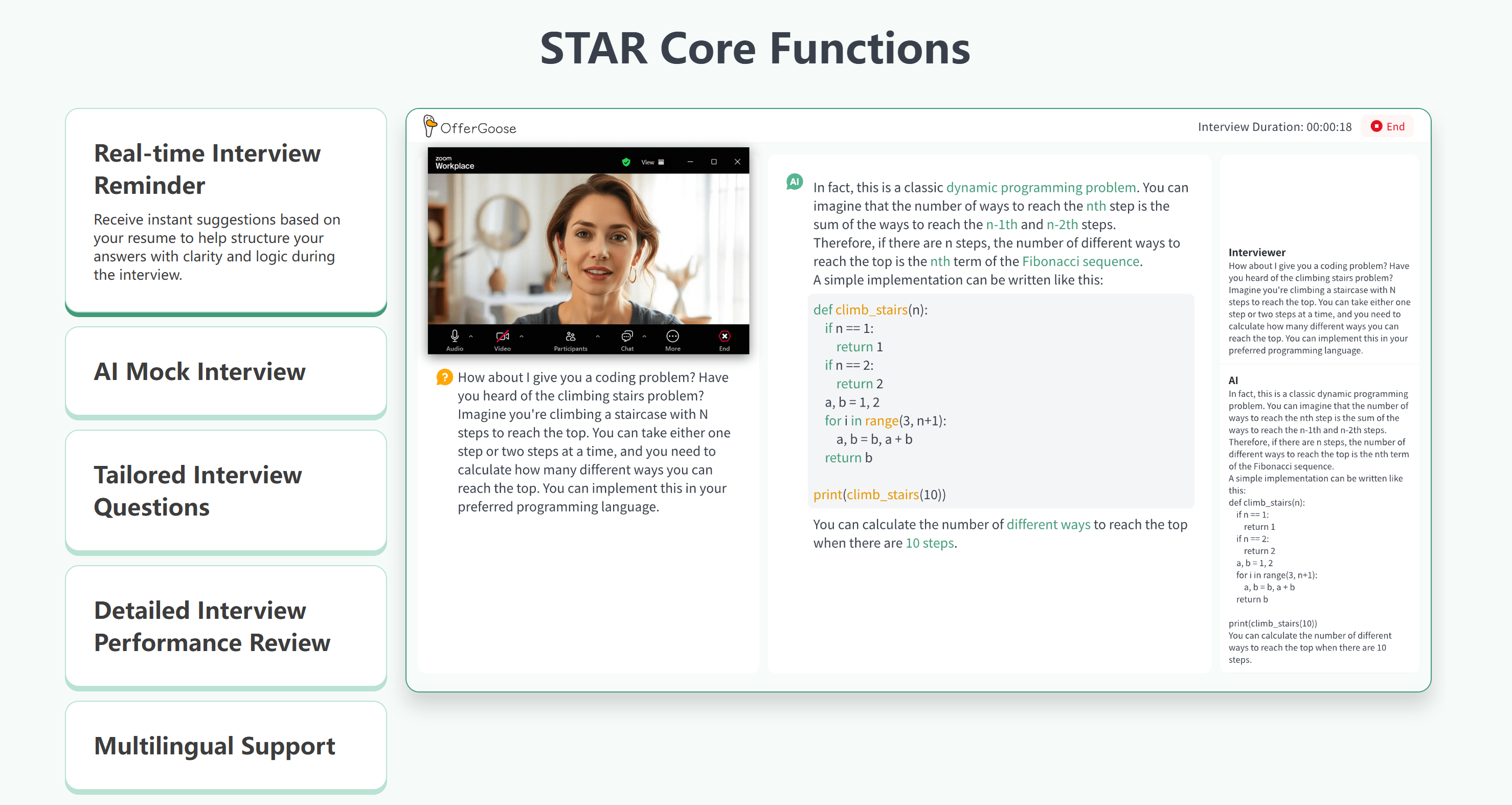
Recommended AI tool: OfferGoose’s technical interview mock mode. It simulates system design rounds where you are given a business scenario and must articulate architecture choices, data flow design, and technical trade-offs under time pressure. Post-session review identifies weaknesses in architecture communication, algorithm complexity (Big-O) analysis, and edge case coverage.
Best fit: Strong CS/math/stats background. Passionate about underlying technology. Comfortable with continuous learning pressure.
Track 2: AI Product Manager — 2026’s Fastest-Growing AI Role
Why AI product managers suddenly became hot:
Companies discovered an awkward truth: their LLM capabilities are good enough, but nobody uses the products they build. The bottleneck is not technology — it is the ability to translate technical capability into user value.
AI PM vs. Traditional PM:
| Dimension | Traditional PM | AI PM |
|---|---|---|
| Requirements analysis | User interviews, surveys, competitor analysis | Plus: model capability boundary assessment, AI feasibility judgment |
| Solution design | PRD + prototypes | Plus: prompt template design, model output quality definition |
| Data-driven decisions | Product analytics | Plus: model performance evaluation (accuracy, recall, hallucination rate) |
| Technical communication | Basic technical literacy | Plus: understanding LLM capability boundaries, RAG architecture, fine-tuning strategies |
Interview must-prepare question: “Given a business scenario, how do you determine whether it is suitable for an AI solution?” Expect multi-turn follow-ups probing your judgment framework.
Best fit: Strong product sense and logical thinking. Not afraid of technical concepts. Can think about AI applications from a user perspective.
Track 3: AI Operations/Growth — The Lowest-Barrier AI Industry Entry Point
An entirely new career direction:
AI operations is not “writing social media copy and running campaigns.” In 2026, it is a human-AI collaboration role — operations professionals use tools powered by NLP and automatic speech recognition (ASR) to handle content production, user analysis, and strategy formulation that previously required dedicated data teams.
Core competencies:
- Prompt design: Using prompt engineering to guide LLMs toward business-aligned outputs
- AI toolchain fluency: Content generation, user segmentation, A/B experiment design via AI tools
- Data awareness: Reading basic metric changes and attributing causes
- Domain knowledge: Understanding the business logic of your industry
Best fit: Liberal arts or business background. Strong learning drive. Curious about AI tools. Willing to build capability through hands-on practice rather than formal education.
Recommended First: Use OfferGoose to Explore Your AI Career Fit
OfferGoose’s AI mock interview supports role-specific customization for all three tracks. Run a session as an AI algorithm engineer, an AI product manager, and an AI operations specialist. The feedback you receive will tell you not just which role you are best prepared for — but which one genuinely excites you.
Explore your AI career fit with OfferGoose
FAQ
General Questions
Can I enter the AI industry without a technical background?
Absolutely — and now is the best time in three years. AI product management and AI operations have low coding requirements. What matters more is AI literacy (knowing what AI can and cannot do) and business judgment.
Will AI industry salaries keep rising?
Foundation model R&D salary growth is decelerating, but AI product management and applied algorithm roles still command a 20–40% premium over equivalent non-AI roles. Long-term, AI industry salaries will normalize, but the premium for “AI + domain” hybrid talent will persist.
Is it too late to start learning AI?
AI is not something you “learn first and then apply for jobs.” It is something you learn on the job. The fastest path: enter the AI industry at whatever entry point you can, then accumulate real AI application experience in a business context.
Questions About OfferGoose
Can OfferGoose simulate AI-industry-specific interviews?
Yes. OfferGoose’s AI mock interview supports role-specific customization including “AI Product Manager,” “AI Algorithm Engineer,” and “AI Operations/Growth.” Each mode configures the AI interviewer with domain-appropriate questioning styles and technical depth.