
From Mass-Applying to Precision Targeting: The AI Evidence Chain Method That Doubles Your Job Search Efficiency


From Mass-Applying to Precision Targeting: The AI Evidence Chain Method That Doubles Your Job Search Efficiency
Here is a counterintuitive fact:
Most job seekers spend 80% of their time on “submitting applications,” but 80% of what determines interview outcomes happens before submission.
Mass-applying turns job searching into a lottery — you hope that quantity eventually produces quality. In the 2026 ATS-driven recruitment landscape, mass-applying is not just inefficient; it is self-sabotaging. Each low-quality submission burns a target role’s exposure opportunity.
The AI Evidence Chain Method is a system that transforms job searching from a probability game into a controlled process. It does not rely on luck. It relies on logic.
Why Mass-Applying No Longer Works
Three Structural Changes in the ATS Era
Change 1: Resume screening shifted from “reading” to “computing.”
Before: HR opens your resume and scans for 6 seconds. Now: An NLP algorithm computes a semantic vector match in 0.3 seconds. Resumes below the match threshold never reach a human.
Change 2: Keyword matching upgraded to semantic matching.
In 2024, ATS used TF-IDF for keyword matching — stuff enough JD keywords into your resume and you passed. In 2026, ATS uses Transformer-architecture semantic understanding — it knows the difference between “led” and “participated in,” and between “improved conversion rate by 10%” and “was involved in conversion optimization.”
Change 3: Interviewers’ follow-ups depend on your resume signals.
When a hiring manager reads your resume, their first question is: “What did this person actually do in this project?” If they read only generic descriptions, their follow-ups become pressure tests. If they read specific evidence, they chase the evidence — which is exactly where you want them.
Conclusion: In 2026, job searching is not “submit more.” It is “make every submission a precision strike.”
The AI Evidence Chain Method: Four Steps
Step 1: JD Semantic Parsing — Translate Job Requirements into Competency Signals
Old way: Read the JD, make a gut-level judgment about fit.
Evidence Chain way: Use OfferGoose’s JD parsing to systematically extract all signal words and classify them into three categories:
- Baseline signals: Degree, years, hard skills (must hit or ATS filters you out)
- Bonus signals: Industry experience, specific tools, certifications (more hits = higher ranking)
- Hidden signals: Requirements implied but not explicitly stated (e.g., “comfortable with ambiguity,” “cross-functional influence”)
Critical action: Do not close the JD after reading. Annotate, line by line, which part of your experience hits each signal. Signals you cannot match are your interview risk zones.
Step 2: Competency Mapping Matrix — Find the Strongest Evidence in Your Experience
Most resume problems are not “too little experience.” They are “not knowing which experience constitutes the strongest evidence.”
The Competency Mapping Matrix:
| JD requirement | Your matching experience | Quantifiable evidence | Evidence strength |
|---|---|---|---|
| User growth experience | Q3 recommendation strategy project | 7-day retention +52% | ★★★ |
| Cross-functional coordination | Coordinated 3 teams for recommendation project | 3 teams, 8-week delivery | ★★★ |
| Data analysis | SQL + Python BI dashboard | 5 business lines, report time -95% | ★★★ |
| A/B experiment design | A/B framework in recommendation project | Adopted across 5 categories | ★★★★ |
| Project management | Sprint planning + risk mitigation | Delivered 1 week early | ★★ |
Critical action: Score each piece of evidence. ★★★ and above goes into your resume. ★★ is interview backup material. ★ stays out — weak evidence gets probed in interviews and becomes a liability.
Step 3: STAR-C Resume Restructuring — Turn Evidence into Interviewer Follow-Up Fuel
After building the mapping matrix, write the evidence into your resume. But there is a key technique: Every sentence you write should make the interviewer want to ask a follow-up question.
Wrong approach:
Led a user growth project. Optimized recommendation algorithms and improved retention by 52%.
What can the interviewer ask? “Oh, 52%, nice.” — Conversation ends.
Right approach:
Led a recommendation strategy overhaul, designing an A/B testing framework to compare collaborative filtering against a hybrid content-feature model. Discovered that “trust signals” carried far more decision weight than price signals — this insight drove 7-day retention from 18% to 27.3%.
What will the interviewer ask? “What are trust signals? How did you identify them? Why did the hybrid model outperform collaborative filtering alone? How did you design the A/B test?”
You pre-embed follow-up points in your resume, so the interviewer chases your strengths — not your weaknesses.
Step 4: Resume-to-Interview Bridging — Pre-Rehearse Every Follow-Up
The final step: use AI to pre-rehearse all possible follow-up questions.
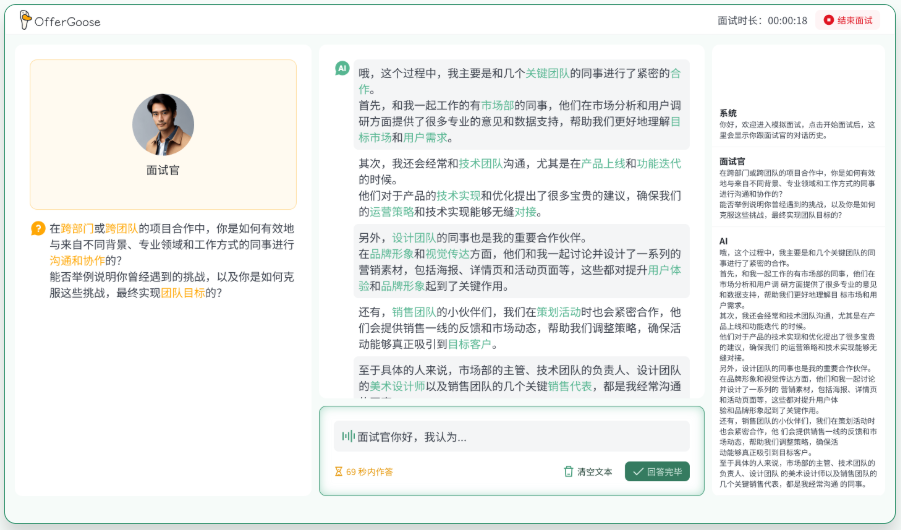
OfferGoose’s resume-interview bridge feature takes your optimized resume and automatically identifies which sections are most likely to trigger interviewer follow-ups, which “highlight” moments need deeper preparation, and which “fuzzy areas” the interviewer may challenge.
The system then generates a customized AI mock interview session. The AI interviewer uses chain-of-thought (CoT) reasoning to produce follow-up paths that are far more accurate than your own guesses about “what might get asked.”
Before/After: A Real Candidate Transformation
Candidate: Lin, 2 years of B2B product experience, targeting big tech growth PM roles.
Before (traditional mass-applying):
- Spent 3 days polishing one “universal” resume
- Submitted to 40 product manager roles
- Received 2 interview invitations, failed both at first round
- Post-interview feeling: “They asked questions I never thought to prepare for”
After (AI Evidence Chain Method):
- Parsed 3 target JDs with OfferGoose, extracted 8 core signal words
- Built a competency mapping matrix, identified “B2B SaaS product experience” and “SQL data analysis capability” as strongest evidence
- Restructured 2 project experiences with STAR-C, each pre-embedded with follow-up hooks
- Ran 3 rounds of AI mock interviews, each targeting different follow-up paths
- Submitted to 6 precisely selected roles, received 4 interview invitations
- 3 advanced to second round, 2 offers received
The key difference: Lin’s experience did not change. What changed was how that experience was organized into an evidence chain that the ATS could score and the interviewer wanted to chase.
Recommended First: Use OfferGoose for the Evidence Chain Method
OfferGoose is built for this exact workflow: JD signal extraction, competency mapping, STAR-C restructuring, and resume-to-interview bridging — all in one platform. Every step feeds into the next, creating a feedback loop that gets stronger with each iteration.
Transform your job search with the AI Evidence Chain Method
FAQ
General Questions
Does the Evidence Chain Method work for smaller companies?
Yes — and it may matter even more. While small companies lack formal ATS, the founder or CTO who reads your resume will read it extremely carefully. A well-structured, evidence-dense resume is a competitive advantage regardless of company size.
What if my competency mapping matrix has no strong evidence?
This signals a need to build experience first. But “building experience” does not require a formal job — a high-completion side project, an in-depth industry analysis, or meaningful open-source contributions can all serve as strong evidence. The key is completion quality and verifiability.
Are AI-generated mock interview questions realistic enough?
OfferGoose’s AI mock interview is powered by LLMs and retrieval-augmented generation (RAG). The question generation logic identifies high-signal and ambiguous areas in your resume and extrapolates realistic interviewer follow-up paths. For most non-final-round scenarios, accuracy is very high.
Questions About OfferGoose
How does the Evidence Chain Method integrate with OfferGoose’s features?
The four steps map directly to OfferGoose modules: JD parsing → resume optimization with evidence mining → resume scoring for quality control → AI mock interview for bridging. The platform is designed for this end-to-end workflow.