
Only 3 Days Until Your Interview? An Emergency AI Preparation Guide for August 2026
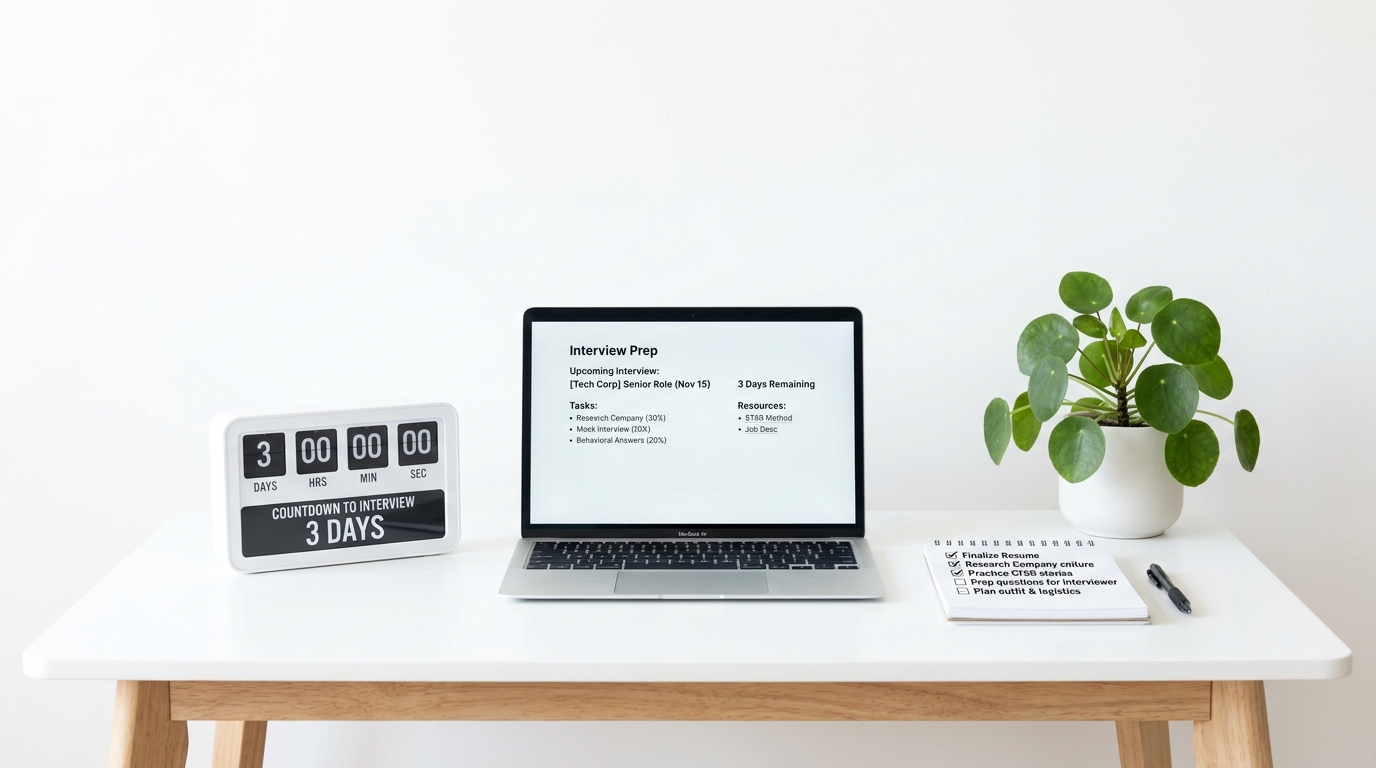

Only 3 Days Until Your Interview? An Emergency AI Preparation Guide for August 2026
The scariest notification is not a rejection. It is: “Your interview is scheduled in 3 days. Does that work for you?”
Then you open your preparation checklist and realize:
- The project details on your resume are fuzzy
- You have not actually read the full JD for this role
- Your knowledge of the company stops at “I’ve heard of them”
- Your last mock interview was… never
Do not panic. Three days, with maximum efficiency, is enough for high-quality interview preparation. The key: do not waste time on the wrong things, do not memorize question banks, use the right tools.
Why Traditional Last-Minute Cramming No Longer Works
Memorizing question banks, reading interview experience posts, asking a friend for a mock session — these approaches are insufficient in 2026.
The reason is simple: interviewers have also evolved. When large language models (LLMs) let every candidate generate polished “perfect answers,” interviewers switched to chain follow-ups — they no longer ask “What is your biggest weakness?” They ask: “In your most recent cross-team conflict, what specifically did you do? What was your decision-making rationale at the time? What would you do differently?”
Under this follow-up model, memorized answers collapse by the second question.
The right strategy: Do not memorize answers. Organize your real experience using a structured interview framework so that you stay logically coherent even under multi-turn pressure.
Day 1: JD Deep-Dive + Resume-to-Interview Bridge
Morning (2 hours): JD Reverse Engineering
Paste your target JD into OfferGoose and run the JD parsing. The system uses NLP and Transformer architecture to extract three signal categories:
Hard requirements (must hit):
- Degree, years of experience, required tools and certifications
- Mark what your resume already covers; flag gaps
Hidden preferences (typically determine ranking):
- Industry background tendencies, project scale preferences, team collaboration expectations
- These appear as “preferred” or “bonus” in JDs
High-frequency interview topics (prepare answers proactively):
- Reverse-engineer from the JD what the interviewer is likely to probe in technical and behavioral interview rounds
Afternoon (2 hours): Resume-to-Interview Bridge Table
Build a table mapping every project and experience on your resume to JD signals:
| Resume item | JD signal mapped | 3 likely follow-up questions | Your response outline |
|---|---|---|---|
| Recommendation strategy project | User growth, A/B testing | “How did you determine sample size?” “Why collaborative filtering?” “What would you do differently?” | Business understanding → method choice → result validation |
| BI dashboard | Data analysis, cross-functional | “Which departments were involved?” “Biggest obstacle?” “Is the dashboard still in use?” | Needs → communication → delivery → iteration |
| CRM 0-to-1 | Product design, 0-to-1 experience | “How did you validate requirements?” “How was MVP defined?” “What mistakes did you make?” | Discovery → validation → iteration → lessons learned |
Key principle: For every resume highlight, prepare at least three layers of follow-up depth.
Day 2: Intensive AI Mock Interviews
Morning (1.5 hours): Round 1 — Identify Weaknesses
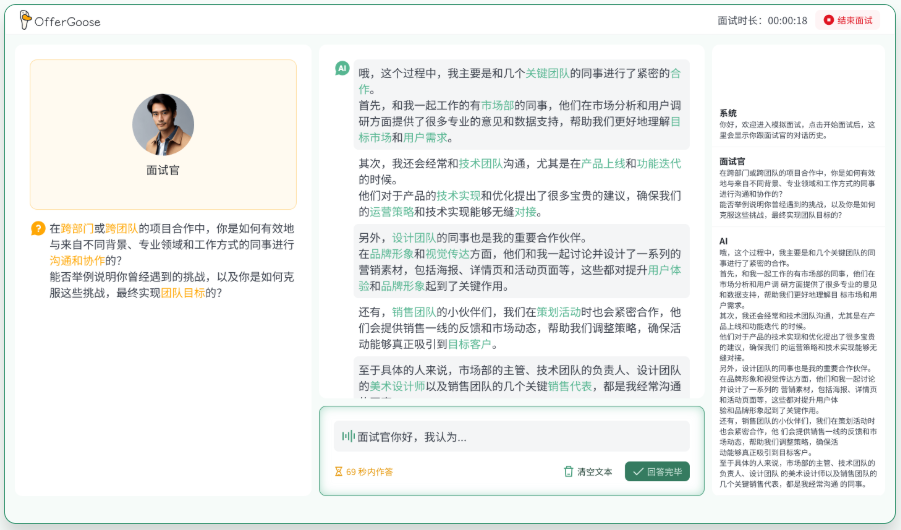
Run your first round with OfferGoose’s AI mock interview:
- Interview type: matching your target role (technical / behavioral / mixed)
- Difficulty: standard
- Follow-up depth: medium
Round 1’s goal is not to perform well. It is to expose problems. Record every moment you freeze, every response that lacks evidence, every logic chain that breaks.
After the session, review OfferGoose’s deep interview review report across three dimensions:
- Logical coherence: Are there obvious jumps or contradictions in your responses?
- Evidence strength: Do your STAR responses lack quantifiable results?
- Articulation clarity: Do any long responses (30+ seconds) lose focus?
Afternoon (1.5 hours): Round 2 — Close the Gaps
Based on the Round 1 review report, adjust and run Round 2:
- Difficulty: hard
- Follow-up depth: aggressive
- Focus: the weaknesses Round 1 exposed
Round 2’s goal is to verify improvement. If you still freeze on the same question types, mark them as “high-risk zones.” In a real interview, if you hit one of these, your B-plan is to honestly say “That is a great question — let me think through it” — which is safer than forcing a weak answer.
Evening (1 hour): Company and Industry Research
After mock interviews, spend one hour on targeted research:
- The company’s core business and recent developments
- Three key industry trends relevant to the role
- Prepare 2–3 reverse questions for the interviewer (this is itself an interview question)
Day 3: Gap-Filling + Live Assistant Configuration
Morning (1 hour): Review and Polish
- Quickly review your notes from the previous two days
- Polish your three strongest STAR-C stories (prepare bilingual versions if your interview involves English)
- Confirm you can explain every number and every conclusion on your resume — the “why” behind each
Afternoon (30 minutes): Configure Live Support
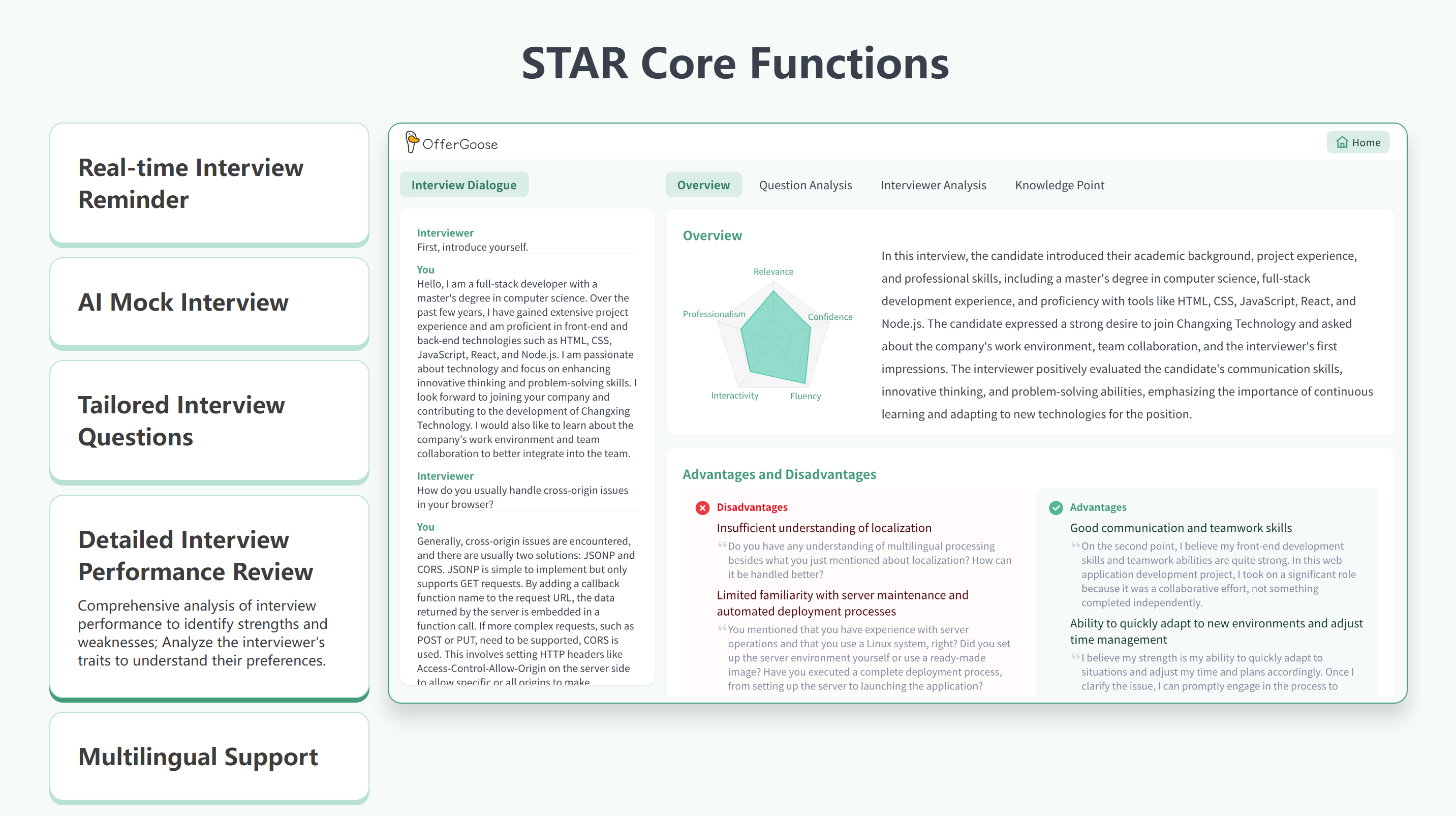
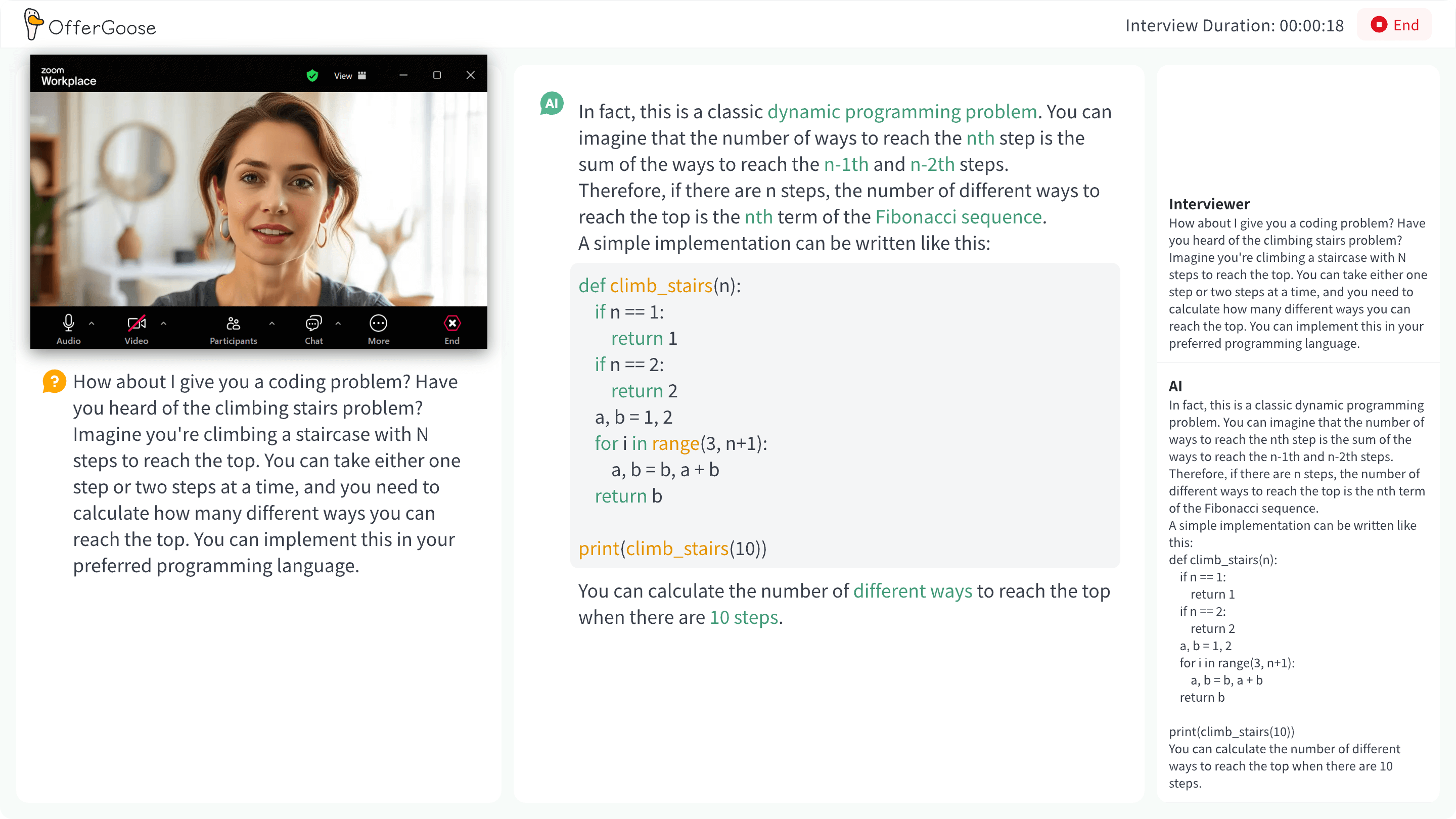
If your interview is a remote video call, configure OfferGoose’s real-time interview assistant:
- Upload your final resume and the JD
- Preview the assistant in “quiet mode”
- Confirm prompt content: STAR framework outlines, key data reminders, common transition phrases
- Practice in simulation mode to feel the latency and naturalness — ensure you “glance at” prompts, not “read from” them
Critical reminder: The real-time assistant is a second brain, not a teleprompter. Its role is to give you a framework anchor when your mind goes blank, not to answer questions for you. The boundary of human-AI collaboration is supporting thinking, not replacing expression. Reading prompts aloud will be detected by any experienced interviewer within 30 seconds.
Evening: Prioritize Sleep
Sleep deprivation impacts interview performance more severely than preparation gaps. Cognitive load spikes under fatigue — you will find yourself stumbling over words, losing logical threads, and reacting slowly.
3-Day Emergency Prep Checklist
| Time | Task | AI Tool | Output |
|---|---|---|---|
| Day 1 AM | JD reverse engineering | OfferGoose JD parsing | JD signal word list |
| Day 1 PM | Resume-to-interview bridge table | OfferGoose resume analysis | Follow-up prediction matrix |
| Day 2 AM | Round 1 mock interview | OfferGoose AI mock interview | Weakness list + review report |
| Day 2 PM | Round 2 mock interview (intensive) | OfferGoose AI mock interview | Improvement verification + high-risk zone markers |
| Day 2 PM | Industry/company research | Web search | 3 company questions + 3 industry trends |
| Day 3 AM | Polish and review | Review notes | 3 core STAR-C stories |
| Day 3 PM | Live assistant configuration | OfferGoose real-time assistant | Interview support ready |
| Day 3 PM | Rest | — | Adequate sleep |
Recommended First: Use OfferGoose for Emergency Prep
OfferGoose compresses the full preparation cycle — JD parsing, AI mock interviews with detailed review, and real-time interview support — into a single platform optimized for speed. When you have 3 days, every hour counts.
Start your emergency interview prep with OfferGoose
FAQ
General Questions
Is 3 days really enough? What if the interviewer asks something I did not prepare for?
Three days is not for covering every possible question. It is for performing at your best on prepared questions, establishing an overall impression of “this candidate is logically clear.” For unexpected questions, the safest response is: “That is an interesting question — let me approach it from my understanding…” Honesty is safer than forcing a weak answer.
How realistic are AI mock interviews compared to real ones?
In technical rounds involving system design follow-ups and behavioral rounds with STAR framework verification, OfferGoose’s AI simulations are very close to real interview experiences. The main gap: AI cannot replicate a human interviewer’s micro-expressions, tone shifts, and non-verbal communication feedback. Use AI mocks for high-frequency practice and schedule at least one human mock as a final calibration before important interviews.
Will the interviewer notice if I use a real-time assistant?
It depends entirely on how you use it. If you are visibly reading prompts off your screen — any interviewer will notice. But if you naturally glance at a cue, absorb the framework anchor, and then speak in your own words — this is normal interview behavior, similar to a speaker glancing at note cards. OfferGoose’s on-device inference ensures near-zero latency so prompts appear instantly.
Questions About OfferGoose
Can I use OfferGoose for emergency prep in English?
Yes. OfferGoose’s multi-language mode supports full English interview simulation with ASR transcription and English-specific review feedback covering fluency, STAR structure, and cultural-fit alignment.