
Returning to China in August: How One International Graduate Used AI to Land 3 Offers in 30 Days


Returning to China in August: How One International Graduate Used AI to Land 3 Offers in 30 Days
“My biggest fear was not that I could not find a job. It was that after my parents spent hundreds of thousands on my overseas education, I would come back and fail even the first interview.”
Yuhan (pseudonym) earned her MSc in Management from Warwick Business School, graduating in November 2025. Her original plan was to find a consulting or tech internship in the UK, accumulate 1–2 years of overseas experience, then return. But the UK’s tightened work visa policies in early 2026 made that path extremely difficult.
She returned in May, adjusted her mindset in June, and started her formal job search in July — only to discover a harsh reality: an overseas degree is not an automatic advantage in the domestic job market. It is something that needs to be “translated.”
By late July, she made two decisions: adjust her job search strategy, and start using OfferGoose for systematic preparation. By early August, she had landed three offers in 30 days — a multinational management trainee role, an internet giant operations position, and a product operations role at an AI startup.
Here is her full story, including how she cracked the three biggest challenges international graduates face when returning to China’s job market.
Challenge 1: Resume “Format Mismatch”
The Problem
Yuhan’s first resume draft looked like this:
Education: MSc Management, Warwick Business School (Merit) Experience: Marketing Intern at XX, London — Supported the marketing team in social media campaign planning and execution for UK and EU markets.
What is wrong? A domestic hiring manager — especially at an internet company — reads this and fills with questions:
- What level is “Marketing Intern”?
- “Supported” — what did you actually do?
- What was the result?
- How does this relate to the role I am hiring for?
British interviewers see “Warwick Business School” and automatically build a capability profile. Chinese hiring managers think: “What is Warwick equivalent to domestically?”
The Solution: “Global-to-Local” Resume Translation
Yuhan used OfferGoose’s resume optimization in three steps:
Step 1: Contextualize the degree. Added Warwick’s global ranking information and how the program is perceived domestically.
Step 2: Restructure experience using the STAR-C framework. Transform “Supported the marketing team” into concrete actions and results:
Independently managed social media strategy for 3 Nordic markets (Instagram + TikTok). Through A/B testing of creative assets, reduced CPA by 34%. The campaign was expanded to 7 European markets. Built automated performance dashboards (Excel + Python), reducing weekly report prep time from 4 hours to 30 minutes.
Step 3: Localize skills and certifications. Changed “Proficient in SPSS, Tableau” to “Proficient in SPSS and Tableau for data analysis and visualization (completed full analysis reports for 5 course projects).”
Her insight: “My overseas experience was not the problem. The problem was that I wrote my Chinese resume with English-style understatement. The domestic job market demands direct, specific, verifiable evidence — not elegant implication.”
Challenge 2: Time Zone and Information Gap
The Problem
In July, Yuhan’s biggest headache was that she could not keep up with the domestic recruitment rhythm:
- She did not know which companies had opened early application tracks
- She could not track application deadlines
- Her LinkedIn was completely useless domestically
- She could not decode the “insider language” in Chinese JDs (“ownership mindset,” “can deliver results,” “closed-loop capability”)
The Solution: AI-Powered JD Semantic Translation
“The tool I needed most was not a resume optimizer — it was a JD translator. Something that could tell me what Chinese HR actually means by these phrases.”
OfferGoose’s JD parsing solved this. Every time she pasted an opaque JD, the system broke it down:
- The surface requirements (degree, experience, skills)
- The real intent (“ownership mindset” = “you do not need a boss pushing you”; “closed-loop capability” = “you can independently complete something end-to-end”)
More critically, the system automatically matched hidden preferences in the JD to corresponding experiences in her resume, flagging exactly which points needed focused preparation.
Challenge 3: Dual-Track Chinese and English Interview Preparation
The Problem
Yuhan was simultaneously targeting multinationals and domestic internet companies. Multinational interviews were entirely in English, using a structured interview format with heavy behavioral interview weighting. Domestic internet interviews were in Chinese but peppered with English terminology (“What was your CAC? How did you calculate ROI?”) and deep business probing.
The two preparation logics are completely different:
- English interviews: Fluent business English + STAR framework completeness
- Chinese interviews: Business depth + domestic market understanding + “translation” of cross-cultural experience
The Solution: Bilingual AI Mock Interviews
Yuhan used OfferGoose’s Chinese and English interview modes for targeted training:
English interview training (multinational management trainee):
- AI interviewer configured as “UK corporate HR style,” probing Leadership Principles and cross-cultural adaptability
- Automatic speech recognition (ASR) transcribed her English responses in real time
- Post-session review evaluated STAR structure completeness, grammatical naturalness, and fluency
Chinese interview training (internet operations):
- AI interviewer configured as “domestic internet operations lead,” with a hands-on, rapid-judgment questioning style
- Focused preparation on the core challenge: “How to translate my UK internship experience into value that a domestic interviewer understands”
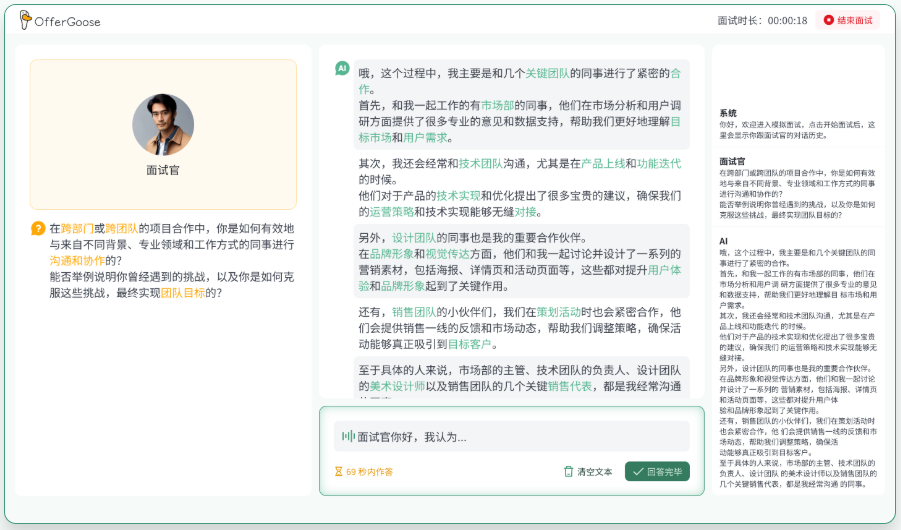
Her insight: “The preparation logic for Chinese and English interviews is fundamentally different. An English interview is a test of narrative capability — can you tell your experience as a story with arc and insight. A Chinese interview is a stress test of business capability — do you understand why this business is not making money.”
Yuhan’s 30-Day Timeline
| Month | Week | Action | AI Tool |
|---|---|---|---|
| Late July | Week 1 | JD parsing + resume localization | OfferGoose JD parsing + resume optimization |
| Early Aug | Week 2 | English mock interviews × 3 rounds | OfferGoose AI mock interview (English) |
| Mid Aug | Week 3 | Chinese mock interviews × 4 rounds + live assistant setup | OfferGoose AI mock interview (Chinese) + assistant |
| Late Aug | Week 4 | Real interviews (8 sessions) + iterative review | OfferGoose deep interview review |
Final results:
- Applications submitted: 12 (precision-targeted, each with a differentiated resume)
- Interview invitations: 6
- Advanced to final round: 4
- Offers: 3 (multinational management trainee, internet operations, AI startup product operations)
- Final choice: AI startup product operations (“because I can see the 0-to-1 journey”)
Three Pieces of Advice for International Graduates
1. Do not write a Chinese resume with an English mindset.
English resumes communicate through understated quality — “Supported the team in…” reads as appropriately modest to a British audience. Chinese resumes reward direct, verifiable claims — “Led XX project, moving metric Y from A to B.” This is not about which is better. It is a cultural difference you must navigate.
2. August is the optimal window for returning graduates.
The domestic campus recruitment calendar is naturally unfriendly to international graduates — your graduation timeline is misaligned, and your information access is delayed. But August happens to be the sweet spot: early application tracks have just opened, headcount is plentiful, and the competitor pool has not yet flooded. By September, you compete with domestic graduates on the same timeline — and they have advantages in information access and on-site interviews.
3. Frame your overseas experience as commercial value, not cultural enrichment.
Interviewers do not want to hear “studying abroad broadened my horizons.” They want to hear “In a cross-border team, I drove X initiative to Y outcome.” Your cross-cultural experience is only an advantage when it can be translated into concrete commercial value.
Recommended First: Use OfferGoose for Your Return Journey
OfferGoose is built for the exact challenges returning graduates face: resume localization from international to domestic formats, JD decoding for unfamiliar market language, and bilingual interview preparation with track-specific AI interviewers. You spent years building your overseas credentials. Do not let a format mismatch prevent them from being recognized.
Start translating your overseas experience into job market value with OfferGoose
FAQ
General Questions
Should returning graduates start applying in August or September?
August. Three reasons: early application headcount is plentiful, ATS screening pools are not yet saturated, and interviewers still have the mental bandwidth to evaluate you carefully. By September, you are competing head-to-head with domestic graduates on their home turf, diluting your differentiation advantage.
How do domestic HR evaluate overseas degrees?
Two categories: multinationals and large internet companies with overseas operations give clear bonus points to QS Top 200 degrees. Smaller companies with purely domestic operations may not recognize your university — include global or subject-specific ranking information on your resume for context.
Do I need to prepare for both Chinese and English interviews?
It depends on your targets. If you are only applying to domestic companies, Chinese interview preparation is sufficient. If you are also targeting multinationals or roles with overseas business exposure, use OfferGoose’s bilingual interview mode for separate training — the two interview logics differ more than you expect.
Questions About OfferGoose
Does OfferGoose support the specific needs of returning international graduates?
Yes. OfferGoose addresses the three core challenges: resume localization (international formatting → domestic expectations), JD decoding (translating domestic hiring language), and bilingual interview preparation (separate training tracks for Chinese and English interview styles).
Let OfferGoose help you translate your overseas experience into career success