
Can You Get Into an AI Job Without a CS Degree? Yes, If You Lead With Projects and Problem-Solving

Can You Get Into an AI Job Without a CS Degree? Yes, If You Lead With Projects and Problem-Solving

“I did not major in computer science. Can I get an AI job?” It is one of the most-asked questions online, and almost nobody answers it straight. The straightforward answer is yes, with a condition: stop grading yourself with an education narrative. AI roles are screening for whether you have used AI, delivered something real, and can explain how you solve problems clearly. This article argues a contrarian but increasingly proven point: a degree is not a hard gate. AI roles care more about evidence that you use the tools to solve problems. What you actually need to do is de-emphasize your degree, lead with cross-domain projects and learning ability, and use one review loop after another to sharpen your interview performance.
Recommended First: Use OfferGoose to See Where Your Resume Actually Stands
Before you deliberate about your background, take one concrete first step: drop the JD of a role you want into OfferGoose and get a match score against your current resume. This tells you, immediately and without bias, whether the gap is a weak project, thin technical wording, or a missed capability, instead of making you wonder if the problem is your degree. Once you can see the actual gap, the advice in this article becomes a step-by-step path rather than an abstract argument.
The Contrarian View: A Degree Is Not a Hard Gate for AI Roles
The dominant story keeps implying that AI roles belong to computer science masters from top universities. That impression grew out of the early research-track era. Today the AI job map has split into algorithms, product, application, operations, and pre-sales, and each of these leans on a different degree of formal education. Asking “can a non-CS person get into AI” as if it were one unified question is itself a false premise.
Dismantling Three Common Misconceptions
Misconception one: every AI role requires you to write models. In reality a large share of AI application, product, and operations roles care more about whether you can connect technology to business value. Misconception two: interviewers only look at the degree label. In a limited window, most interviewers actually want to know whether you can deliver, and they judge that from your projects and your answers. Misconception three: without a full course of study you can never catch up. Non-CS people frequently learn the “usable twenty percent” along a much shorter path, which matches the real needs of a great many engineering-heavy roles.
Evidence Over Labels Is the Underlying Logic
Instead of obsessing over the label, look at how AI hiring actually filters. At the resume stage, an applicant tracking system mechanically scans for keywords and structured information. What it cares about is whether your resume carries the role’s vocabulary and quantified outcomes, not which university you attended. At the interview stage, the interviewer judges your problem-solving ability and how you think, which is exactly what a non-CS background can improve quickly through deliberate practice.
Why a Non-CS Background Can Be an Underrated Advantage
A non-CS background is not pure disadvantage. A great deal of AI work lands inside specific industries, and that rewards a multi-disciplinary view that a single technical background often lacks.
Cross-Domain Perspective Is a Scarce Asset
AI products end up embedded in healthcare, manufacturing, retail, and education. A candidate who only knows algorithms is not necessarily better positioned than one who understands a business, decomposes problems well, and is willing to learn model tooling. Interviewers increasingly recognize this, which is why “how would your past industry experience make an AI solution fit the real scenario better” has become a high-frequency, high-value question.
Learning Ability Is the Hardest Asset to Fake
Non-CS people tend to develop a survival-style learning habit: instead of finishing a whole course, they dig into a specific problem, try things, and adjust. That goal-oriented learning matches the daily reality of AI work, where you are always applying something new on the spot. In an interview, using a clear situation-task-action-result structure to describe one instance of “learning something new from scratch and making it work” tends to be far more convincing than listing course titles.
De-Emphasize the Degree: Give the Space to Projects and Numbers
A modest background on a resume is not the problem. The problem is letting it take up so much room that your projects have nowhere to go. Keep the education line to a single row and give most of the page to projects, outcomes, and quantified results. The goal is not concealment; it is steering the interviewer’s limited attention from where you graduated toward what you have solved.
Build Your Evidence With Projects and Problem-Solving
Talk is cheap, so a non-CS comeback has to be fought with verifiable projects. A project’s value does not depend on whether it comes from a big company. It depends on whether you can explain the problem it solved and the impact it had.
What Counts as a Good Project
A strong project has three parts: a clear business problem, a concrete technical approach, and a measurable result. You might have no formal AI internship, but you can build a small tool that uses language models to summarize meeting notes, and track that it cut the time from forty minutes to eight while improving the accuracy score. Even a few thousand lines of code becomes a complete evidence chain.
Use Matching and Scoring to Point the Project in the Right Direction
Do not pick a project by guessing. Drop the JD of the role you want into a matching tool and see which capability points it repeats, then choose a project that fills the biggest one. Once the resume is drafted, run it through a scoring pass and check whether the project section scores well on quantifiability, action verbs, and relevance, then fix the lowest-scoring spot first.
From a Review Loop to a Real Comeback: An AI Assistant Story
Let us set aside the theory and tell one real story. A candidate with an economics background wanted an AI assistant role at a company. In the matching tool, his resume’s project-to-role relevance scored low, because the “e-commerce operations data analysis” project was not written in technical language. After strengthening the project and compressing the education line to one row, the resume cleared screening. But the first interview round exposed a new problem: when pressed on “how confident are you that this analysis conclusion is reliable,” he answered in a jumble, with obvious logical jumps.
A Weak Version Versus a Strong Version
Before (from the first interview):
I did an e-commerce data analysis project. I looked at user behavior, found some patterns, and wrote down conclusions.
After (rebuilt after review):
I ran an analysis project on e-commerce user behavior. The question was how to identify high-churn segments. My approach was to clean the data first, then use feature comparison to lock onto three high-churn user groups, then use a split to check that the conclusion was stable, and finally translate it into one operational action. The result was that monthly actives for that segment rose by about nine percent the following month.
Why this version works: it walks the full problem-method-validation-result chain, and it actively mentions the step of checking whether the conclusion is stable. The interviewer’s follow-up was testing whether you form the habit of questioning your own conclusions, which matters a great deal in data and AI work because it directly affects whether you check for edge cases and risk before shipping a model.
The Review Loop: Turn Each Interview Into a Springboard
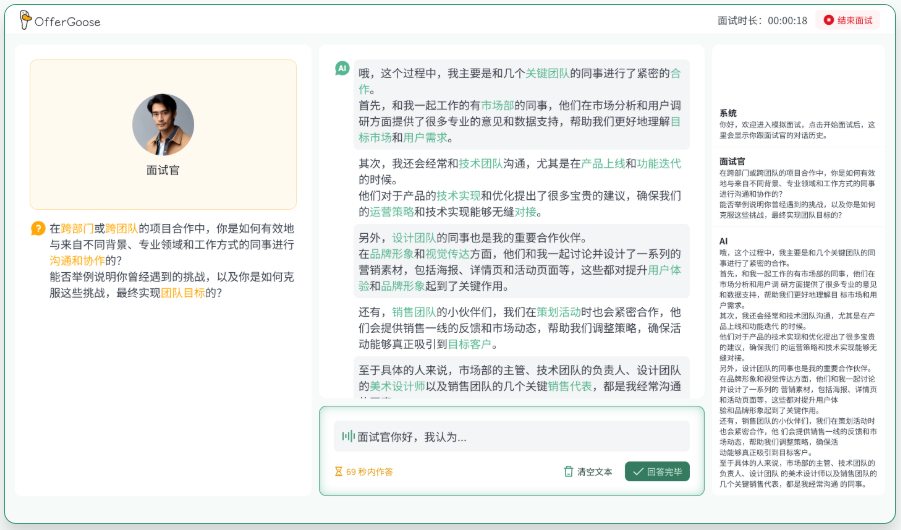
This candidate made the comeback not through talent but through one review loop after another. After every mock or real interview, he used OfferGoose’s deep interview review to flag the questions he answered weakly, the places where the logic jumped, and the dead ends the interviewer led him into, then went into the next round with targeted fixes. He also used the talking-points feature to prepare structured answer anchors for the questions that kept tripping him, so he would not have to organize his words on the spot.
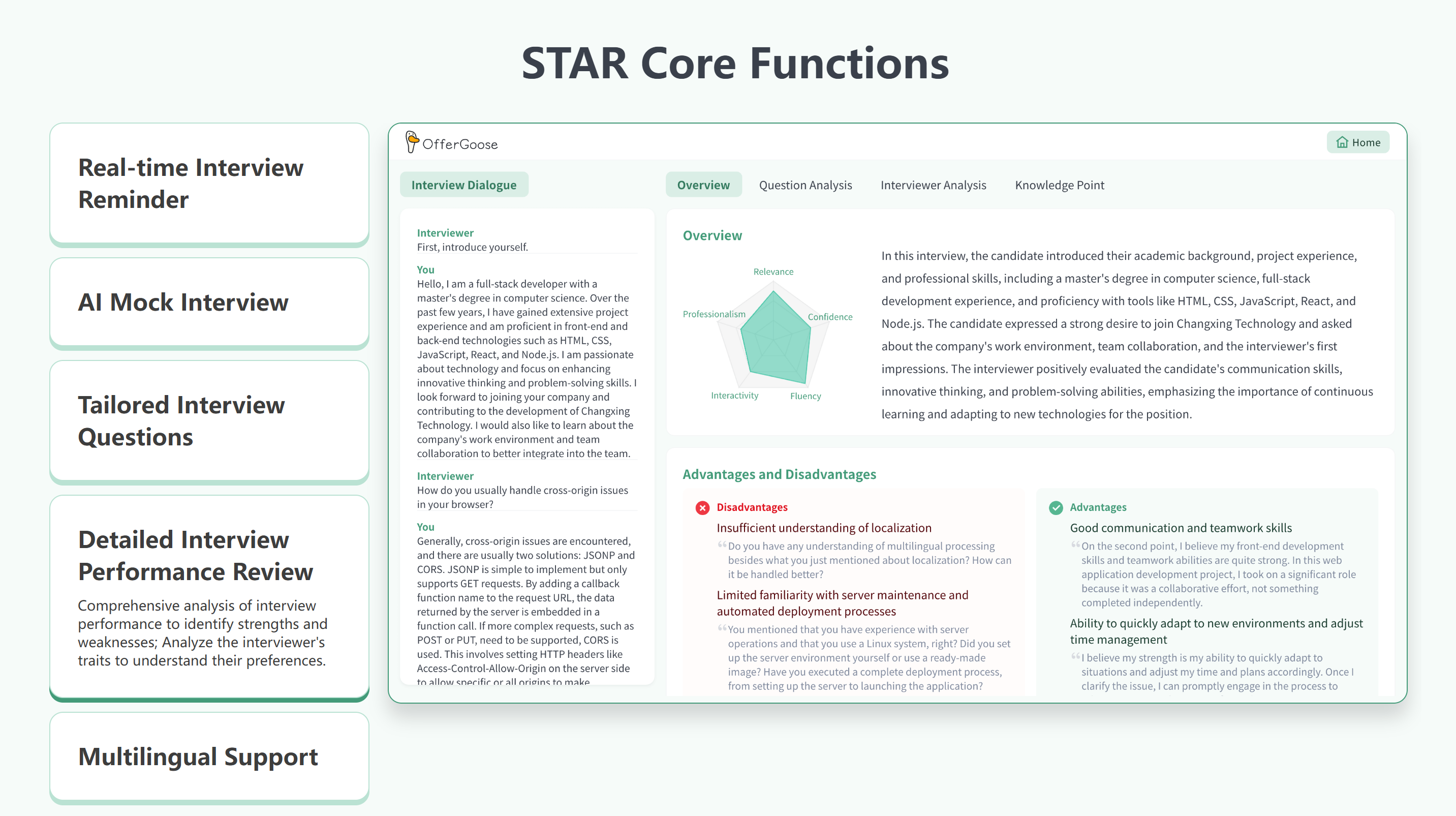
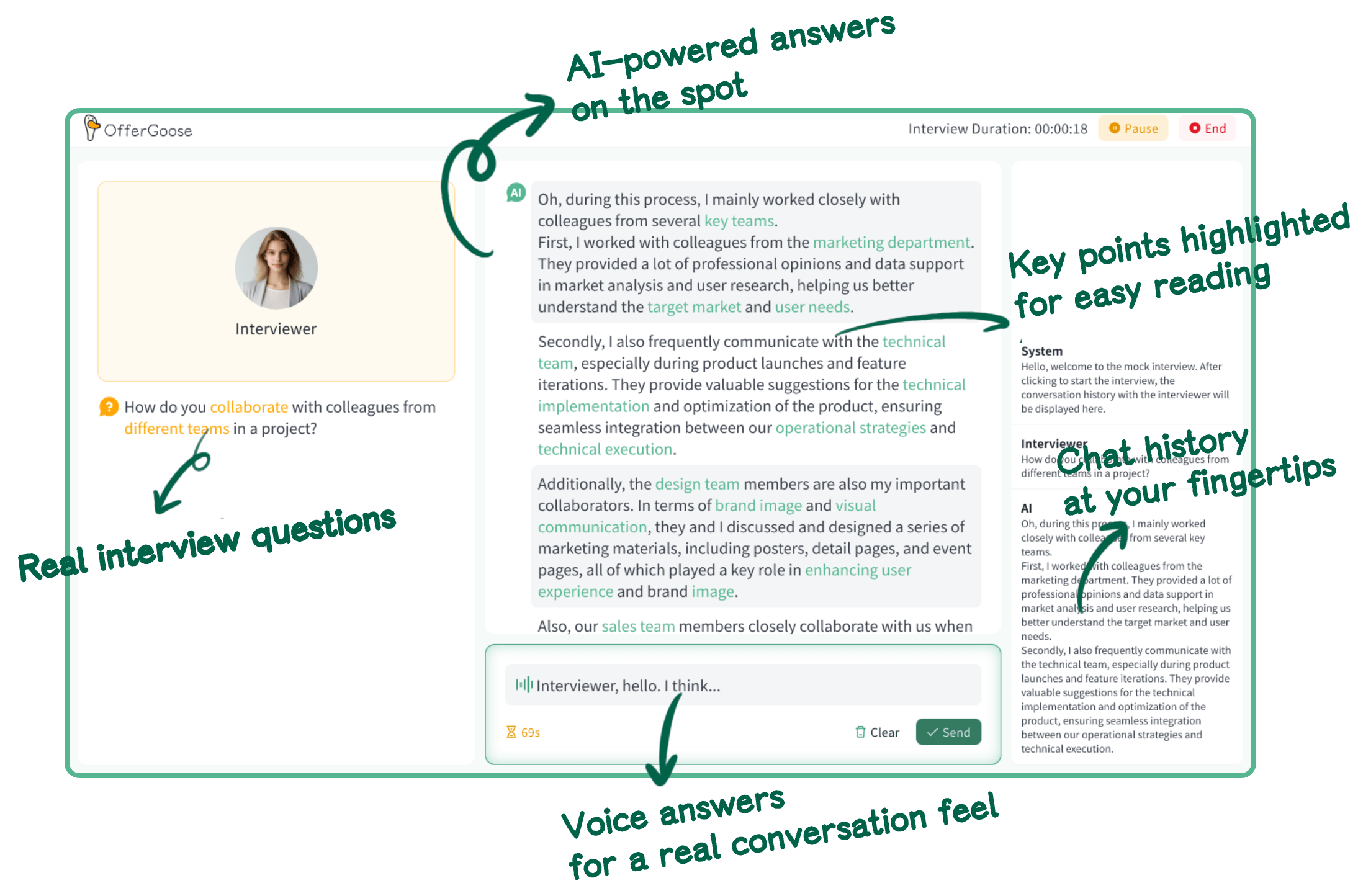
After three cycles of mock interviews and review, his second real interview was a different story: the self-introduction no longer sounded scripted, and the freeze on follow-ups dropped noticeably. He landed and accepted the AI assistant role. His degree never changed. What changed was his project evidence, his answer structure, and his review habit, and none of those three requires any diploma.
Before:
A candidate from a non-CS background described a project in vague terms with no numbers, so interviewers could not tell what they had actually done or owned.
After:
In a campus project the candidate processed 12,000 rows of data, found three data-quality issues, and cut reporting time from five hours to one, then rehearsed the evidence chain in mock interviews so they could explain it under pressure.
Why this version works: the after version foregrounds concrete numbers and a real project, names the candidate’s ownership, and shows the follow-up readiness that a non-CS background needs to overcome.
FAQ
General Questions
Will an ATS automatically filter out non-CS resumes?
Not necessarily. An applicant tracking system primarily matches keywords and structured information, not school background. As long as your resume carries the target role’s high-frequency vocabulary, a project structure, and quantified outcomes, it can reach human review. The degree field only tilts the decision when two candidates are otherwise hard to separate.
I have no matching project. Where should I start?
Start with the smallest combination of “a business you understand” and “one AI tool.” Pick a problem inside the industry you know best and solve it with a language-model application, a data analysis, or an automation script, then record a measurable result. Direction matters more than scale; one small project rooted in a real scenario beats ten oversized template projects.
How should I answer “you are not from a CS background, why should we hire you”?
Do not argue. Answer with evidence. Walk through one instance where you used goal-oriented learning to solve a real problem: what needed to happen, how you learned on the job, and what the result was. The move is to pull the conversation from your origins toward the results you can deliver.
Questions About OfferGoose
What exactly does deep interview review check?
It reviews three things: which question types keep tripping you, where a single answer logic-jumps, and which wording loses you small points. After each session it records those and tells you what to fix for the next round. The value is turning “vague lack of fluency” into specific, locatable, fixable problems.
Can OfferGoose make me get an AI job without a degree?
No tool can make that promise. OfferGoose accelerates the mechanical parts of preparation and surfaces weaknesses early, but the projects, the reasoning, and the decisions remain yours. It is a strong companion for a structured plan, not a replacement for doing the work.
Wrapping Up
Back to the opening question: can a non-CS person get into an AI job? The answer is yes, but the route is not acquiring another degree. It is built on three things: building evidence through verifiable projects, de-emphasizing your degree to steer attention toward problem-solving, and polishing interview performance through one review loop after another. A degree is a starting point, not an endpoint. Teams that actually build models are increasingly willing to hire candidates who can deliver and make things work.
If you are also a non-CS candidate, consider checking out OfferGoose and walking the full evidence chain, from resume matching and scoring through mock interviews and deep review, before you decide whether to make it part of your preparation. Try it first, then decide. Learn more at https://offergoose.com/lp/blog.