
How to Ace a Programmer Technical Interview: System Design and Algorithm Communication

How to Ace a Programmer Technical Interview: System Design and Algorithm Communication

Many software engineers know the feeling: you nail the practice problems, your code runs, and yet the moment you are in the interview you freeze. Your answers become tangled, a follow-up question throws you, or you solve the problem but fail to explain it clearly enough to earn the points. Technical interviews are harsh precisely because they do not just test “can you do it” — they test “can you explain what you know in a structured way under pressure.” This article breaks down a repeatable method across algorithms, system design, and live delivery.
Recommended First: Use OfferGoose to Translate Cross-Domain Experience for Each Role
Your non-AI background is an asset only if interviewers can read it. Use OfferGoose’s resume matching and multilingual interview prep to reframe a past project into the target role’s terms, then rehearse how you tell the cross-domain story so it lands as a strength rather than a gap.
What technical interviews really test: from “solving” to “communicating”
It is easy to assume that enough practice sets guarantee a pass. But an interviewer’s evaluation is far broader than “is the code correct.” Understanding that evaluation logic is the precondition for scoring high.
Interviewers evaluate your thinking process, not just the answer
Most technical rounds are a structured interview with a fixed set of dimensions: problem decomposition, trade-offs, complexity awareness, edge-case handling, and communication. What the interviewer wants to see is “how you arrived at the answer,” not just “what you answered.” This is exactly why many people who “can solve problems” still fail to score well.
Doing and explaining are two different skills
Chain-of-Thought has become a widely discussed idea — it emphasizes making your reasoning explicit. The same applies to interviews: walking through “why I chose this approach,” “which options I ruled out,” and “under what assumptions this holds” immediately separates you from answer-memorizing candidates. Clear expression is itself a technical skill.
Figure out what the problem is really asking
Do not start writing code the second you see a problem. First confirm the boundaries: how large is the input? Is the data sorted? What are the consistency, latency, and cost requirements? These upfront questions are not just soft skills — they are technical judgment. Clarifying requirements proactively usually earns you more credit than diving straight into a solution.
Algorithms: framework thinking and complexity awareness
Algorithm problems are the foundation of a technical round, but they test more than whether you pass all test cases. They test whether you can reliably produce a readable, explainable solution within the time limit.
Think in a “brute force → optimize → edge case” rhythm
For any algorithm problem, first offer a working brute-force solution as a safe baseline, then discuss how to optimize, then cover edge cases (empty input, single element, overflow, duplicates). This way, even if you do not finish the optimization, the interviewer sees a complete thought path. Many candidates fail by skipping the baseline and charging straight at the optimal solution — getting stuck and collapsing entirely.
Complexity is the native language of a technical round
Big-O time complexity is the language every interviewer expects you to speak. With every solution, state the time and space complexity and explain why it is O(n), O(n log n), or O(log n). Being able to state complexity fluently and justify it is the dividing line between “can write code” and “understands algorithms.”
Turn common patterns into muscle memory
Binary search, sliding window, two pointers, monotonic stack, Top-K, prefix sums — these high-frequency patterns are worth internalizing in advance rather than deriving live. When patterns become reflex, you free up cognitive resources for the parts that actually need original thinking. OfferGoose’s programmer-focused module includes explanations of such concepts, helping you build muscle memory before the interview.
System design: structured problem-solving instead of memorized answers
If algorithm problems test fundamentals, system design tests architectural thinking and big-picture judgment. There is no single correct answer, but there is a recognized solving framework.
Sketch the framework first, then fill in details
The high-scoring approach to a system design problem is to structure it up front: requirement clarification, capacity estimation, high-level design, data model, core interfaces, and extension plan. Just as you build a document’s skeleton before the flesh, a clear framework keeps you from drifting over forty minutes.
Talk trade-offs, not just tech buzzwords
Interviewers dislike “buzzword dumps.” Rather than rattling off load balancing, caching, and message queues at once, explain the trade-off against a specific bottleneck: why load balancing here, how to estimate cache hit rate, whether the caching strategy uses side-car or write-through. Talking trade-offs equals talking understanding — this is what separates top scores in system design.
Use architectural evolution to show judgment
A strong system design answer often follows an evolution rather than a one-shot design: from “works” to “handles load” to “scales.” Moving from a single machine to microservices should come with clear justification and a cost analysis. Showing when you would not use microservices is a stronger sign of seniority than adopting them blindly.
Live delivery: real-time expression and the boundary of a “second brain”
No matter how well you prepare, there will be moments of tension, blanking, or forgotten terminology. This section covers how to keep your rhythm in the moment and how to understand the boundary of real-time assistant tools.
Turn “I forgot” into “let me clarify”
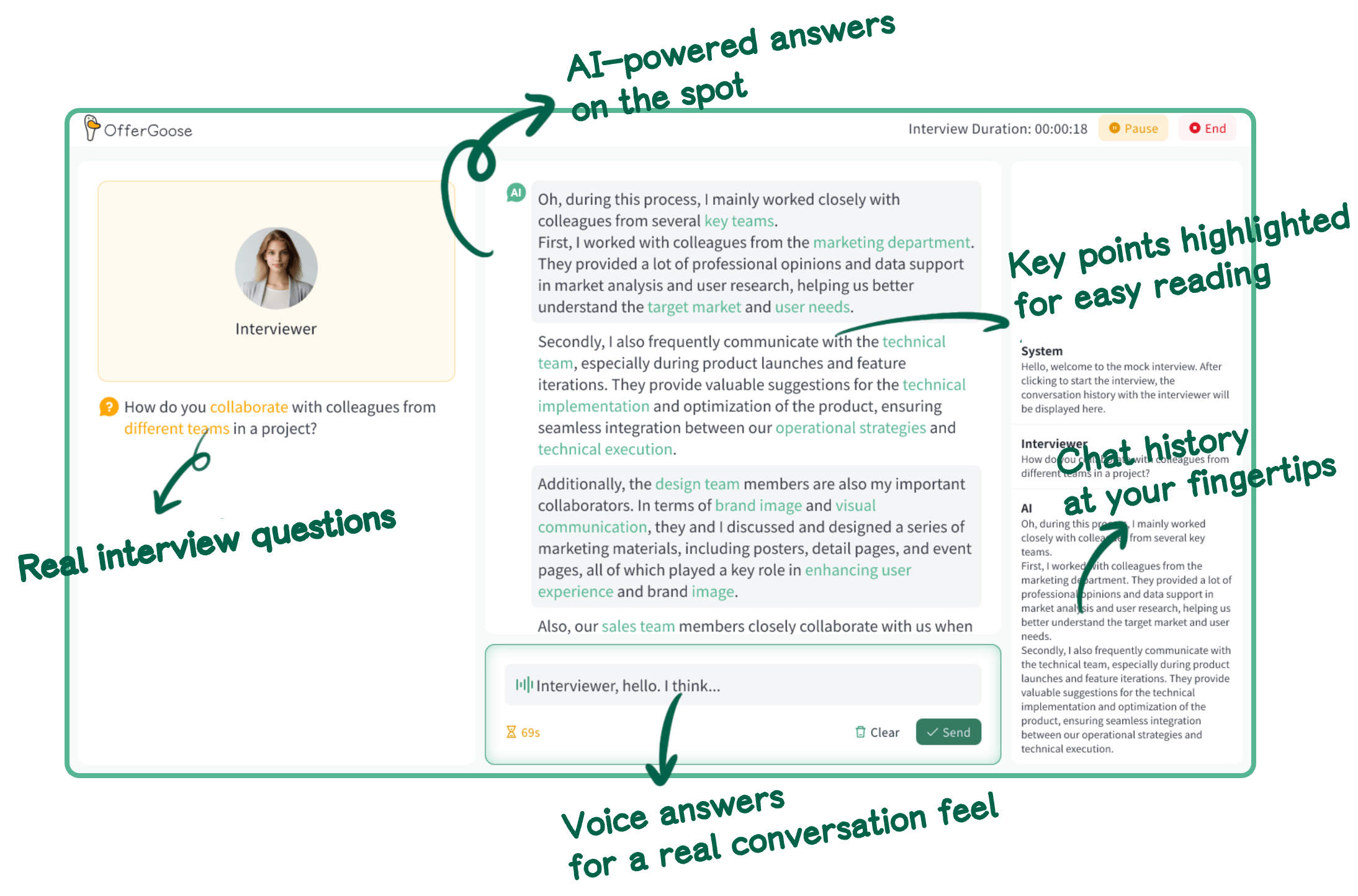
When you blank, do not go silent or improvise a fake answer. Restate the problem, say “let me confirm the constraints first,” or talk through your assumptions out loud. This buys you thinking time and shows you can stay logical under pressure — itself a credit. ASR (Automatic Speech Recognition) that transcribes the conversation in real time acts as an extra safety net for your delivery, not a replacement for your answer.
Real-time assistant tools are for “anti-blank,” not “answering for you”
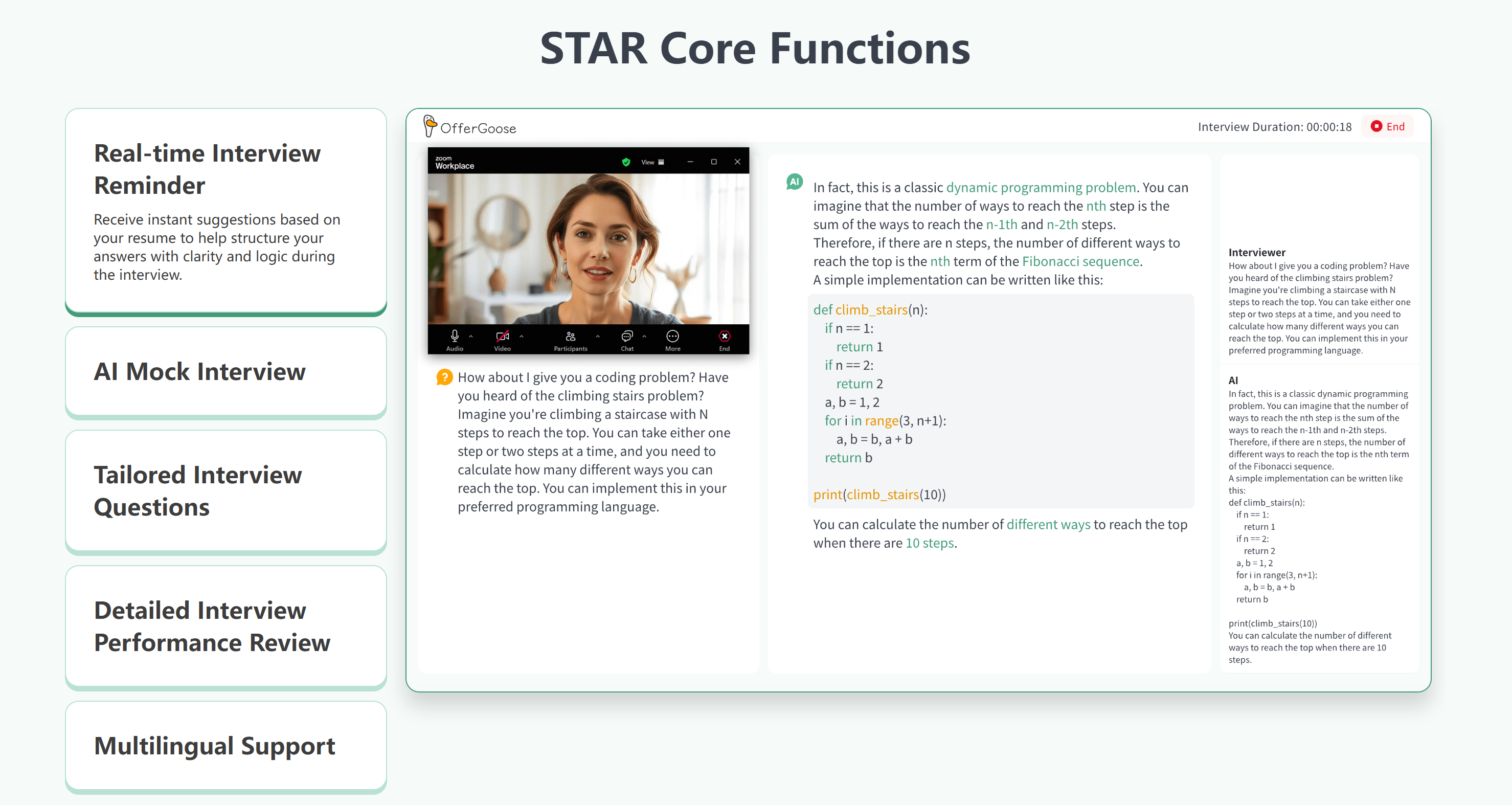
Online interviews are increasingly common, and real-time assistant tools have appeared alongside them. The right mindset is to treat them as an in-the-moment logic navigator: when you blank, they help you recall the structure you prepared, a STAR frame, or a key concept — not read out a full answer. Prompt engineering thinking applies here too: the clearer the signal you give the tool, the more useful its reminder. OfferGoose’s interview prompting feature is designed along exactly this line — understanding the live question and prompting your answer framework — so you can deliver what you prepared consistently.
Full-process preparation beats relying on luck in the moment
High technical interview scores come from stable performance, and stability comes from systematic preparation: every technical point in your resume should be expandable, algorithm patterns should be reflex, and the system design framework should be walked through beforehand. When you front-load the preparation, the risk you carry into the room shrinks.
The hidden scores beyond the tech: communication and review
Often two candidates have comparable technical skill, and the one hired is the one who communicates more naturally and reviews faster. The “soft points” in a technical round are frequently underestimated.
Treat every mock like a real live session
Interview communication is a skill you can deliberately train. Instead of reciting answers to a mirror, enter an environment with follow-up questions and evaluation. An AI mock interview can generate and probe questions at the industry, role, and style you set, letting you train your live state in a low-risk setting and dissolve the tension in advance.
Use review to turn “can but unstable” into “stable and can”
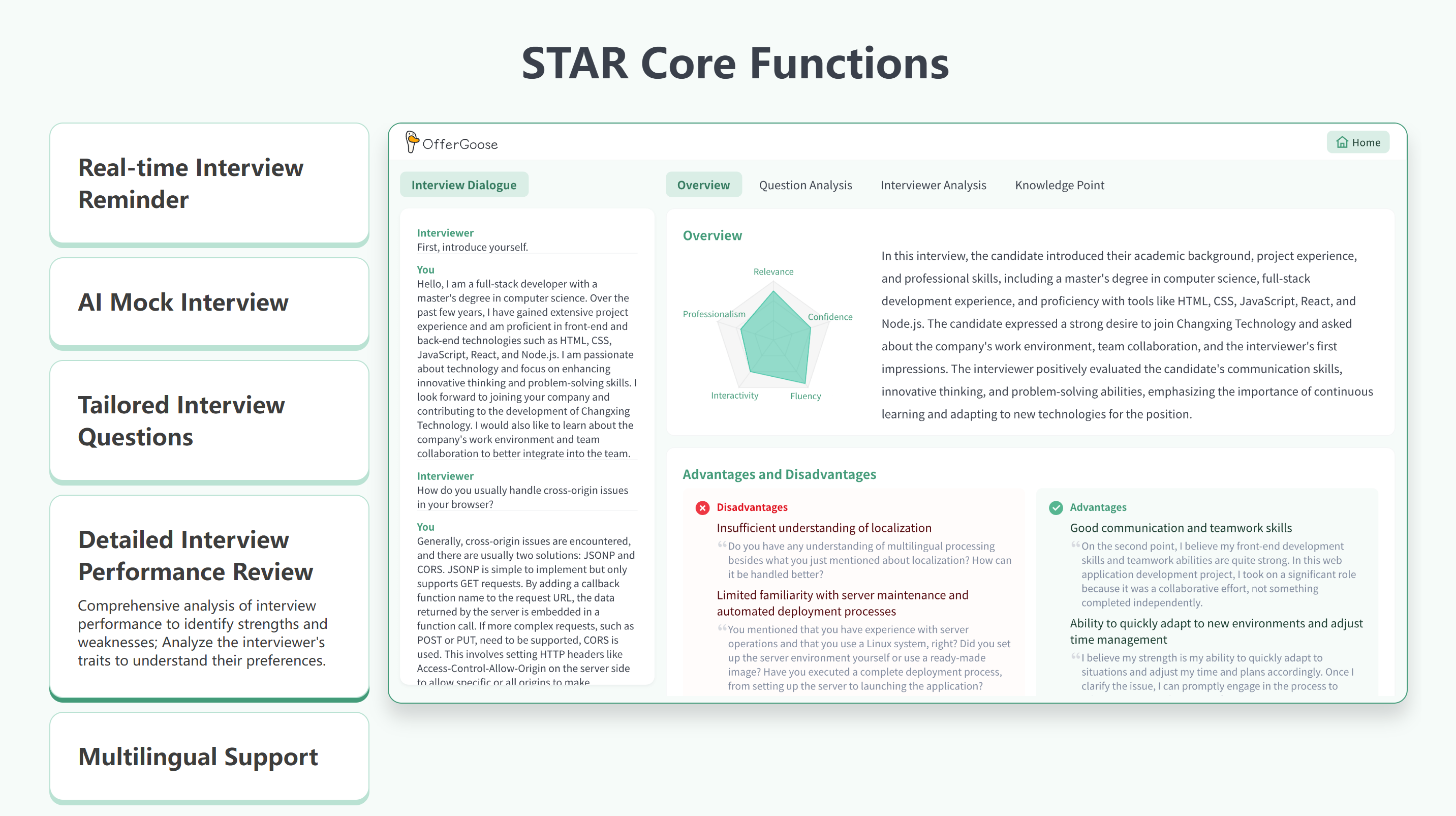
After an interview, most people just exhale; very few actually review. The value of a review is turning “this round’s gap” into “the next round’s starting point.” You can score your own performance across logic, expression, and professionalism, then pick the one or two issues that cost you the most points and fix them. OfferGoose’s deep interview review is built along this logic: decompose the interview into actionable improvements so each attempt is steadier than the last.
Treat the technical round as “proving you are already capable”
Finally, a technical interview is not an exam to see how painfully you can justify yourself — it is a process of proving “you are already at this level; you just need to show it steadily.” When your mindset shifts from “afraid of being wrong” to “let me explain clearly,” the energy of your delivery changes completely. Strong preparation + staying steady live + reviewing afterward form the full loop for a high technical interview score.
So a high score in a programmer technical interview is never about grinding problems alone. You need Chain-of-Thought reasoning to explain your process, complexity awareness to prove you understand algorithms, structured frameworks to handle system design, and live delivery plus review to make steady performance the norm. If you want the process to be less effortful, learn how OfferGoose helps programer candidates prepare for the technical round, or start with a free trial and experience it before you decide. Upgrade from “can do” to “can explain,” and your scores will visibly rise.
Before:
An operations candidate said “I did data-related work in my old company” in one line, and no interviewer could see the cross-domain value or any measurable outcome.
After:
After reframing the story, the candidate explained how they migrated a retail customer-segmentation method into data-need analysis, cut requirement-clarification time by around 30%, and rehearsed the migration as a STAR story in live-practice sessions.
Why this version works: it shows a specific cross-domain transfer, a concrete method, and a number, and it proves the candidate can convert experience across fields into evidence an AI team can evaluate.
FAQ
General Questions
I have no idea where to start on a system design problem. What do I do?
Do not answer directly. Walk a structured framework first: requirement clarification (scale, consistency, read/write ratio) → capacity estimation → high-level design → data model → core interfaces → extension plan. Even walking through only half the framework reads better than silently writing code.
Should I skip an algorithm problem if I get stuck?
Do not skip hastily. Provide a brute-force solution as a safe baseline, then discuss optimization so the interviewer sees your full thought path. If you are truly stuck, state where you are stuck and the approaches you tried — this often earns process points and reads better than silence.
Is using a real-time prompting tool during an interview cheating?
It depends on the boundary. Treating it as an “anti-blank safety net” — recalling prepared structure, a STAR frame, or key concepts when you blank — is a reasonable prep aid. Reading a full answer or replacing your own thinking carries compliance and ethics risk. Follow the company’s recruiting rules and use tools for “assisting delivery,” not “answering for you.”
Questions About OfferGoose
How do I know when my technical prep is enough?
Check three things: can you start high-frequency algorithm patterns quickly, can you expand on every resume technical point for three minutes, and can you open a system design problem with a framework within five seconds? If the three gates pass, you are basically ready. Then use mock interviews and review to verify live state — more efficient than blindly grinding.
I am bad at technical communication. Is there a shortcut?
No shortcut, but there is an efficient path: deliberate practice plus immediate feedback. Treat every mock like a real session, let AI probe with a realistic style, then use review to isolate one improvement across logic, expression, and professionalism. Repeat a few cycles and your delivery stability will visibly improve.
Summary
High technical interview scores come from stable performance, and stability comes from systematic preparation: explain your reasoning with Chain-of-Thought, prove your foundation with complexity awareness, handle system design with structured frameworks, and guard your floor with live delivery and review. Explore how OfferGoose supports technical candidates, or try a free trial to validate the method before committing. The shift from “can do” to “can explain” is how you win the round.