
Freeze Up in Interviews? How to Use AI Mock Interviews and Deep Review the Right Way

Freeze Up in Interviews? How to Use AI Mock Interviews and Deep Review the Right Way

You have probably read countless interview guides, memorized answer templates, and still the moment the real interview starts, your mind goes blank, your words speed out of control, and a single follow-up question throws you off. The problem is never “you do not know enough” — it is that you are missing a realistic practice ground and a feedback mechanism that takes each setback apart. An interview is essentially a performance of “stable output under pressure,” and stable output can be trained deliberately. This article gives you a practical method across mock interviews, deep review, behavioral questions, and live delivery.
Recommended First: Use OfferGoose to Structure a Problem-Solving Story Before It Matters
Get the framing right before the real conversation: use OfferGoose’s live interview support and mock interviews to structure how you open with the problem, name your key decisions, and close with a measurable result. What changed is that the story stops being a timeline and becomes evidence you can defend under follow-up.
Why memorizing answers still fails to get you through
Many candidates equate preparation with memorizing answers, but an interview’s evaluation logic makes memorization the least efficient path. Understanding this is the key to finding the real breakthrough.
Interviews test stable output, not recitation
Interviewers want to assess how you react under genuine pressure, not how well you recite a script. The moment a follow-up question goes beyond your script, a memorizing candidate falls apart. Solid preparation means your understanding of your experience and the role “lives in your head,” not “sits on paper.”
Anxiety amplifies cognitive load
Nervousness during an interview consumes a large share of your working memory. In psychology this is called cognitive load. When your cognitive resources are spent on “I am panicking,” fewer remain for organizing your words — hence the incoherence. The fix is not telling yourself “do not be nervous”; it is practicing enough that expression becomes low-load reflex.
Practice without feedback just repeats mistakes
Practicing against a mirror or reciting scripts has one big flaw: no feedback. You cannot tell where you ramble, where logic breaks, or where you sound unnatural. Practice without feedback essentially makes the same mistake more fluent. This is exactly why the “mock + review” combination beats rote memorization.
Use AI mock interviews to recreate the real session
To train stable output, you need a realistic low-risk practice ground. AI mock interviews are built for this — they generate questions for your industry, role, and interviewer style, and probe your answers in real time.
Build a scene that feels like the real thing
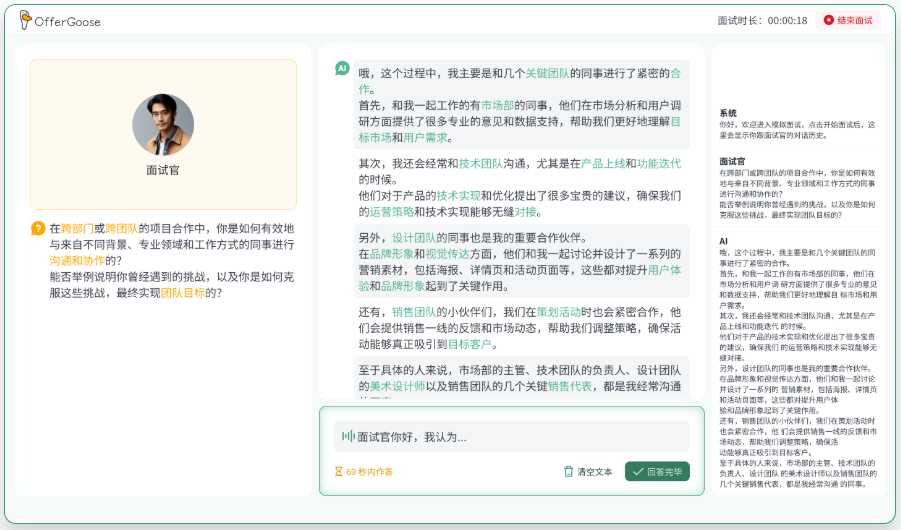
The value of a mock interview is recreating pressure: time limits, follow-ups, interruptions, and different interviewer styles. OfferGoose’s AI mock interview lets you configure duration, interviewer style, and question preferences so you “walk the real process” before the actual interview and dissolve the tension in advance.
Use follow-ups to train your pressure response
Most freezing happens on follow-up questions. An AI mock interview continues from your answer like a real interviewer, forcing you to organize language live. After several rounds of “follow-up → steady → explain clearly,” your reaction to unknown questions becomes visibly stronger.
The point of mocks is to expose problems, not to be perfect
Poor performance in the first mock is normal — its purpose is to reveal problems. Treat each mock like a health check and note where you break down most: the opening, the numbers, or the follow-ups. When you know where the problem is, you know what to practice.
Deep review is the action that truly separates the best candidates in interviews
If mocks “find problems,” then review “solves them.” Many people separate the two — they mock but never review, so progress stalls.
Review “stability,” not just “correctness”
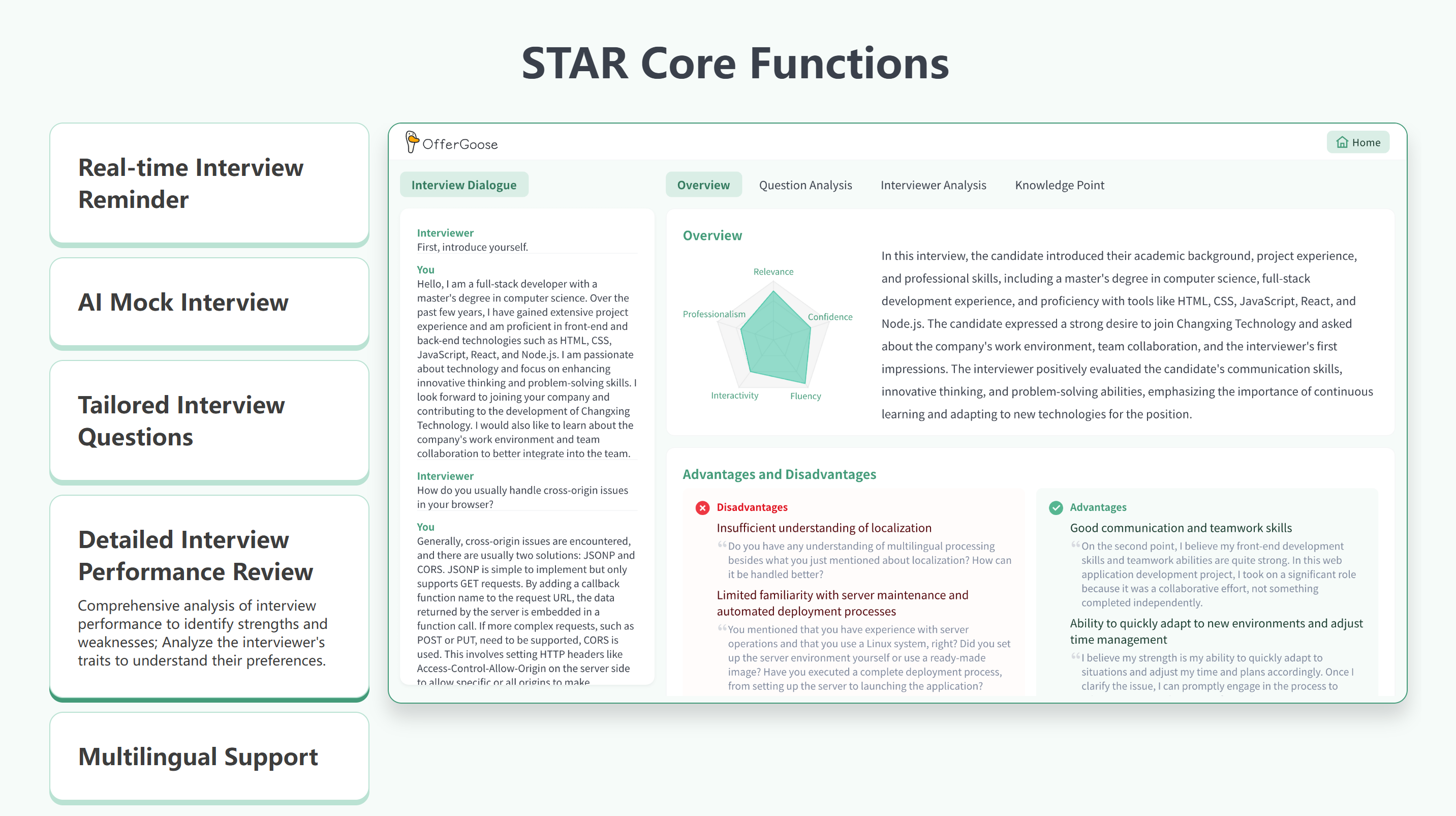
Good review does not only ask “did I answer right.” It assesses your performance across multiple dimensions: logic, relevance, professionalism, expression, and engagement. When you dimensionalize your performance, you can locate a specific weakness instead of vaguely thinking “I did badly.”
Fix one critical weakness at a time
After one interview, do not try to fix ten problems at once. Pick the one or two weaknesses that cost you the most points and improve them in the next mock, forming a small loop of “find problem → targeted practice → verify improvement.” Compared with aimless grinding, this closed loop converges much faster.
Let AI help break down your performance
When it is hard to evaluate yourself objectively, use AI to give structured feedback across logic, expression, and professionalism. OfferGoose’s deep interview review is built around this logic: it acts like a patient coach, decomposing an interview into clear, actionable improvements so each attempt is steadier than the last.
Behavioral interviews: organizing life experience into STAR stories
No matter how technical the role, a behavioral interview is almost unavoidable. The high-scoring approach is to organize experience into complete STAR stories rather than listing facts.
STAR is evidence structure, not just a template
The STAR method (Situation-Task-Action-Result) is a structure that turns personal experience into verifiable evidence: situation, task, action, result. It works because the interviewer can see “under what context, facing what problem, doing what, with what result” — far more credible than a claim of “I have teamwork skills.”
Upgrade your story with business impact
Basic STAR works, but to go further, add a layer of business impact after the result, explaining how your actions affected revenue, cost, efficiency, or users. In competitive interviews, an upgraded story leaves the impression that “this person sees the big picture.”
Keep an archive of high-performance moments
The biggest pain in behavioral interviews is “I cannot recall an example on the spot.” Keep a “high-performance archive” in advance: record those moments when you solved a hard problem, delivered a result, or earned recognition, written in STAR. Before the interview, pick the three to five most relevant to the target role and polish the details. OfferGoose is good at using follow-up questions to turn scattered memories into complete STAR stories, so this archive pays off when it counts.
The hidden signals of live delivery: pace, presence, and emotion
Beyond content, many “invisible points” in an interview come from your non-verbal signals. They often shape the interviewer’s overall impression.
Pace and pauses are “visible confidence”
Nervous people speed up uncontrollably or recite without pausing. Candidates judged “confident” usually speak at a steady pace with natural pauses at key points. In practice, deliberately pause half a second before a key sentence — it gives your delivery breathing room and reads far more convincing than a rushed monologue.
Eye contact and body language signal reliability
During an online interview, eye contact is especially easy to neglect — staring at the screen edge or down at notes reads as uncertain. Practice focusing on the camera or the key person, with a relaxed but upright posture. Non-verbal communication matters as much as what you say, and in moments of tension it reveals your true state even more clearly.
You can rehearse emotional management in advance
Pre-interview nerves are hard to fully eliminate, but you can rehearse “entering the state”: breathe deeply, repeat a self-affirmation, and shift attention from “fear of failing” to “explain clearly.” Affective computing is the type of technology that helps analyze and recognize emotional signals — used in training, it can alert you to the moments when you “think you look calm but actually look flustered,” helping you find the trigger points and handle them before the real session.
Before:
I memorized twenty common questions the night before. In the real interview I spoke faster and faster, trailed off at one point, and when the interviewer drilled into my project metrics I could not explain the number I had written. I walked out knowing I had the skills but had shown none of them.
After:
I ran three AI mock interviews at my target role’s style, recorded where I broke down, and did one focused pass on explaining my project metrics in STAR. In the real interview I paused before key points, walked into a drilling question with a clear structure, and landed the offer.
Why the improved version works: it replaced “reciting answers” with “training stable output.” The mocks surfaced the exact failure points, the review gave concrete fixes, and the STAR structure let the candidate explain metrics credibly instead of freezing.
So interview freezing is not a “capability problem” — it is a “missing practice ground and feedback mechanism.” Use AI mock interviews to recreate the real session, use deep review to locate and close weaknesses, use STAR to organize experience into evidence, and use live-delivery training to protect the hidden points. These four steps form a reusable training loop. If you want to put this loop into practice with less effort, learn how OfferGoose helps you get steadier with mock interviews, live assistance, and deep review, or start with a free trial to experience one round before you decide. Upgrade from “memorizing answers” to “stable output,” and your next interview will feel noticeably calmer.
FAQ
General Questions
Are AI mock interviews as good as practicing with a real person?
They are not mutually exclusive. The strength of a real person is “realism” and human reactions, but scheduling and cost are high. An AI mock interview is always available, configurable, unlimited in follow-ups, and cheap at high frequency. The ideal combination: use AI mocks for frequent baseline training, then do one real-person “final dress rehearsal” before the actual interview.
How do I review an interview effectively?
Do not only review “right or wrong”; review “stability.” Score yourself across logic, relevance, professionalism, expression, and engagement, then find the one or two weaknesses that cost the most points. Do targeted practice on that weakness and verify improvement next time, forming a small loop. Fixing one weakness at a time is far more efficient than vague self-blame.
I can never recall behavioral examples. What should I do?
Keep a “high-performance archive” as you go. Every time you solve a hard problem, deliver a result, or earn recognition, write it down in STAR (situation, task, action, result). Before an interview, pick the three to five examples most relevant to the role and polish them — far more reliable than thinking on the spot.
My speaking pace runs away during interviews. What helps?
This is a standard sign of nervousness. In practice, deliberately pause half a second before a key sentence to give your delivery breathing room, and watch your pace during review. Once pausing becomes a habit, you will stop rushing to dump your words and your delivery will calm down.
Questions About OfferGoose
Will OfferGoose’s live assistance distract me during a real interview?
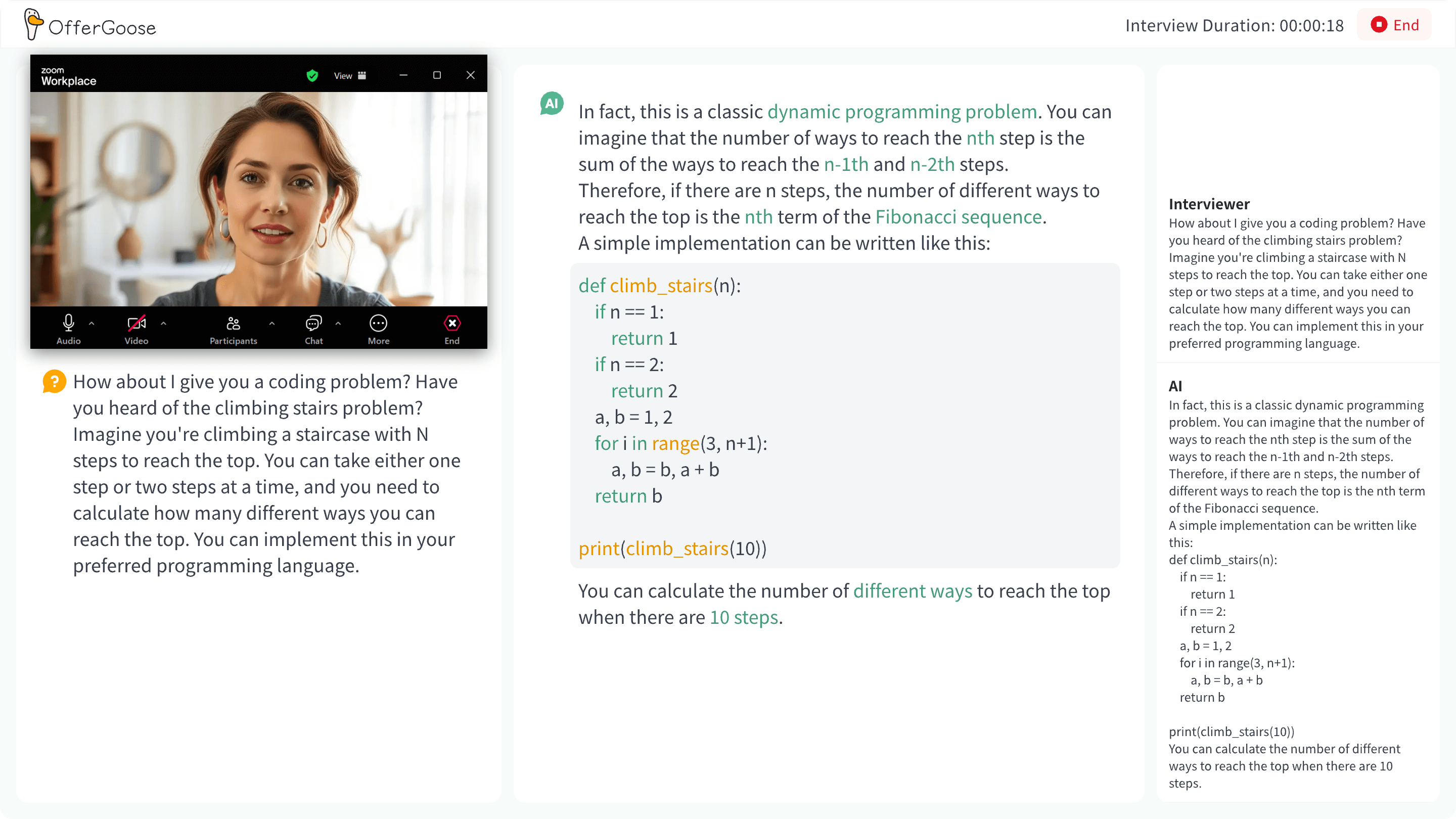
Its role is a “low-distraction second brain” — when you blank, it quietly reminds you of a prepared structure, STAR frame, or key concept, rather than reading answers beside you. Whether to use it live is up to the company’s recruiting rules. Many users rely on it mainly in the mock phase, rehearsing until they are confident enough to need it barely at all in the real meeting.
Summary
Behind interview freezing is not a knowledge gap but a missing practice ground and feedback mechanism. Use mocks to expose problems, review to close weaknesses, STAR to organize evidence, and live-delivery training to protect the hidden points — four steps form a reusable loop. Explore how OfferGoose helps bring this loop to life, or try a free trial to experience one round before deciding. Move from “memorizing answers” to “stable output,” and your interview state will visibly improve.