
Career Change Resume and Interview Guide: Translating Old Experience Into New-Role Value
Career Change Resume and Interview Guide: Translating Old Experience Into New-Role Value

“I want to switch careers, but I have no relevant experience — how can I compete with people who studied this?” Almost everyone changing careers asks this. You have spent years building expertise in one field, yet when you apply for a new role you feel like you “have nothing.” The truth is you are not short of experience — you are short of the ability to “translate” what you already have into value the new role can see. Changing careers is not starting from zero; it is completing a “value transfer” — retelling the capabilities you have already proven in a language the new field understands. This article gives you a practical method for making that transfer persuasive.
Recommended First: Use OfferGoose to Avoid the Classic Career-Switch Traps in One Flow
If you are switching into AI, the usual landmines are generic phrasing, ignoring the JD, and never rehearsing. OfferGoose fixes all three at once: match the resume to the JD, rebuild experience into an evidence chain, and rehearse the new-role narrative with mock interviews and review. Start there instead of rebuilding everything by feel.
The real barrier is not “no experience” — it is “no translation”
Most failed career changes are not due to a lack of ability but to a “language gap” between you and the employer. Your old experience contains valuable transferable skills, yet because you express them the wrong way, the employer never sees them.
Employers filter for relevance; you are offering the past
When an ATS (Applicant Tracking System) and recruiters do a first pass, they look for keywords and signals relevant to the role. If you describe experience in your old field’s language, the new employer cannot read the relevance and drops you. The problem is not your experience — it is that the “relevance translation” never happened.
Transferable skills are your invisible asset
Anyone who has spent years in a field almost certainly has generic and scarce skills: project management, cross-team collaboration, data analysis, problem solving, resilience. These are cross-role. The real career-change expert makes these “invisible assets” explicit so an employer sees their fit with the target role at a glance.
Reverse-engineer your experience from the target role
Instead of agonizing over “am I a fit,” reverse-engineer it: look at what capabilities the target job description asks for, then look back at which parts of your old experience prove them. Starting from the role — rather than from yourself — is the first step of career-change translation, and it determines everything you will be able to write afterward.
Turn competency evidence chains into a translation of old experience into new-role value
“Translation” is not just renaming a job title. It is reorganizing the actions, outcomes, and capabilities of your old experience into an evidence structure the target role recognizes.
Translate from “duties” to “competency evidence”
A competency evidence chain is the core method of career-change translation: every old experience must answer “what problem I solved, which key capabilities I used, what result I produced,” and land the conclusion on a capability the target role needs. Done this way, even a “seemingly unrelated” experience becomes a proof the new field can read.
One experience, two ways of telling it
Here is a piece of “offline event operations” experience, told for a “user operations” role.
Before:
Responsible for planning and executing the company’s offline events, coordinating departments. The events went well and improved my organizational skills.
After:
Led 18 offline user events covering 5,000+ attendees and built a complete register-to-attend-to-review flow. Through user segmentation and data review, raised repeat-purchase event participation by 35% and developed a reusable user operations methodology.
Why the stronger version works: the candidate’s project and its measured outcomes translate old-field work into the exact language of the new role, so the resume reads as capability rather than duty.
Why the improved version convinces
The upgraded version is stronger for three reasons. First, it translates “organizational coordination” — an old-field phrase — into “user segmentation, repeat rate, methodology,” which are the core language of user operations. Second, it gives quantifiable results, so the employer does not have to guess your value. Third, it shows “capability” rather than “duty,” making it credible that you already have the fundamentals the target role needs.
Let AI help you find blind spots
Because you are so familiar with your old field, you can easily miss which capabilities matter to the new role. Use a tool for a transfer analysis: give it both your old experience and the target JD, and let it surface the capability points “you overlook yourself but the new role values highly.” OfferGoose is good at this kind of “experience × JD” cross-analysis, helping you dig out hidden value.
Career-change resumes: make both ATS and hiring managers understand the transfer
The challenge of a career-change resume is getting the machine to read keywords while getting a human to understand your value transfer. This requires both keyword alignment and narrative structure.
Align keywords first, then tell the transfer story
An ATS driven by NLP (Natural Language Processing) parses keywords first. So the first step of a career-change resume is to embed the target JD’s hard keywords (tools, methods, capability words) into project descriptions; the second is to adjust the narrative so people see your transfer logic. You need both: keywords with no story gets past the machine but not the person; a story with no keywords is understood by people but rejected by the machine.
Use a “transferable skills” section to guide reading
In your resume, add a dedicated “transferable skills” area that maps old-field skills to target-role capabilities one-to-one, for example “old field: offline event coordination → target capability: user operations and project execution.” This explicit mapping lowers the employer’s understanding cost immediately, guiding them from “can this person do it?” to “ah, they have done this.”
Run a “career-change health check” with scoring first
Before you apply anywhere, run a match health check on your career-change resume to see where it stands versus the target role and what needs the most work. OfferGoose’s resume scoring inspects your resume against a JD item by item and points out match gaps and expression improvements — more precise than editing ten times blind, and it tells you where to direct your effort from the start.
Career-change interviews: prepare your “why the change” and STAR stories
The first high-frequency question in a career-change interview is almost always “why are you changing careers?” If you do not answer this well, it is hard to recover regardless of what follows. Polish this answer into a narrative that stands firm and persuades.
Frame “why the change” as an active choice, not an escape
The interviewer’s worst fear is hearing “my old industry declined, so I fled.” A better framing is to present the change as a deliberate choice based on rational judgment: what trend you saw, how your skills transfer, and why you believe the new direction suits long-term growth. Shift the story from “escaping the past” to “heading toward the future,” and the tone is completely different.
Use STAR-C to turn old achievements into new-role evidence
In career-change behavioral interviews, the core is still turning old experience into evidence. The STAR-C method adds business impact on top of STAR, giving your old achievements more weight. Whether you were in sales, operations, or administration, you can find a full “situation, task, action, result, commercial impact” story that proves “I did it and it worked.” Career changers fear follow-up questions most; polishing these STAR-C stories in advance is your confidence for handling them.
Translate “no experience” into “fresh perspective”
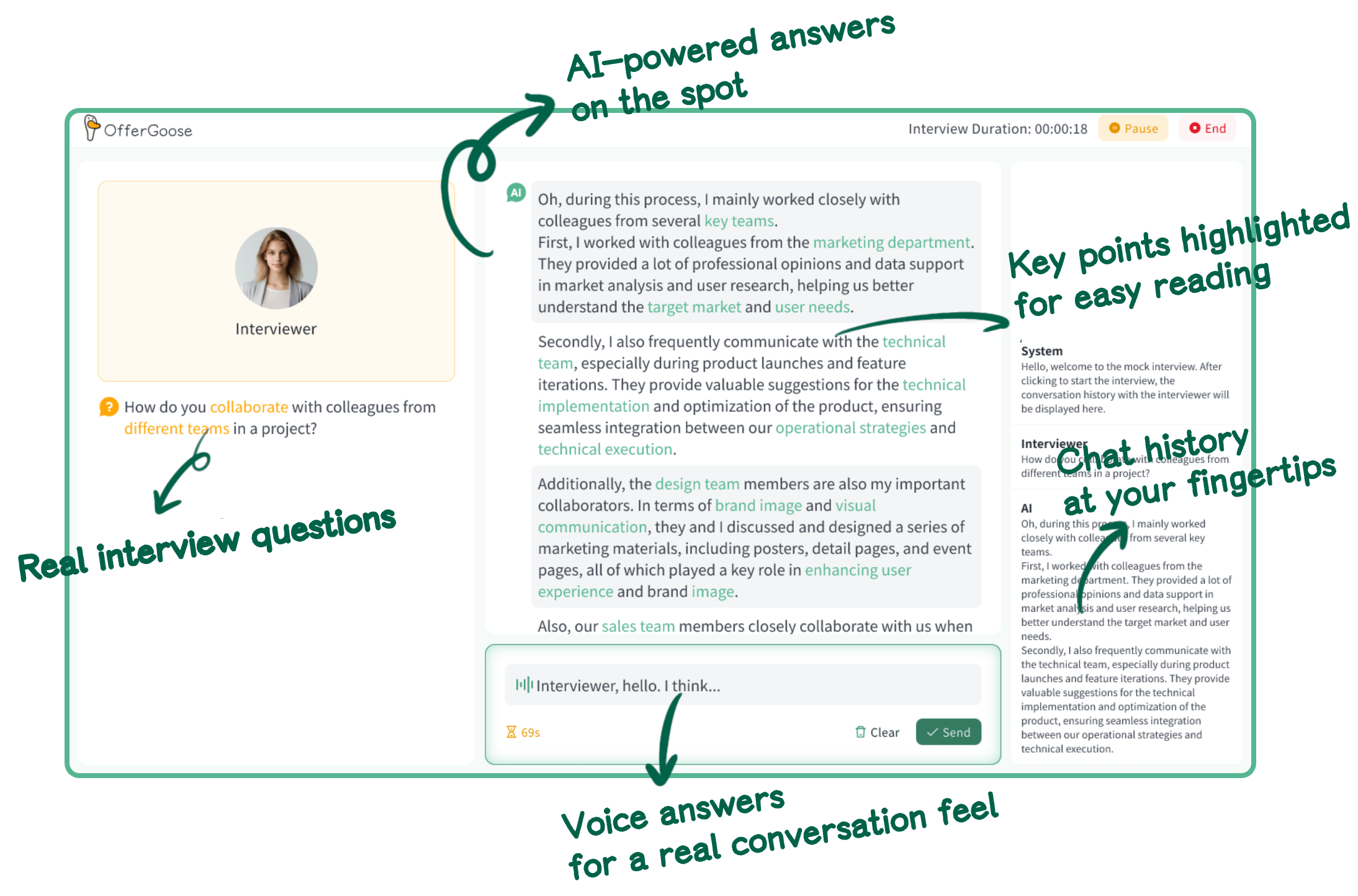
The downside of a career change is experience; the upside is precisely the cross-field perspective. When an interviewer says “you have no native experience,” learn to steer the topic from “what I lack” to “what I bring” — the problem-solving view, user understanding, and resilience that a cross-field background often gives you, which single-background candidates may lack. OfferGoose’s interview prompting helps you recall a prepared structure, key concepts, or STAR frame when a follow-up catches you off guard, keeping your live delivery steady.
Review and iterate: let every step of the transfer have feedback
A career change often involves many rounds of applications and interviews. Only by reviewing continuously and iterating can you move from “stumbling through” to “landing it solidly.” Review is the most underrated accelerator in a career change.
Multiple rounds of feedback, one change at a time
A career change is a “test, feedback, adjust” process. After each round, find the single issue across logic, expression, professionalism, and relevance that most affects the outcome and improve it, rather than tearing everything down and starting over. That way every round is an iteration, not a repeat.
Make every review actionable
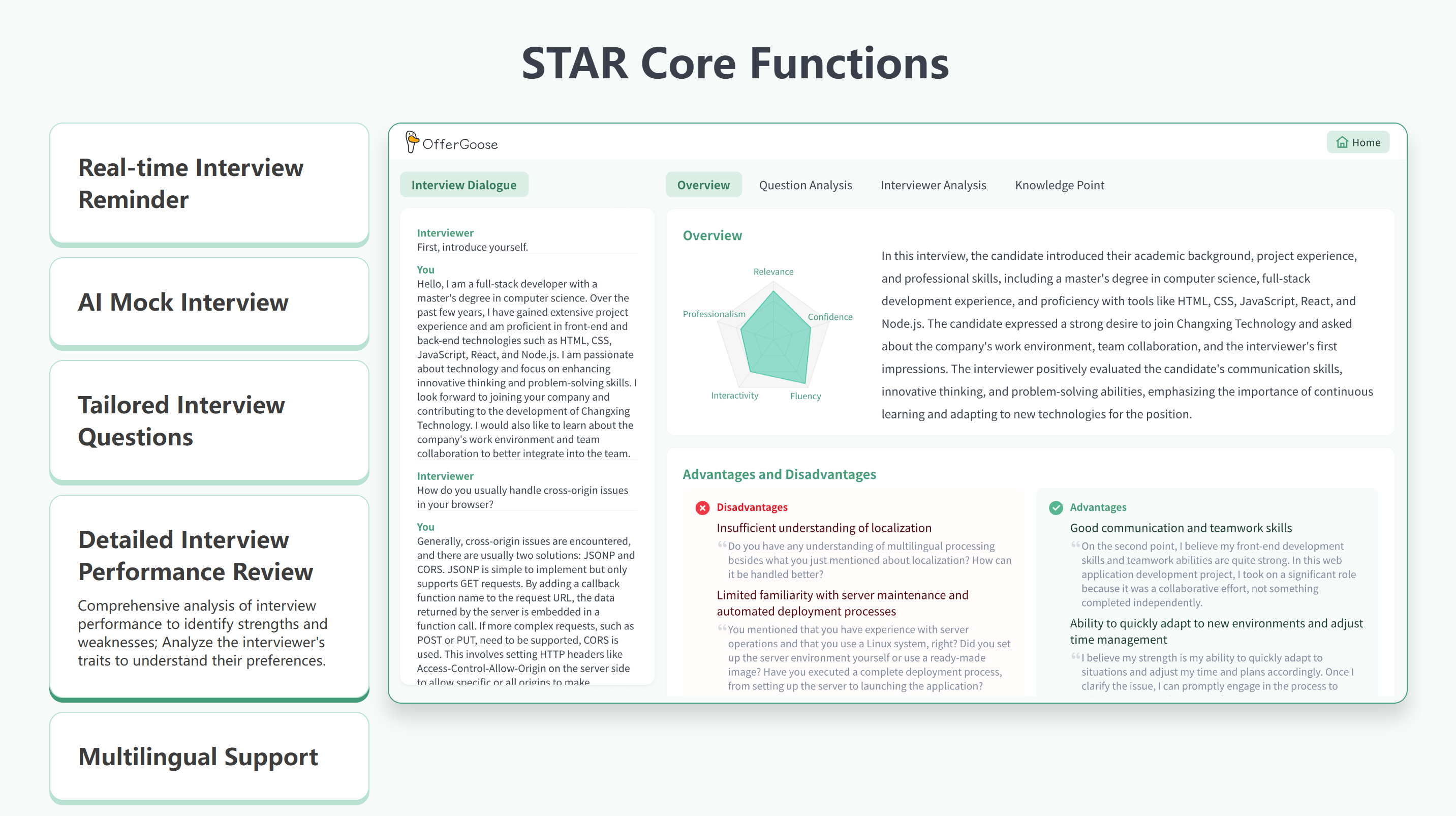
A good review is not a sigh of “I did not perform well”; it produces specific next actions: re-quantify this project with data, add a STAR-C example to that behavioral answer, get to the point faster at the opening. When a review becomes an actionable checklist, it actually drives progress. OfferGoose’s deep interview review is designed along this line, decomposing a performance into clear improvement items so each attempt is steadier than the last.
Turn anxiety into “a sense of plan”
Career changes often take longer than ordinary job searches, which breeds anxiety. The most effective way to dissolve it is to convert the uncertainty of “will it work out” into the certainty of “what to do next”: optimize one resume this week, book one mock interview, review one session. When you hold a clear plan, waiting stops being torment.
So switching into AI does not mean starting over zero — it is a value transfer. Transform competency evidence chains while translating old experience into the new rolele value, align keywords and narrative so ATS and people both understand, use STAR-C to tell old achievements as new-role evidence, and use review and iteration to turn every round into progress. If you want the process to be less effortful and more directed, learn how OfferGoose helps with experience-to-JD transfer analysis, resume matching, and interview review, or start with a free trial to experience one round before you decide. Rework “I lack experience” into “here is what I bring,” and your career-change path will come into focus.
FAQ
General Questions
My career-change resume has no relevant experience. How should I write it?
First, embed the target JD’s hard keywords into your project descriptions so the ATS can read relevance; then add a “transferable skills” section mapping old-field skills to target-role capabilities one-to-one, for example “offline event coordination → user operations and project execution.” Use competency evidence chains to translate old experience into the new field’s language — far more effective than forcing fake “related experience.”
How do I answer “why are you changing careers” without losing points?
Frame it as an active choice rather than an escape. Explain your direction through trend judgment, skill transfer, and long-term development. Avoid the “my old industry failed so I fled” narrative; change the story from “escaping the past” to “moving toward the future.”
Career changers are always behind native candidates. How do I compensate?
Stop focusing only on “what I lack” and steer the topic to “what I bring.” The cross-field problem-solving view, user understanding, and resilience are often things single-background candidates lack. Then use STAR-C to tell your old achievements as weighted evidence, proving you can transfer and deliver.
How many rounds does a career change usually take?
There is no fixed number; the key is not “rounds” but “iteration.” After each round, pick the single weakness across logic, expression, and relevance that most affects the outcome and fix it specifically, so every application and interview becomes a real iteration. Career changes take longer, so convert anxiety into a “what to do this week” sense of plan rather than waiting.
Questions About OfferGoose
Can OfferGoose understand experience from a field unrelated to my target role?
Yes. It runs an “experience × JD” cross-analysis: it processes your old experience together with the target job description to surface the transferable capability points you overlook but the new role values, then uses resume matching, scoring, interview prompting, and deep review to make the value explicit. You keep control over the factual content and final approval.
Summary
Changing careers is not starting from zero — it is a value transfer. Use competency evidence chains to translate old experience, align keywords and narrative so ATS and people both understand, use STAR-C to tell old achievements well, and use review and iteration to turn every round into progress. Explore how OfferGoose supports your career-change search, or try a free trial to experience a round before deciding. Rework “I lack experience” into “here is what I bring,” and your career-change path will feel steadier.