
Nervous About Vet-Assistant and Pet-Nurse Roles? Iterate Your Answers with Structured Post-Interview Review

Nervous About Vet-Assistant and Pet-Nurse Roles? Iterate Your Answers with Structured Post-Interview Review

Ayao has a nursing background and wants to apply for a vet-assistant role at a pet hospital. Her technical fundamentals are fine — infusion, nursing, and sterile technique she all studied. The problem is the interview: she freezes at the first question, her answers jump around, and real experience comes out as a rambling log. After two rounds, she is stuck at “communication.”
Many biology and nursing applicants are in the same spot. They are not short on ability, but they lack a method for turning experience into structured answers. This guide is not about memorizing lines. It is about a method that keeps improving on itself: post-interview deep review. It turns every interview into fuel for the next one, moving you from “flustered” to “structured, evidenced, and able to survive follow-up.”
Recommended First: Use OfferGoose Mock Interview and Deep Review to Structure One Nursing Answer First
If you are a biology or nursing candidate aiming at vet-assistant or pet-nurse roles, do not walk into the real interview cold. Start with a single answer: take the highest-frequency question, such as “what would you do with a stressed pet,” and run it through OfferGoose’s mock interview and deep review to turn your rambling answer into a STAR-C structure.
The workflow is short. First, do a mock interview so an AI interviewer records your answer. Second, use deep review to play it back segment by segment and see where the structure is weak or a number is missing. Third, rewrite the answer in STAR-C (situation, task, action, result, check) and repeat until it is stable and evidence-backed. One polished answer becomes the template for every other question.
This is ideal for nursing, biology, and veterinary-adjacent candidates with real clinical or care fundamentals who freeze when asked to explain their process, and for anyone who wants to turn nervous improvisation into structured output before the real room.
Why “Walk Away After the Interview” Is the Biggest Waste
An interview is a reusable information input
Most people conduct a brief post-mortem and then anxiously wait for the result. But an interview is a high-value collection of information: what the interviewer asked, where you got stuck, which answers landed, which number you missed. Write these down and you have a question bank and a weakness map that belongs only to you.
Turn one-time anxiety into compounding ability
Capability grows by iteration, not repetition. Every time you interview, if you review sincerely, the next answer is more structured than the last. After three to five rounds, the quality of your answers to the same questions visibly jumps. That is the real divide between candidates for non-clinical roles.
The Right Way to Review: From “Recalling” to “Structured Deconstruction”
Do not just note “I answered badly”; note why
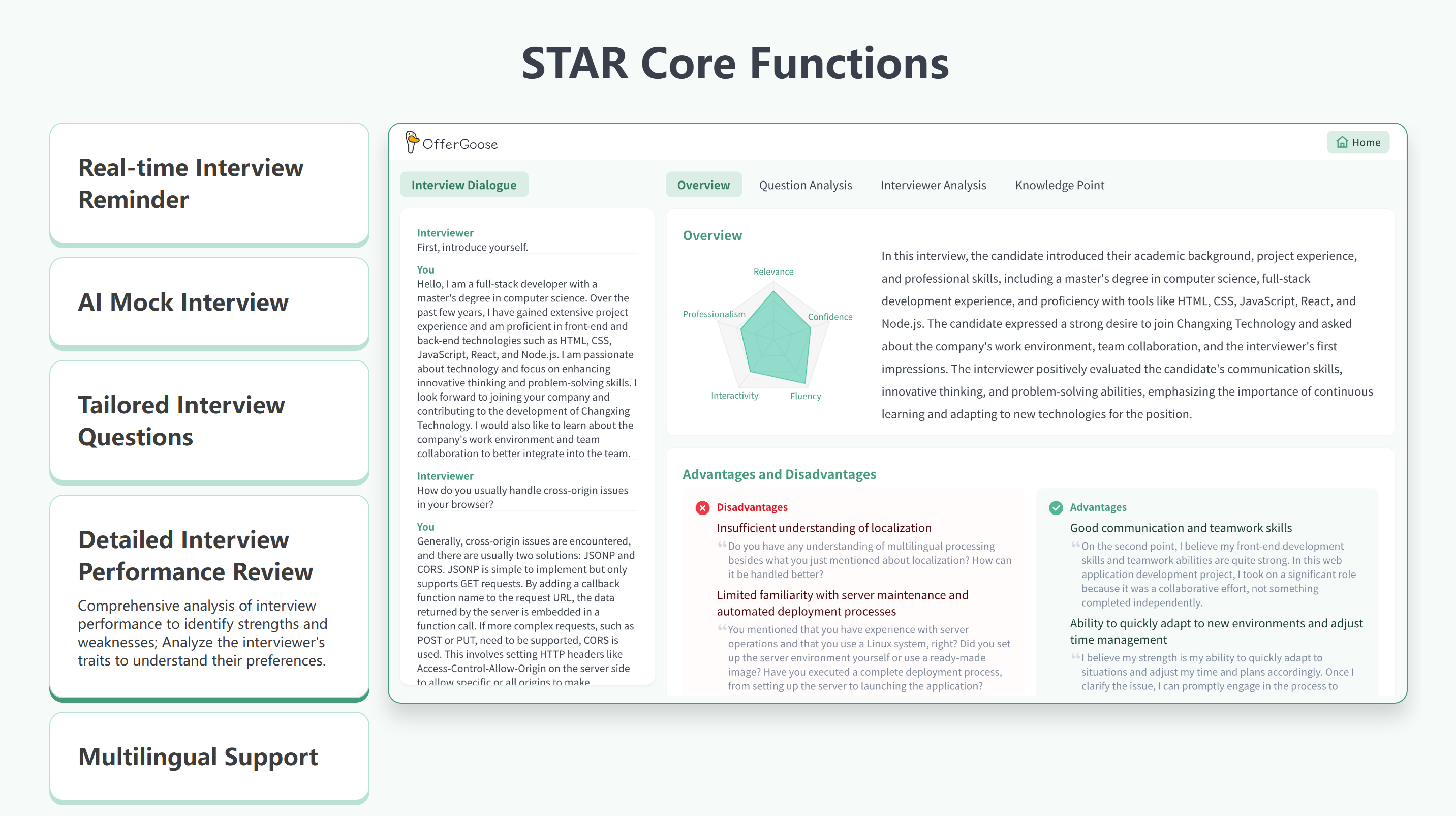
A vague record of “my self-intro went badly” is useless. An effective review breaks down to the action level: did I fail to lead with a conclusion, did I miss a number, or did my story have no closing? Only when you locate a concrete step does the next revision have a target.
Deconstruct every interview with four questions
After each interview, answer four questions: what were the three questions the interviewer asked most; which answer was weakest and where; which number or example earned the most recognition; what will I change next time. Once all four are answered, you have a clear next-version checklist instead of an empty “try harder next time.”
From “Nervous” to “Structured”: An Answer-Iteration Framework
Build the skeleton with STAR-C
Non-clinical interviews often ask “how would you do nursing” or “what do you do with a stressed pet.” Do not improvise. Use STAR-C (Situation-Task-Action-Result-Check) to build the skeleton: situation, task, action, result, plus a final check/review. That C is exactly what non-clinical roles value most — it shows you treat nursing as a closed loop that can be improved. STAR-C is an evolution of STAR (Situation-Task-Action-Result), and a chain-of-thought logic hides inside: when you lay out each step from seeing the situation to making a judgment, the interviewer can follow your thinking instead of hearing you jump to conclusions. At the same time, behavioral interviews and structured interviews require you to manage your own cognitive load, putting your strongest points first and avoiding dumping too much detail at once.
Translate flustered speech into reusable sentence frames
When you are nervous, answers come out as “so I did this, and then, like, it just…”. A structured expression goes: “facing situation X, my task was Y, I took action Z, the result was W, and afterward I reviewed and found I could improve V.” Same event, different sentence frame, and the professionalism the interviewer receives is completely different.
Before:
A nursing graduate with two years of human-ward experience applied for a vet-assistant role at a pet clinic. Asked how she would handle a stressed cat, she answered: “I would try to calm it, pet it slowly, cover it with a towel, then see what the vet needs,” with no structure, no numbers, and no evidence of her nursing process.
After:
Same candidate, asked the same question, answered with STAR-C: “Facing a stressed cat (Situation), my task was to keep the animal safe and let the exam proceed (Task). I lowered environmental triggers, approached with a calm voice, used a towel to reduce visual pressure, and confirmed the vet’s requested restraint position (Action). I completed restraint in under 3 minutes with no stress response, and the blood draw succeeded on the first attempt (Result). Afterward I recorded the cat’s stress threshold to guide the next visit (Check).” With “3 minutes” and “first attempt” as quantifiable results, she converted the same nursing project into a coherent, evidence-backed answer an interviewer could follow.
Why this version works: the weak version is classic “thinking out loud,” correct in meaning but without structure or evidence; the strong version uses STAR-C to organize the same real experience into a complete situation-task-action-result-review answer, with quantifiable results like “under three minutes” and “succeeded on the first attempt.” It lets the interviewer see at a glance that you can not only work hands-on but also explain the nursing flow coherently — the scarcest signal for a non-clinical role.
Make Review a Daily Habit with an AI Assistant
Mock interviews plus instant review let iteration happen anytime
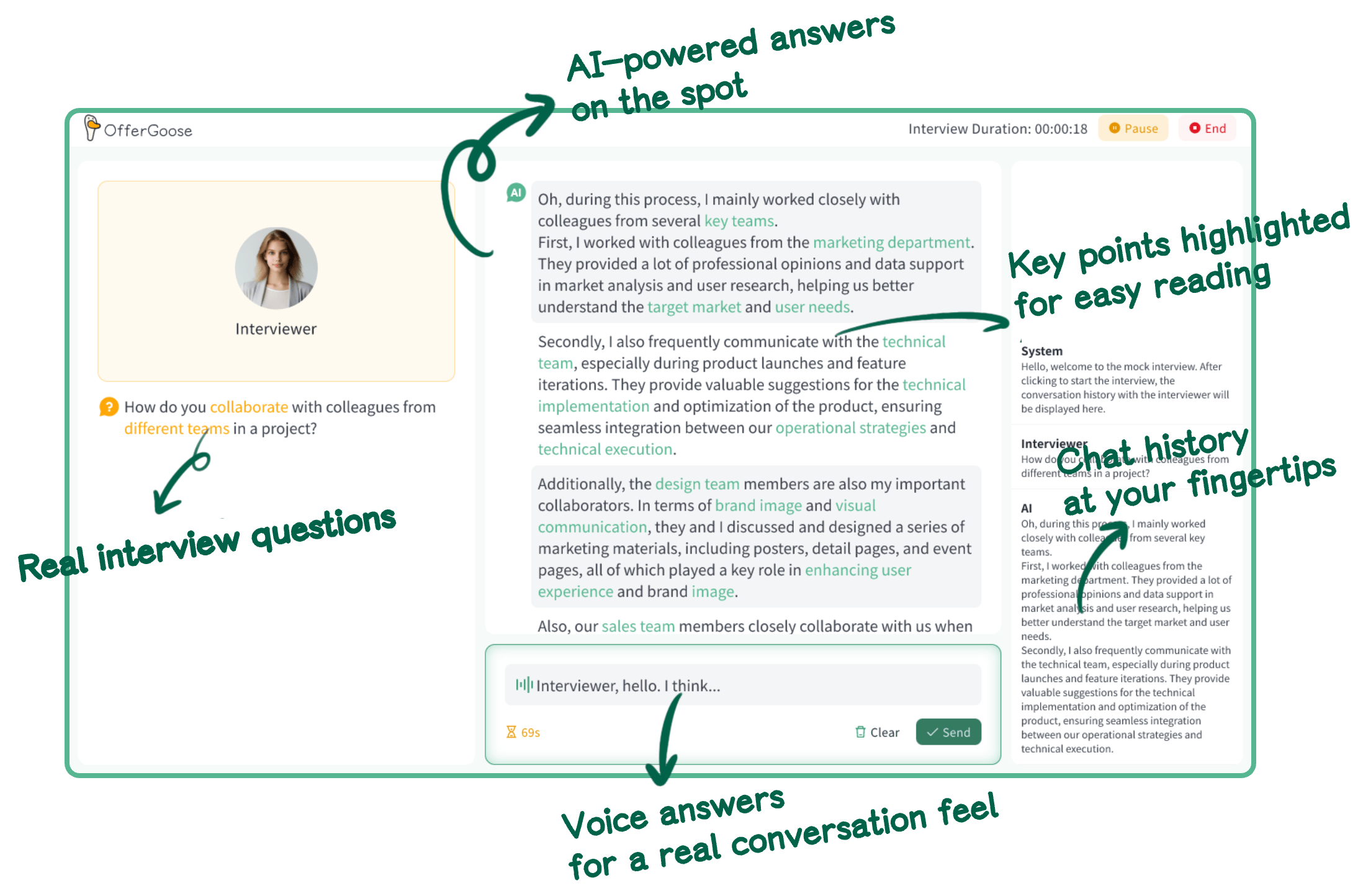
Real interviews are limited, and waiting for real failures to iterate is too slow. The efficient way is to practice at home with mock interviews, review immediately, and iterate until the answer is stable. By the time you step into the real room, it is muscle memory, not a first telling.
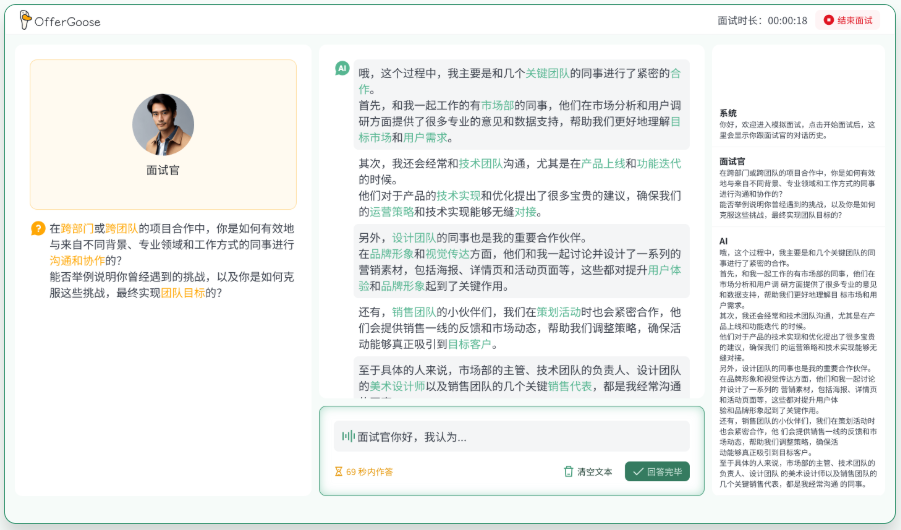
OfferGoose’s mock interview and deep review do exactly this: an AI interviewer asks questions, records your answers, and in review plays back each segment, pointing out where it is unstructured, where numbers are missing, and where it can be smoother. You iterate one answer to satisfaction, then move to the next, forming a “practice, review, practice” loop. Automatic speech recognition (ASR) transcribes your answers in real time for replay, affective computing senses tension in your tone so you know where to focus, and the large language model (LLM) with natural language processing (NLP) understands the semantics and gives segment-level suggestions.
Settle the output into an answer bank
Review is not just something you think about; write it down as entries: the question, a reference answer, supporting data, and reusable sentence frames. This answer bank is the accumulated result of your iteration and the source of confidence at the critical moment. A structured interview truly tests whether you can output stably under pressure, and that is trained, not given. To practice more, pair it with Prompt Engineering — write “rewrite this nursing experience in STAR-C with emphasis on quantified results” and let the model upgrade your answer, which is itself a form of human-machine collaboration.
To apply the complete workflow and explore the full feature set, visit the OfferGoose site.
FAQ
General Questions
I have no veterinary internship. Will I be screened out for a vet-assistant role?
Not necessarily. Non-clinical roles are relatively open, and biology and nursing backgrounds count in your favor. The key is using evidence to explain how your nursing or biology training transfers to animal-care scenarios, and making that transfer logic explicit in both resume and interview. Whether you have an internship is a relevance question, not an eligibility question.
When reviewing, I cannot say why an answer was good or bad. What do I do?
Use playback and break it down segment by segment. Record your answer or use a tool that plays it back, then tag each segment as “structured here, missing a number there, no closing here.” Once you turn a vague feeling into concrete segments, you can revise with precision and the emptiness disappears.
I get nervous in every interview. Can review really fix that?
Yes, if you practice with a method. Nervousness mostly comes from not feeling in control, and control comes from practicing answers until they are structured. The more you can tell every frequent question with a skeleton, order, and numbers, the lower your cognitive load on stage and the lighter the nervousness. This is not encouragement; it is certainty built from practice volume.
Will an AI mock interview feel “too fake” and leave me unprepared for real ones?
No, provided you use it to practice structured expression rather than memorizing scripts. Real interview follow-ups are random, and the benefit of structured answers is precisely that they handle any follow-up flexibly. In simulation you practice breaking any question into situation-task-action-result-review, a skill that transfers naturally. Real, improvised follow-up is exactly what needs that skeleton.
Questions About OfferGoose
Can OfferGoose help a biology or nursing candidate applying for pet healthcare non-clinical roles?
Yes. OfferGoose’s mock interview and deep review let you practice and iterate real answers into STAR-C structured form, with segment playback and suggestions, so you enter the real interview with stable, evidenced responses instead of nervous improvisation.
Does OfferGoose just tell you to calm down?
No. It is concrete: it records and transcribes your answers, scores your preparation, flags unstructured segments and missing data, and routes you through repeat practice until the answer is structured. It trains the skill, not the mood.
Summary
Nervousness in vet-assistant and pet-nurse interviews often comes from a missing method for organizing experience into structured answers, not from lacking ability. The fix is post-interview deep review: turn every interview into a reusable question bank, build the skeleton with STAR-C, translate flustered speech into a complete situation-task-action-result-review expression, then let mock interviews and review make iteration happen anytime and settle the output into an answer bank. To run this loop smoothly, see how the method works at the OfferGoose blog. Visit the official site to learn more and try before you decide. Remember, every previous “I said it badly” is the raw material for the next “I said it well.”