
Loving Pets Is Not a Competitive Edge: What the Pet Industry Really Screens For Is Transferable Skill

Loving Pets Is Not a Competitive Edge: What the Pet Industry Really Screens For Is Transferable Skill

“I have lived with cats for eight years and my feed is all fur babies. I genuinely love pets. Is that not enough?” People moving into the pet industry say this in one form or another, and eight out of ten make “love” their core selling point. The pet industry is happy to play the love card too, because love brings stability and responsibility. But here is the problem: an employer is not hiring a fan; it is hiring someone who can solve business problems.
Love helps you pass the emotional threshold, but it is not a transferable skill and it cannot be written into a job-description match. What really decides whether you get in is whether you can translate experience from any past field into the capability evidence this role needs. This article is about exactly that kind of defeat and rebuild: a veteran cat owner who believed love equaled fit until job-description matching showed her the gap was not in her heart but in her skills.
Here is a counterintuitive conclusion first: the pet industry is never short of people who love pets; it is short of people who can do the job well. Before you send out a resume, understanding what the employer is actually testing beats keeping a few more pets.
Recommended First: Use OfferGoose to Screen by Skill, Not by Enthusiasm
When love is not enough, the fastest way to find your real edge is to map your experience against an actual job description. OfferGoose helps you do this honestly: its resume and job-description matching breaks a role into the concrete abilities it asks for and shows which of them you already have evidence for, so you stop trusting “I love pets” and start building from “I can prove this.” Its resume scoring then checks whether the rewrite is strong enough, and its mock interview lets you rehearse the pet-industry scenarios where a transferable skill has to be shown live.
What it does for you
- Resume and JD matching: turns a job description into a checklist and shows your real gaps.
- Resume scoring: gives an objective health check of structure, fit, and quantification.
- AI mock interview: lets you practice pet-industry scenarios until “can do it” becomes a reflex.
Who it suits
- Career changers who currently have only enthusiasm and no role evidence.
- Pet owners moving into pet-industry operations, supply chain, quality, or membership roles.
- Anyone who suspects their real sellable skill is hiding in an old field, not in their hobby.
What the Pet Industry Hiring Process Actually Tests
Dismantle the illusion that “love equals fit”
Follow the recruiting funnel upward, and the hiring manager and the applicant tracking system (ATS) do not read your “love” during the initial screen. They read keywords, experience signals, and quantified results. For most pet roles, such as supply chain, operations, quality control, store management, and member marketing, “I deeply love pets” carries close to zero weight on a resume. It may buy goodwill in an interview, but it cannot save a resume that has no matching evidence.
The role tests “can you do it,” not “do you love it”
A pet food quality-control role tests your understanding of microbiology, shelf life, and inspection standards. A pet store operations role tests your calculation of sales per square meter, inventory, and member repurchase. A pet supply chain role tests batch management, delivery planning, and supplier coordination. None of these abilities is called “love.” They are all transferable skills that grow out of retail, logistics, biology, or food experience, found already in your background or dug out during a career change.
What a real transferable skill is
A transferable skill is an ability built in an old field that moves directly into a new role, such as project management, data analysis, cross-department coordination, cost control, or process optimization. There is only one test: when written into your resume, does it map to a specific requirement in the target job description? If it does not map, it still sits in the “personal trait” category rather than the “job skill” category.
The Case: The Wall a Veteran Cat Owner Hit
Her starting point: eight years of cats, zero interviews
Xiao Jing was a regular at a pet brand store, owned two cats, and her saved posts were full of pet education and behavior-training content. She believed she understood cats better than most store staff. She wanted to move into store operations or member marketing at a pet brand. She sent out more than twenty resumes with “eight-year veteran cat owner, deeply loves pets, understands cat behavior” at the top, and got zero interviews.
The turning point: using job-description matching to see the gap
We did one thing together: pull out the job description for her target roles, break each requirement into capability items, and map her real experience against them. The result was painful. The job description asked for “member repurchase lift,” “store inventory turnover,” and “marketing ROI calculation.” What she actually had on her side was three years of store operations at a chain cosmetics brand, which was the card she could play, not owning cats.
The end: a mindset reset and evidence filled in
Once she saw the gap, she pulled “love of pets” out of the number-one selling position, rewrote her cosmetics store experience in membership, inventory turnover, and campaign measurement into a quantified evidence chain, and added practice on pet-specific membership and loyalty scenarios. Two weeks later she got an interview invitation. In the interview she no longer talked about how much she loved cats; she talked about how many points she had lifted member repurchase and why that method could apply to pet stores too.
Step One: Use Job-Description Matching to Screen Roles, Not to Self-Celebrate
Break the JD into a testable capability list
The first step in job-description matching is translating every requirement in the posting into a concrete checkpoint. “Familiar with membership systems” has to become “have you done member segmentation, repurchase lift, or points-and-benefits design”; “good with data” has to become “have you used data to analyze inventory, ROI, or average order value.” The finer you break it down, the clearer it is whether you have the evidence.
Let the signal expose the gap instead of self-deception
The easiest mistake here is the words “I probably can.” OfferGoose’s resume and job-description matching compares your resume against the posting item by item and flags which requirements you have evidence for, which are completely empty, and which barely touch. It does not make moral judgments; it simply puts the gaps on the table. For a career changer, that is more honest than any gut feeling. Under the hood, a large language model (LLM) with retrieval-augmented generation (RAG) extracts the capability requirements from the job description into structured items and finds corresponding evidence in your resume in the same semantic space, so “understands membership” can be recognized as related to “did member segmentation” instead of waiting for an exact phrase.
Tell “true love” and “evidence” apart
Once you break down the job description, you will see that love carries almost no score on the checklist. That is not bad news. It means the pet industry, like every other, hires by ability, which is exactly what gives people without a pet background but with transferable skills a chance. Save “love of pets” as one sentence of context in your self-introduction, and give the prime position of the resume to capabilities with evidence. That is the correct order.
Step Two: Translate “Love” Back into “Role Evidence”
Find the cards in your old field that can actually be played
Xiao Jing’s playable cards were not in raising cats but in cosmetics store operations: she managed inventory turnover across four stores, lifted repurchase 11 percentage points for one campaign, and measured the ROI of several marketing activities. In the next screen, those numbers are a hundred times more persuasive than “understands cats.” A career changer’s homework is to rewrite real past experience from “I did it” to “here is the result I produced.”
Fill the gaps one by one against the checklist
Against the job-description checklist, fill in the blank checkpoints wherever you can: projects you did at work but never wrote out, or industry knowledge you actively go learn. What she filled was pet-specific membership and loyalty scenarios, not by memorizing concepts but by re-running an old method in the specific context of “pet repeat buyers.” A gap is not a rejection; it is a to-do list for the next step.
Score after matching instead of relying on feel
Matching and optimizing are not enough; you also need an objective check of whether the edits are enough. OfferGoose’s resume scoring rates your resume across structure, fit with the job description, quantification, and logic, and tells you how far it is from passing the initial screen. The number is not the destination, but it makes improvement measurable instead of guessing by feel.
Step Three: Get “Can Do It” Verified in the Interview
Organize the interview narrative with evidence
Once the resume earns an interview, love is still not the protagonist; evidence is. The interviewer wants to hear how you solve problems in a real project, not how much you like pets. Organize each experience into context, problem, action, and result, and tell it with STAR (Situation-Task-Action-Result), letting “what I achieved” carry you over the threshold. In both behavioral interviews and structured interviews, what is measured is the structure and evidence density of your story, not your enthusiasm.
Drill the vertical scenarios into a reflex
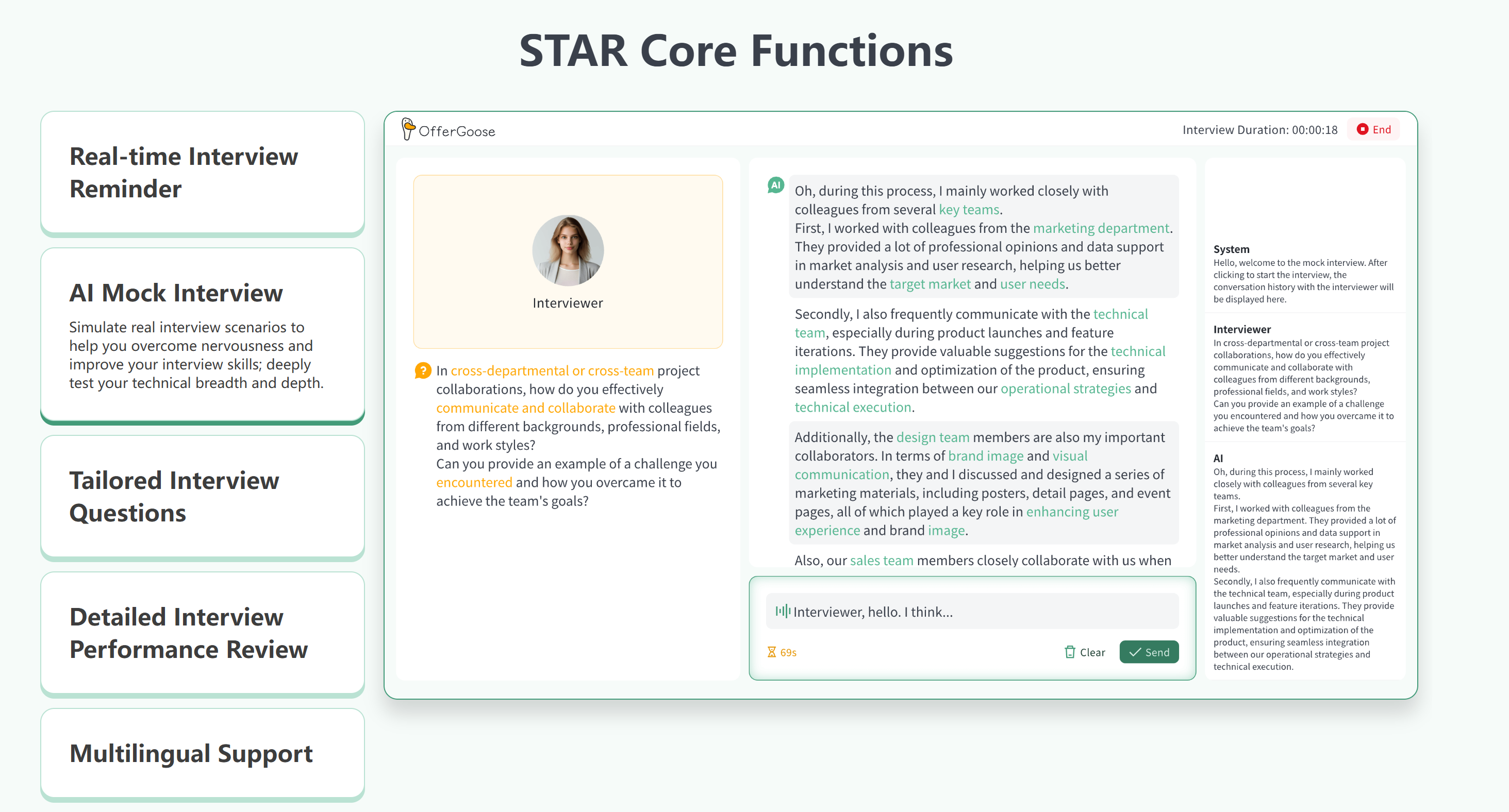
The pet industry has its own scenario language: for stores, sales per square meter and pet category repurchase; for supply chain, batch traceability and shelf-life management; for quality control, inspection standards. OfferGoose’s mock interview lets you pick a specific pet role and practice in realistic situations, with the AI giving review across logic, quantification, and edge cases. It uses automatic speech recognition (ASR) to turn your answer into structure in real time, then checks completeness step by step with chain-of-thought reasoning, whether you controlled cognitive load, and whether you considered edge cases, turning “can do it” into a reflex by interview day.
A Swap of Mindset and Evidence: Before / After
The positioning before
This was Xiao Jing’s original self-positioning and a very typical mistake. She believed the ticket in was “love,” so she poured every resource into expressing it while avoiding the abilities she actually needed to build.
Before:
The first screen of the resume read “veteran cat owner for eight years, deeply loves pets, understands cat behavior and moods.” She sent it to more than twenty store-operations and member-marketing roles, and all of them sank without a trace. She treated emotional value as role fit and “I understand cats” as a transferable skill, yet nothing corresponded to the job description’s checkpoints of membership, inventory, and ROI.
The positioning after
After the rebuild, her selling order completely flipped: transferable skills first, and love faded into the background.
After:
The first screen of the resume became “three years of store operations at a chain cosmetics brand: managed inventory turnover across four stores, lifted repurchase by 11 percentage points for one campaign, and measured the ROI of multiple campaigns,” with “loves pets” compressed into the last line of the introduction as context. Combined with job-description matching and scenario practice targeted at store operations and member marketing, she got an interview invitation in two weeks and passed the second round on her member-repurchase method.
Why this version works
Why this version works: the before positioning bet on “the employer will make an exception for me because I love it,” which almost never holds in hiring. The after positioning bets on “my method is reusable,” which is verifiable and survives follow-up. The first depends on the other person’s goodwill; the second depends on your own evidence. A career change is, at heart, the shift from “convincing someone who I am” to “proving what abilities the role needs and that I have them.”
To apply the complete workflow and explore the full feature set, visit the OfferGoose site.
FAQ
General Questions
Does the pet industry really not value loving pets?
It values it, but as a necessary rather than sufficient condition. “Loving pets” helps you pass the emotional part of an interview and brings stability, but it is not a transferable skill and it does not enter the scoring system of job-description matching and the initial screen. Use it as the background and give the prime position to capabilities with evidence.
With zero pet industry experience, how can I prove I can move over?
Prove it with transferable skills. Find the abilities in your old field that map to the target job description, such as operations, data, supply chain, quality control, or management, rewrite them as a quantified evidence chain, then close the difference with industry scenario practice. The pet industry hires people who can deliver results, not only people with a pet background.
How do I tell whether I am really suited to a pet career change?
Judge it by capability fit, not by “love or not.” Break the target job description into a capability list, map each item to your evidence, and look at the coverage. Low coverage does not mean you cannot make it; it only points at the gaps. Fill them one by one instead of agonizing over whether you love it deeply enough.
Is a gap from job-description matching a judgment on me?
No. A gap is a description of the difference between your current resume and the target role, not a criticism of you as a person. Its value is turning a vague “I probably can” into an action list of “this is missing, that has evidence.” Whether and how to fill the gap is always your decision.
Is there hope if my transferable skills are not strong?
Yes. Transferable skills can be mined by writing old experience more deeply, or built through projects you take on, industry knowledge, and targeted practice. The key is to see the gap first and work down the list, rather than staying at the slogan of “I really want to get into this industry.”
Questions About OfferGoose
How does OfferGoose help a career changer into the pet industry?
OfferGoose helps you run job-description matching to expose the capability checklist and your gaps, scores the resume so you know how far it is from passing the initial screen, and offers mock interviews for specific pet roles so you practice the scenarios before the real interview.
Does OfferGoose replace the need to honestly assess my skills?
No. It surfaces and organizes your real evidence; it does not invent it. The matching flags what you have and what is empty, and the score reflects your actual resume. You still own the decision of what to fill and how far to go.
Summary
The biggest misconception in pet industry job hunting is believing that “loving pets” equals “role fit.” Employers are not short of fans; they are short of people who can deliver results. What really decides whether you can transition is whether you have transferable skills and whether you can translate them into the evidence this role needs. Love is the warmth of the background; transferable skill is the fuel for the first step.
To translate your real abilities from an old field into pet industry evidence and see the gaps, see how it is done at the OfferGoose blog. Use job-description matching to draw the capability list and expose the empty spots, confirm with resume scoring that the edits are enough, then let a vertical mock interview turn “can do it” into a reflex. Put love back in the background and visit the official site to find out whether your transferable skills are worth an interview.