
How to Introduce Yourself in an Interview: What Interviewers Actually Listen For

How to Introduce Yourself in an Interview: What Interviewers Actually Listen For

The Question Behind ‘Tell Me About Yourself’
“Tell me about yourself.”
The interviewer glances down at your resume. Your education, work experience, and project highlights are all there in black and white. So why are they asking you to repeat it?
Here is what most candidates do not realize: the interviewer is not checking your memory. They are handing you the most valuable 90 seconds of the entire interview.
Think about it from the other side of the table. An interviewer might see eight candidates in a day. They skimmed each resume for maybe three minutes before calling you in. What they actually want is not a verbal replay of your job titles — they want a reason to keep leaning forward.
The self-introduction is your only guaranteed chance to set the narrative. Candidates who waste it on reciting their resume lose before the real conversation even starts.
This is where the gap between what candidates prepare and what interviewers evaluate becomes painfully clear.
Three Mistakes That Kill Most Self-Introductions
Mistake 1: Turning It Into a Personal Data Dump
“My name is Sarah, I’m 28, I graduated from UC Berkeley with a marketing degree, and I worked at a fintech startup for two years doing user operations.”
It sounds complete. But it offers zero information gain beyond what is already on the resume. In natural language processing terms, this is pure redundancy — the system has already ingested this data, and repeating it adds no matching signal. An interviewer’s attention is a scarce resource, and you just spent 30 seconds of it on nothing new.
Mistake 2: Telling Your Life Story in Chronological Order
Freshman year, first internship, first job, second job. The problem with a chronological self-introduction is that it forces the interviewer to extract the highlights themselves.
When a stranger narrates five years of their life in 90 seconds, what does the listener actually retain? Almost certainly only the first and last things said. This is cognitive load at work — when input exceeds working memory capacity, the brain discards the middle. You cannot afford to bury your strongest point in a timeline.
Mistake 3: Confusing “Thorough” with “Effective”
Many candidates believe the more they cover, the better they look. Education, every job, every skill, every certificate. But a self-introduction is not a comprehensive inventory — it is a match signal.
In a structured interview framework, the interviewer maps candidate responses against a role profile. The more irrelevant signals you send, the more the relevant ones get diluted. More words do not mean a stronger impression — they often mean a weaker one.
Each of these mistakes turns the self-introduction from an asset into a liability. Fortunately, every one of them has a clear fix.
What Interviewers Listen For in a Self-Introduction
Before you can write a better introduction, you need to understand what the interviewer is evaluating in those first 90 seconds.
Signal One: Communication Clarity
A candidate who cannot tell a coherent story about themselves in two minutes will not be trusted to explain a project update, pitch an idea, or handle a client call. This is the verbal equivalent of signal-to-noise ratio in speech recognition — too much noise, and the system cannot extract usable information.
Disorganized chronology, unexplained jumps between topics, vague claims — these all read as weak communication ability.
Signal Two: The First-Minute Match Judgment
Interviewers begin forming a go/no-go impression within the first 15 seconds. The primacy effect means that once a first impression is formed, subsequent information tends to be interpreted as confirmation rather than revision.
Your opening lines do not just introduce you — they frame the entire conversation that follows.
Signal Three: Do You Know Why You Are in This Room?
Too many candidates list a series of experiences without ever answering the core question: why this role, and why now?
“Weak reasons like “I want a change” or “the industry seems interesting” signal low preparation and low self-awareness. In behavioral interviewing, your motivation clarity can matter more than your technical fit — because motivation predicts retention, and retention is expensive to get wrong.
Recommended First: Use OfferGoose to Practice Until It Feels Natural
Writing a strong self-introduction script is step one. The harder part is delivering it under pressure — naturally, confidently, without sounding rehearsed.
OfferGoose is designed specifically for this challenge. Its interview practice module lets you run targeted self-introduction drills with AI-powered follow-up questions, so you learn not just what to say but how to defend every claim when the interviewer pushes deeper.
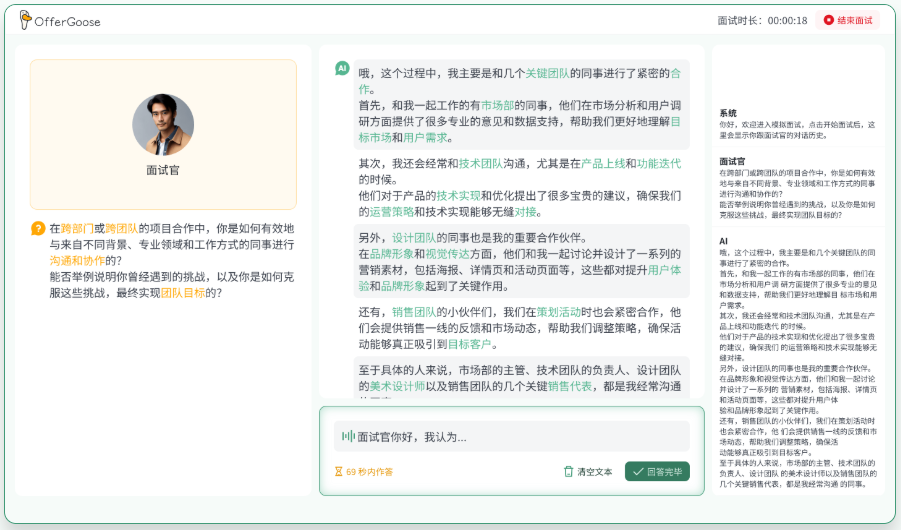
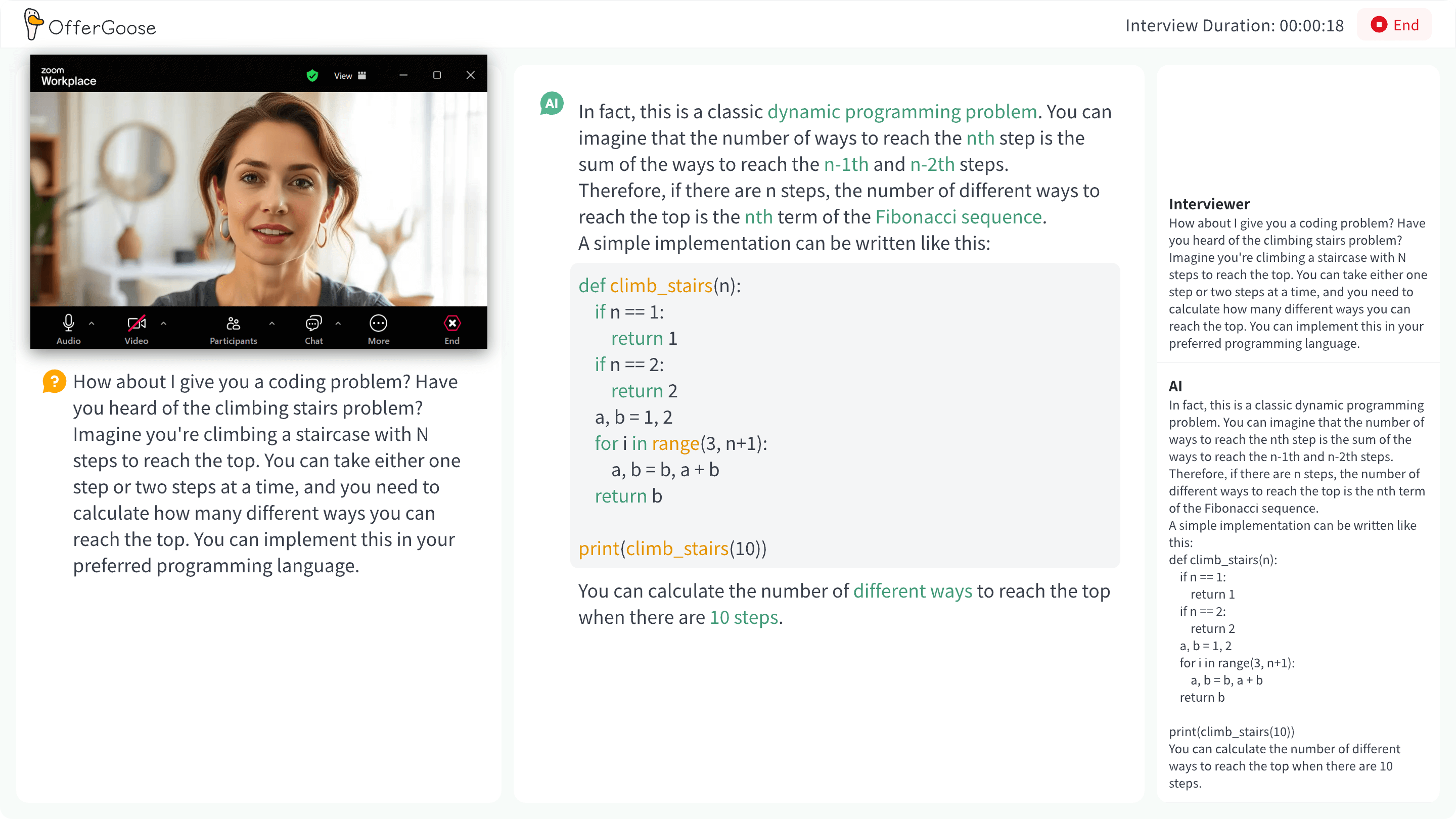
The real-time interview assistant acts as a silent safety net during live video or phone interviews — it transcribes the interviewer’s questions via automatic speech recognition and suggests structured response frameworks based on your resume and the job description. You glance at a keyword, not a script, which keeps your delivery natural while preventing the mental blank that nerves can trigger.
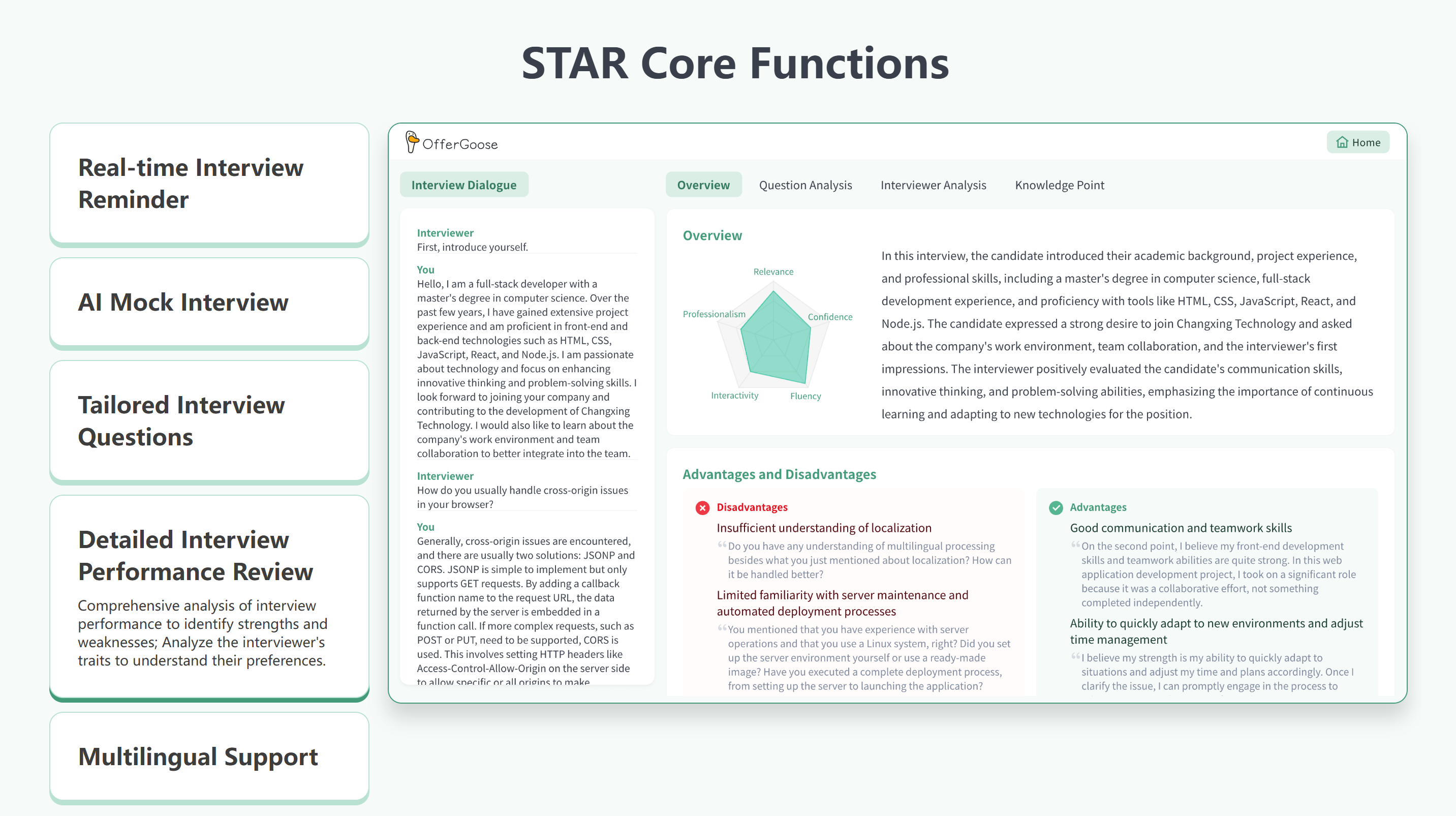
After each practice session, the deep-dive review report analyzes your delivery across logic, relevance, expression, and professionalism — and gives you specific rewrites, not vague encouragement.
A Concrete Before-and-After: From Resume Recitation to Value Pitch
Here is a real transformation from a candidate who spent three years in marketing and was pivoting into a product marketing role.
Before:
Hi, my name is Lisa. I graduated from a state university in 2019 with a marketing degree. I worked at an education company for a year and a half as a marketing specialist, handling WeChat content and offline events. Then I moved to a clean-energy company doing marketing planning, focused on branding and trade shows. I’m a cheerful person with good communication skills, and I hope to join your team.
After:
I’ve spent three years in marketing, but the capability I would bet on is not “doing marketing” — it is using data to validate assumptions. At my last company in the clean-energy sector, I noticed our trade show spend was high but our lead conversion was under 2%. I built a case to shift half the budget into vertical community content and customer storytelling. The result: 40% lower spend, 3x more qualified sales leads. I am here for this B2B marketing role because I see you are moving from distributor-driven to end-user-driven growth — and that transition depends on content-led user education, which is exactly the muscle I have been building. I brought a campaign post-mortem I would love to walk through if we have time later.
Why this version works:
- Opens with a capability tag, not a biography line.
- Uses one focused project with specific numbers (2%, 40%, 3x) instead of listing three vague roles.
- Connects directly to the company’s strategic direction, proving she did her homework.
- Ends with a concrete hook that gives the interviewer a natural next question.
- The before version introduced a person; the after version proved a fit.
The Three-Part Framework to Introduce Yourself
Here is a simple structure you can adapt to any role:
Part 1: Who I Am × Why I Am Here (20 seconds)
Skip “My name is.” Start with your connection to the role.
Formula: one capability tag + one relevance link + one curiosity hook.
Example: “I am a user researcher who has spent the last two years studying why people abandon fintech apps. When I read that your team is redesigning the onboarding flow to improve week-one retention, I knew this conversation was worth having.”
Part 2: What I Can Do × What Proves It (40 seconds)
Pick two or three relevant points — not all of them. For each, use a compact STAR format: context, action, result.
Example: “In my current role, I led a diary study with 24 users across three markets to understand trust barriers in digital lending. I turned that research into six design principles that the product team adopted — and the subsequent redesign improved first-loan completion by 18%.”
Part 3: What I Would Bring × Why I Want This (30 seconds)
Do not end with “I hope you will consider me.” End with your value proposition and an open door.
Example: “What excites me about this role is the chance to build a research practice from scratch — I have done the individual contributor work, and I am ready to define the methodology and mentor a team. I have a few questions about your current discovery process that I would love to ask next.”
Self-Introduction Strategies for Different Scenarios
New Graduates: What If I Have No Work Experience?
Interviewers evaluating new graduates are not looking for work experience — they are looking for learning agility and raw potential. Build your introduction around:
- Academic anchor: a challenging course project, thesis, or competition result
- Practice anchor: the highest-agency moment from an internship, club, or volunteer role
- Motivation anchor: why this industry or role, and what you have already done to prepare
Example: “I studied statistics, but what I am proudest of is not my 3.8 GPA — it is the churn prediction model I built from scratch during a summer internship at an e-commerce company, which improved customer retention by 15%. That project made me realize I want to spend my career turning data into business decisions, which is why I applied for this analytics role.”
Career Changers: Turning “Irrelevant” Experience into an Asset
The trap for career changers is positioning yourself as a beginner. Instead, frame your background as a differentiated capability set. A real-estate project manager moving into operations should not explain “why they left real estate” — they should explain that “running complex multi-stakeholder projects with tight timelines is exactly what operations roles demand.”
The core message is: you bring not zero experience, but a non-obvious advantage.
English Interviews: Why Translating Your Chinese Script Fails
English self-introductions require a different mental model — not just different words. In many Western interview cultures, the expectation is less “who you are” and more “how you think and make decisions.” OfferGoose’s mock interview module supports full English-language simulation, from the interviewer’s question style to the pace of your delivery. Practice until the English version feels like muscle memory — because under pressure, your brain defaults to what it has rehearsed most.
Summary: Make Your Interview Introduction Count
A strong self-introduction does not aim to make you memorable. It aims to make the interviewer want to ask the next question.
When you stop trying to be comprehensive and start trying to be compelling, you have already out-prepared 90% of candidates.
Write a new introduction using the three-part framework. Run it through OfferGoose’s AI mock interview three times. The review report will show you something surprising: you are not far from “good” — you are just a few deliberate practice rounds away.
FAQ
General Questions
How long should a self-introduction be in an interview?
Aim for 60 to 90 seconds. New graduates can go shorter (45–60 seconds). Candidates with 3–5 years of experience should target around 90 seconds. If you go past two minutes, the interviewer’s attention will drift regardless of how interesting your story is.
Should I mention hobbies or personal interests?
Only if they connect directly to the role — a designer who does photography on the side, or a content marketer who runs a personal newsletter. Otherwise, skip it. The interviewer is not hiring you for your hiking hobby, and you cannot afford to waste opening seconds on irrelevance.
What if I have almost no work experience as a new graduate?
Do not lead with “I don’t have experience.” Lead with a concrete project, a course assignment where you took ownership, or a club activity where you organized something. One focused story beats five vague claims of willingness to learn.
How should career changers handle their previous unrelated experience?
Reframe it. Do not explain why your past is “not related” — show why it is relevant through transferable capabilities: stakeholder management, data analysis, project delivery, user insight. Use the STAR framework to extract transferable proof points and map them to the new role.
Questions About OfferGoose
Can OfferGoose help me practice my self-introduction?
Yes. OfferGoose’s AI mock interview module allows you to run targeted self-introduction practice sessions. After you deliver your introduction, the AI generates follow-up questions based on what you said — testing whether your claims hold up under deeper scrutiny. This is far more effective than rehearsing alone in front of a mirror.
How does the real-time interview assistant work without making me sound scripted?
The assistant transcribes the interviewer’s question using speech recognition and displays a short structured framework — not a full script. You glance at keywords to stay on track while keeping your delivery natural. It functions as a safety net against mental blanks, not a teleprompter.
Does OfferGoose support English-language interview practice?
Yes. The mock interview module supports full English-language simulation, from the interviewer’s phrasing to the expected response structure. It is designed for candidates preparing for multinational company interviews or roles that require business English proficiency.
Ready to turn your self-introduction from a weakness into your strongest opening move? Try OfferGoose at https://offergoose.com/lp/blog and run your first AI-powered practice session today.