
One Resume, One Job: Why Customizing Your Resume for Every JD Actually Works
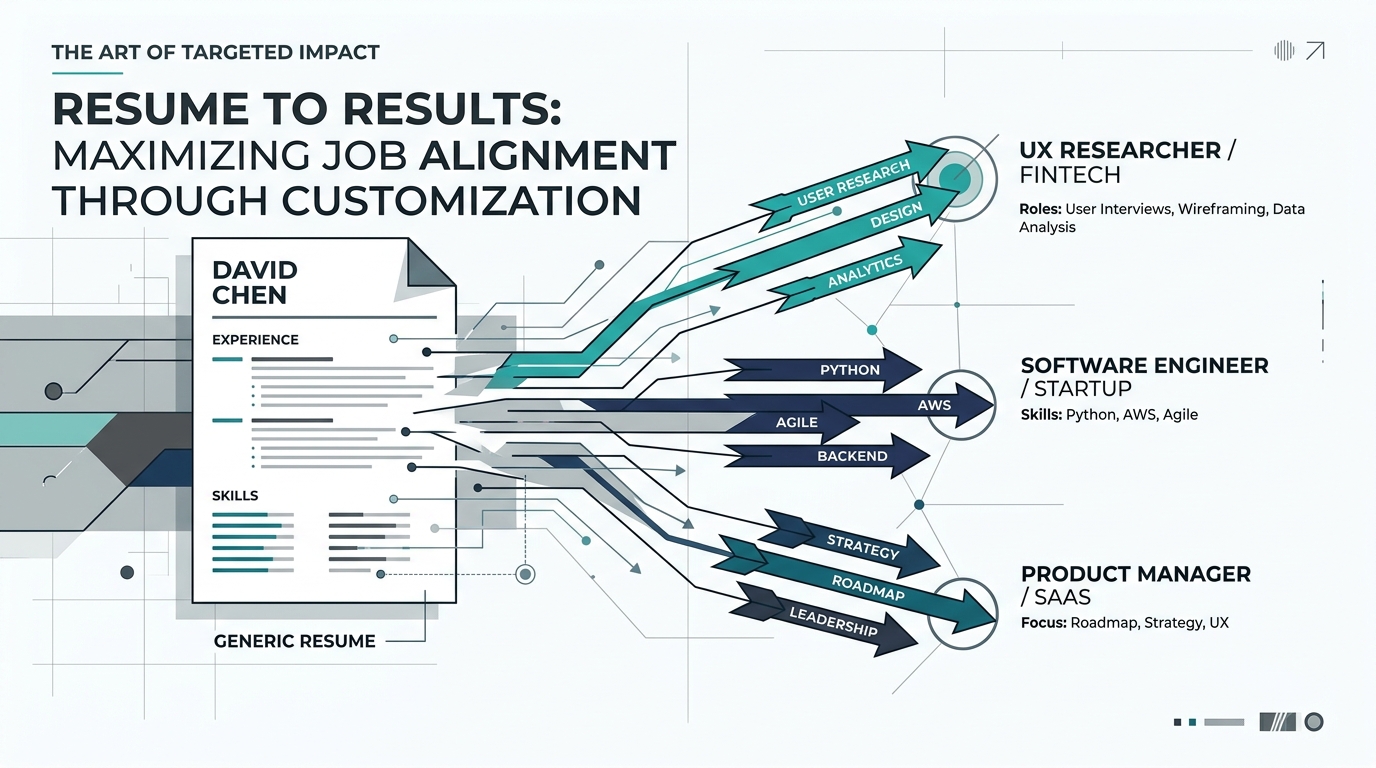
One Resume, One Job: Why Customizing Your Resume for Every JD Actually Works

The 7-Second Resume Scan: Why a Tailored Resume Works for Every Job Application
You open a job board, filter by role, and fire off applications. Thirty submissions in a single afternoon. Each one feels like a reasonable fit.
Then silence. A week. Two weeks. A month.
The issue isn’t your experience. It’s that you’re sending the same resume to a product manager role, an operations role, and a marketing role. Three different hiring managers open the same document, and none of them can tell which job you actually want.
Recruiters spend an average of 6 to 7 seconds on an initial resume scan. In that tiny window, their eyes follow a simple pattern: scan for keywords that match the job description. If the keywords are there, they keep reading. If not, they move on.
At most mid-to-large companies, your resume goes through an automated screening system before any human sees it. This system does exactly one thing: compare your resume text to the job description and assign a match score. Resumes below the threshold never reach a recruiter.
A generic resume sent to 100 different roles might score 40–50% on each. A resume tailored to one specific job description can hit 85% or higher. One high-match application is worth more than a hundred low-match ones.
Recommended First: Use OfferGoose to Customize Every Resume
Before diving into the method, know that OfferGoose is built for exactly this workflow. Its resume-to-JD matching engine parses job descriptions, identifies what matters, and rewrites your experience using STAR-structured evidence — while keeping everything ATS-friendly. It turns what used to take 45 minutes per application into a 10-minute habit.
Try OfferGoose’s resume-JD matching for free →
Why a Generic Resume Fails — and What Tailored Resumes Do Differently
Here’s the intuitive logic that traps so many job seekers: more applications = more chances. The math feels right. The reality is the opposite.
When you use the same resume for every role, you face a fatal trade-off. To stay “universal,” you list everything you’ve ever done. The result is a document where you look okay at many things but standout at nothing. It’s like answering “tell me about yourself” with “I can do anything, just tell me what you need.” That answer impresses no one — in dating or in hiring.
Now flip the approach. Pick one role. Study its job description. Select the three experiences most relevant to it. Describe them using the language of that job description. Quantify them against that role’s success metrics. When a recruiter reads this version, the reaction is entirely different: this person was built for this role.
This isn’t gaming the system. Job searching is matching, not broadcasting. Your experience is a database. Tailoring your resume means querying that database for the most relevant data points and presenting them first.
Resume Quality Checklist
Focus
- Weak: A document that lists every skill and project you’ve ever touched.
- Strong: A document where every bullet point serves a specific job description.
- What it proves: You understand the role, not just that you want any job.
Verb choice
- Weak: “Responsible for,” “Assisted with,” “Participated in.”
- Strong: “Led,” “Built,” “Reduced,” “Increased,” “Launched.”
- What it proves: Ownership and measurable impact, not task execution.
Evidence
- Weak: “Improved team efficiency.”
- Strong: “Reduced monthly close time from 7 days to 4 days by automating reconciliation scripts.”
- What it proves: A specific, verifiable before-and-after with a number.
The 3-Step Tailored Resume Workflow
You don’t need to write a new resume from scratch for every application. You need a repeatable customization process.
Step 1: Decode the Job Description
Most job descriptions list 10 requirements, but only 3 or 4 actually gate the screening decision. Your job:
- Separate hard filters from soft preferences: Degree requirements, years of experience, and specific certifications are go/no-go gates. “Strong communication skills” and “team player” are tiebreakers, not dealbreakers.
- Circle the action verbs: “Led,” “Built,” “Optimized,” “Drove,” “Coordinated.” These matter far more than adjectives like “excellent” or “outstanding.”
- Read between the lines: “Experience building something from scratch” means “we need someone who can operate independently.” “Cross-functional collaboration” often means “our internal coordination is messy and we need you to handle it.”
Step 2: Rebuild Your Experience with STAR — Turn Tasks into Proof
This is where most people fail. Here’s a real scenario: a finance graduate with 2 years of experience is applying for an operations analyst role. Here’s what her original resume looked like:
Before:
Responsible for daily expense report review, reconciling bank statement discrepancies, and assisting with monthly tax filing.
The problem? This describes job duties, not performance. For a finance graduate targeting an operations analyst role, this reads like a task list — not a candidate with measurable impact. After reading it, the hiring manager knows what she was assigned — but has no idea whether she did it well.
Now, using the STAR method, here’s the same experience rewritten for the target role:
After:
Managed monthly processing of 200+ expense reports in a company with decentralized approval workflows. Built a standardized SOP with cross-validation rules that cut audit time by 40% and reduced monthly discrepancy rates from 3.2% to under 0.5%. Independently completed quarterly tax filings within 3 months of hire.
Why this version works:
- Context — “200+ reports,” “decentralized workflows” — tells the reader the scale and complexity. Context-specific examples are rated as far more credible than generic ones.
- Action — “Built a standardized SOP with cross-validation rules” — shows independent problem-solving beyond following instructions.
- Result — “40% faster,” “3.2% to 0.5%” — turns a vague claim into a verifiable outcome. Screening algorithms weight numerical results heavily.
- Role relevance — If the target job requires process improvement and accuracy, this bullet hits both directly.
Screening systems follow a similar logic. They scan for verb + result combinations tied to JD keywords. “Responsible for X” registers as near-zero signal — no action, no result.
Step 3: Align Your Keywords — Speak the JD’s Language
This step is simple but essential. Weave the JD’s core terms into your resume naturally:
- JD asks for “data analysis experience” → Your resume says “Analyzed 5,000+ user behavior records using SQL and Excel to identify conversion funnel drop-off points.”
- JD asks for “project management” → Your resume says “Led a cross-functional team of design, engineering, and QA to deliver the project on schedule.”
- JD asks for “e-commerce operations” → Your resume says “Managed daily Tmall store operations, optimized product titles and detail pages, raising conversion from 2.1% to 3.8%.”
This isn’t copying the JD. It’s making sure your resume and the job description are speaking the same language. When the screening system compares the two, the closer they are in semantic space, the higher your match score. Keyword alignment moves your resume closer to the target.
Before / After: A Marketing Specialist Targeting a Brand Manager Role
Meet Li, a marketing specialist with 3 years of experience at a mid-size tech company. She’s applying for a Brand Marketing Manager role at a consumer brand. Here’s what her resume looked like before and after tailoring.
Before:
2019.07 – 2022.06 | XX Technology Co. | Marketing Specialist
- Responsible for planning and executing brand promotion activities
- Assisted the department with daily operations
- Participated in writing proposals for online marketing campaigns
- Tracked project progress and coordinated internal and external resources
- Maintained client relationships and handled feedback
Five bullet points. Zero memorability. Every line could belong to any marketing specialist at any company — no context, no ownership, no numbers.
After:
2019.07 – 2022.06 | XX Technology Co. | Marketing Specialist
- Led an end-to-end annual brand campaign across 3 cities and 12 events, reaching 800+ B2B decision-makers, generating 120+ qualified leads, and closing 7 accounts with a total contract value of RMB 2.8M.
- Built the company’s WeChat content ecosystem from zero — established editorial calendars and KPI frameworks, grew followers from 2,000 to 35,000 in 6 months, lifted average readership from 300 to 2,800, with a best-performing article reaching 100K+ reads.
- Overhauled paid acquisition strategy through A/B testing of creative assets and scheduling, reducing CPA from RMB 85 to RMB 42 and improving ROI from 1:2.3 to 1:5.1.
Why the tailored version is stronger:
- Numbers everywhere: 120+ leads, 2.8M contract value, 35K followers, CPA halved. Numbers beat adjectives every time.
- Verbs signal ownership: “Led,” “Built,” “Overhauled” communicate initiative. “Responsible for” and “Assisted” imply passive execution.
- JD keyword mapping: If the target role requires brand campaigns, content marketing, and paid acquisition, these three bullets map perfectly — forming a complete evidence chain.
- Business impact: Every bullet connects action to business outcome. The hiring manager sees what your work was actually worth.
How OfferGoose Makes Customization a Habit, Not a Chore
Here’s the honest friction: doing this manually for every application takes 30–45 minutes. JD parsing, STAR rewriting, keyword alignment — it adds up fast when you’re applying to 10+ roles.
That’s exactly where OfferGoose changes the game.
The resume optimization engine maps directly to the three-step workflow:
JD parsing: Paste a job description link or text, and OfferGoose automatically extracts hard requirements, key skill signals, and role subtext — ranked by importance. No more manual circling and analysis.
Experience mining and STAR restructuring: OfferGoose probes your raw experience entries with follow-up questions — “What was the scale?” “What was your specific role?” “Any measurable outcome?” — to surface every detail that could become a highlight, then generates STAR-formatted bullets automatically.
Keyword alignment and match scoring: OfferGoose’s matching engine scans your resume against the target JD, flags missing keywords, suggests phrasing improvements, and shows your predicted match score — so you know whether your resume will pass the first screening before you even submit it.
This isn’t about fabricating experience. It’s about expressing your genuine background in the language that hiring systems and hiring managers actually respond to.
Start customizing your resume with OfferGoose →
The One-Page Rule: Cut Harder to Get Noticed
There’s a persistent belief among job seekers: more experience deserves more pages.
The data says otherwise. Research on recruiter behavior shows that for resumes longer than one page, read-completion rates drop to near zero. Anything on page two has roughly a 1% chance of being seen.
The deeper issue: longer resumes dilute your strongest signals. When information exceeds what the reader can process, the brain selectively ignores most of it and only retains the easiest-to-digest pieces — items with numbers, contrasts, and clear conclusions.
A one-page constraint isn’t a formatting rule. It’s a signal strategy. When forced to fit everything on one page, you must make hard decisions: which experiences are most relevant to this role? What’s the headline of each bullet? What skills matter — and which ones can you drop? This filtering process is the customization.
Your Resume Opens the Door. Interview Prep Walks Through It.
The ultimate goal of resume tailoring isn’t passing the screening system. It’s entering the interview with a document that makes the conversation feel inevitable.
A highly tailored resume creates a powerful dynamic: the interviewer’s questions almost all fall within your prepared territory. Why? Because every bullet on your resume was chosen for this specific role. The interviewer sees a brand campaign — they ask about campaign strategy. They see content growth — they ask about growth tactics. And you’ve prepared for all of it.
Resume customization and interview preparation are one continuous workflow.
If you’re already using OfferGoose for resume optimization, activate the AI mock interview feature in parallel. It generates question sets based on your tailored resume and the corresponding JD, helping you rehearse and refine your answers. On interview day, the real-time interview copilot provides seamless STAR structure prompts and key data reminders during video calls — completing the loop from resume to interview.
Job searching isn’t about volume. It’s about match quality. Firing the same resume at 100 jobs isn’t hard work — it’s avoiding the harder work of understanding what each role actually needs.
Three things to start doing today:
- Spend 15 minutes reading each job description before applying. Circle 3–5 core keywords and understand what problem the role is trying to solve.
- Rewrite every experience bullet with STAR — Situation, Task, Action, Result. All four, every time.
- Force your resume onto one page — not by shrinking the font, but by cutting everything that doesn’t serve this specific application.
OfferGoose’s resume-JD matching engine exists to turn “customize every resume” from a worthy-but-time-consuming idea into a standard step you complete before every submit.
Head to the OfferGoose website, drop in your resume and a target job description, and see your real match score. It’s probably lower than you think — but knowing is the first step to fixing it.
FAQ
General Questions
Is the one-page rule absolute?
For new graduates and professionals with under 3 years of experience: strictly one page. For 5+ years with roles requiring deep project portfolios, 1.5–2 pages is acceptable — but page one alone must convince a recruiter to keep reading. Over two pages is never recommended.
Doesn’t customizing every resume take too long?
This is the core tension between mass-applying and tailoring. OfferGoose’s resume-JD matching feature compresses what used to take 45 minutes into under 10 — keyword analysis, experience mining, and phrasing optimization all handled in one flow. The real math: 10 low-match applications cost more time than 1 high-match one.
How does the STAR method relate to automated screening?
Screening systems scan resumes for keyword patterns and semantic structures. STAR-written bullets naturally contain three high-weight signal types — context nouns, action verbs, and quantified results — which are exactly what these systems prioritize. Resumes written in STAR format consistently score higher on match assessments than flat duty-list-style resumes.
What if my experience isn’t impressive enough for STAR to help?
Most people’s problem isn’t weak experience — it’s that they haven’t learned to surface what’s already there. A campus event can become “Coordinated a 200-person offline event across 5 student organizations with a 92% satisfaction rating.” OfferGoose’s experience mining feature probes your entries with specific follow-up questions to help you discover details you’ve been overlooking.
Can I tailor my resume without misrepresenting my background?
Tailoring is selection and framing, not fabrication. Your experience is a database. Tailoring means querying it for the data points most relevant to this role. You’re not changing facts. You’re changing which facts you lead with and how you frame them. This is a core professional skill for any job search.
Questions About OfferGoose
How is OfferGoose different from a generic AI chatbot for resumes?
Unlike a general-purpose chatbot, OfferGoose is purpose-built for job search workflows. It maintains context across your resume, target JDs, and interview preparation. Its matching engine provides real match scoring — not generic feedback. And its output is calibrated for recruiter readability, not keyword stuffing.
Does OfferGoose work for both technical and non-technical roles?
Yes. For technical roles, it understands engineering terminology, system design concepts, and algorithm frameworks. For business and creative roles, it optimizes for business impact, campaign metrics, and cross-functional leadership signals.
Can I try OfferGoose before committing?
Yes. You can test the resume-JD matching feature on the OfferGoose website — upload your current resume, paste a target JD, and see your actual match score along with specific optimization suggestions.