
The 2026 Campus Recruitment Signal: AI Skills Are Now a Baseline, Not a Bonus
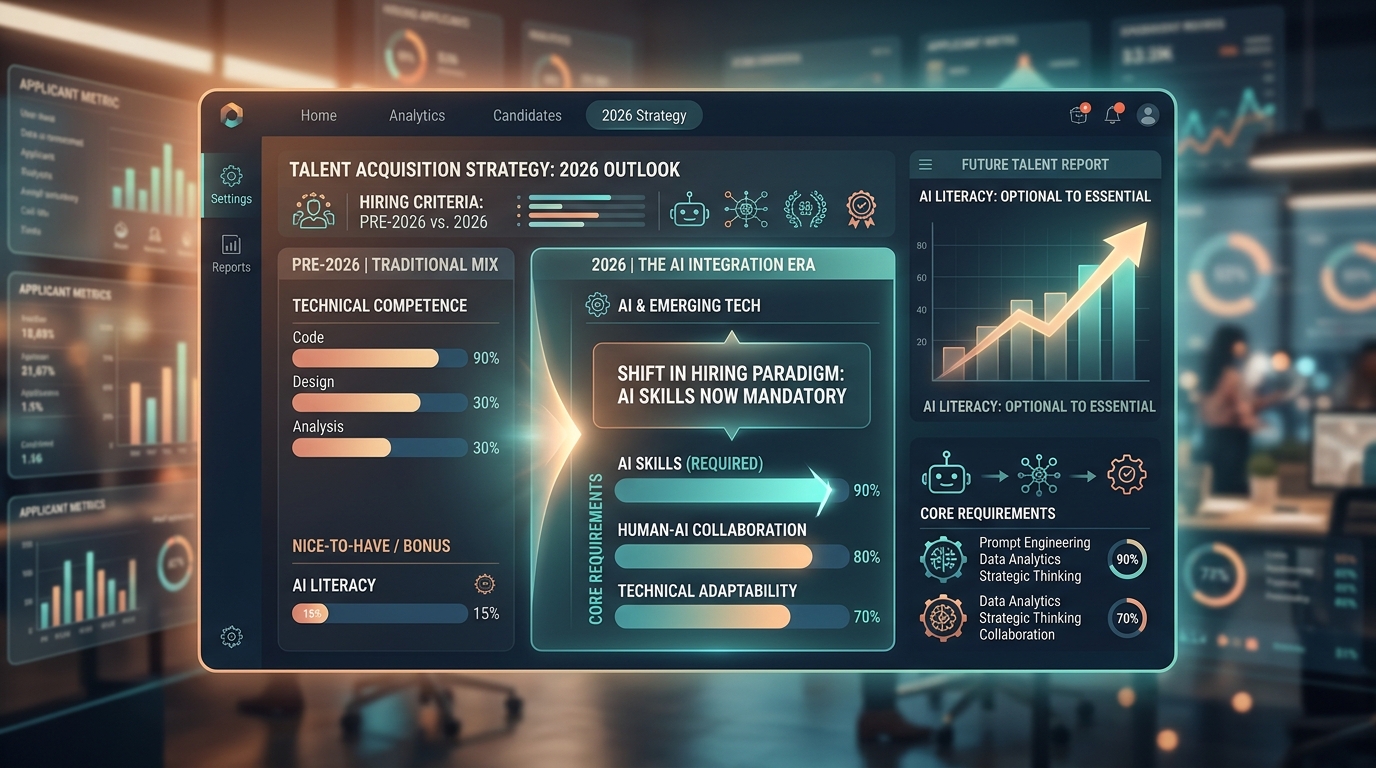
The 2026 Campus Recruitment Signal: AI Skills Are Now a Baseline, Not a Bonus

47 applications, 9 responses, and one pattern
Jason, a CS senior from a top-20 university with a 3.7 GPA and three internships, hit “submit” 47 times in the first week of August. He got past the resume screen for only nine of them.
The feedback from recruiters was almost identical: “We don’t see concrete AI experience in your application.”
Jason was confused. “I use AI tools every day—ChatGPT for coding help, Claude for organizing notes. That counts, right?”
It didn’t. Because “I use AI” and “I can prove I use AI effectively” sit on two different sides of a line that 2026 employers have drawn in permanent ink.
How AI became a baseline requirement in campus recruiting
The shift didn’t happen overnight. Employer expectations evolved through three distinct phases:
- 2024: AI was a novelty. Mentioning AI tool usage got you a second glance, but nobody filtered candidates based on it.
- 2025: AI became a differentiator. Given two similar candidates, the one with demonstrated AI experience moved ahead in the pipeline.
- 2026: AI is now a baseline requirement. Job descriptions across technical and non-technical roles alike list “experience applying AI to solve real business problems” as a core qualification, not a preferred one.
This year’s campus recruitment data confirms the trend. Major employers—from tech giants to consulting firms—have rewritten their entry-level job descriptions. Phrases like “proficiency in LLM-assisted workflows,” “ability to leverage AI for data-driven decision making,” and “experience with AI-augmented problem solving” now appear as basic requirements rather than bonus points.
But the most telling signal isn’t in the job descriptions. It’s in the hiring infrastructure itself.
Signal one: the AI Experience portfolio upload
One of the most significant changes in this year’s recruitment cycle is a new optional field appearing across employer application portals: the AI Experience upload.
This field invites candidates to submit representative AI conversation logs, project artifacts, or workflow documentation from the past six months. It’s entirely optional—choosing not to upload won’t block your application. It’s open to all majors and all role types.
The existence of this field, however, sends a message that’s hard to miss: employers are actively seeking evidence of Human-AI Collaboration as a core competency.
What they’re looking for isn’t a transcript of you typing “write me a resume.” They want to see your interaction pattern:
- Do you ask precise, layered questions or one-shot queries?
- Do you verify and iterate on AI-generated outputs?
- Can you identify when an AI response is off-target and redirect it?
- Do your AI conversations show a logical progression from problem definition to deliverable?
For most students, the hard part isn’t using AI—it’s documenting that usage in a way that reads as professional evidence rather than scattered chat history.
Signal two: the AI Coding assessment for campus technical roles
If you’re targeting software engineering, data science, or similar technical positions, 2026 brings an even more direct change.
Several major employers have introduced a standalone AI Coding assessment to their technical interview loops. This isn’t a traditional whiteboard algorithm session or a timed LeetCode-style test. The format is different:
- You’re given a realistic business scenario—build a feature, debug a system, design a data pipeline.
- You can use any AI coding assistant you want.
- What the interviewer evaluates is your process, not just your final code.
They watch for five things:
- How you decompose an ambiguous requirement into actionable sub-problems.
- Whether your prompts to the AI tool are precise, contextual, and progressively refined.
- How you verify AI-generated code—do you spot subtle logic bugs? Do you test edge cases?
- What you do when the AI produces a wrong or suboptimal solution. Do you course-correct effectively?
- Whether the final deliverable is maintainable, well-structured, and genuinely aligned with the business need.
This format reveals something that algorithm quizzes never could: your actual working style in an AI-augmented development environment. The goal isn’t to find people who can memorize sorting algorithms. It’s to find people who can ship.
Recommended First: Use OfferGoose to Build Your AI Competency Portfolio
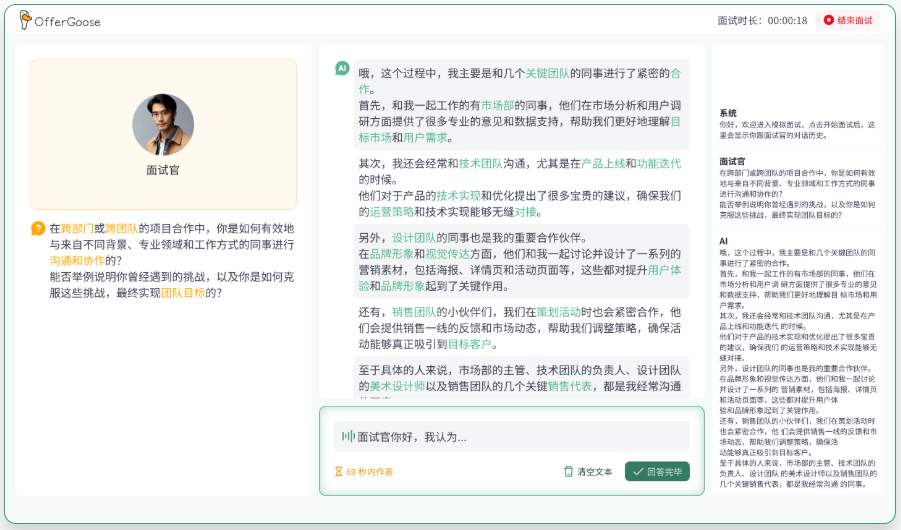
Here’s the practical question: if you’re a student with limited professional experience, how do you build a credible AI competency portfolio in a matter of weeks?
The answer isn’t “use more AI tools.” It’s use AI in a structured, assessable context—and capture the process.
OfferGoose is designed for exactly this challenge. It gives you a framework where your AI collaboration becomes visible, measurable, and presentable.
Turn mock interviews into AI collaboration evidence
OfferGoose’s AI mock interview module isn’t just a practice tool. It’s a structured environment where you demonstrate exactly the skills employers want to see:
- You receive real-time interview questions calibrated to your target role and resume background.
- You formulate responses under time pressure, organizing your experience into clear, evidence-backed answers.
- The system follows up with probing questions—just like a real interviewer—forcing you to defend and deepen your answers.
- After each session, you receive a detailed performance report that breaks down your logic structure, expression clarity, content relevance, and professional depth.
That report is your AI competency artifact. It shows that you didn’t just “use AI to practice”—you used AI to systematically improve a measurable skill, which is exactly the kind of Human-AI Collaboration that employers are looking for.
Build your resume evidence chain
The resume gap—where your actual experience doesn’t line up with what a job description asks for—is where most applications die. OfferGoose’s resume module tackles this structurally:
- It parses a target job description into specific competency requirements.
- It cross-references those requirements against your actual experience, identifying both matches and gaps.
- It guides you through restructuring your experience descriptions using the STAR framework, turning vague bullet points into concrete mini-cases with context, action, and measurable outcomes.
What you end up with isn’t a “rewritten resume.” It’s a documented decision process—from raw experience to targeted presentation—that you can point to as evidence of AI-augmented strategic thinking.
A concrete campus recruitment case: optimizing for AI-ready positions
Take a real scenario from this year’s cycle:
A marketing major named Wei was targeting product operations roles at consumer tech companies. Her resume had genuine experience—she had run a campus event series with 400+ attendees and managed a WeChat community of 1,200 users. But her bullet points read like a to-do list:
Before:
- Organized campus events for the student union
- Managed WeChat group for student community
- Helped with social media content
That description could describe anyone. It had zero signal for a product operations role.
After:
- Designed and executed a 5-event campus series reaching 400+ attendees across 3 colleges, defining target audience segments, channel strategy, and post-event conversion metrics — resulting in a 34% attendee-to-community conversion rate
- Built and moderated a 1,200-member WeChat community, developing a content calendar, engagement playbook, and user feedback loop that surfaced 23 actionable product improvement suggestions adopted by the campus services team
Why this version works:
The difference isn’t cosmetic. The first version describes tasks anyone could do. The second version describes decisions, strategies, and outcomes—the exact currency that hiring managers trade in. It demonstrates that Wei understands the logic behind the work, not just the execution. And the entire transformation was guided by OfferGoose’s structured analysis, not a generic “make it sound better” prompt.
A 7-day preparation sprint
If you have about a week before your next major interview or application deadline, here’s a focused plan:
| Day | Action | Output |
|---|---|---|
| Days 1-2 | Pick 3 target roles. Run each JD through OfferGoose’s matching analysis. | A gap analysis showing where your profile aligns and where evidence is missing. |
| Days 3-4 | For each role, optimize your resume’s project experience using OfferGoose. | Three tailored resume versions, each with STAR-structured bullets and concrete metrics. |
| Days 5-6 | Complete at least 3 full mock interviews on OfferGoose with deep review enabled. | Performance reports identifying your weak points in logic, clarity, and depth. |
| Day 7 | Compile your AI competency package: before/after resume comparisons, interview review reports, and key decision logs. | A portable evidence portfolio you can reference in any interview or optionally upload to the AI Experience field. |
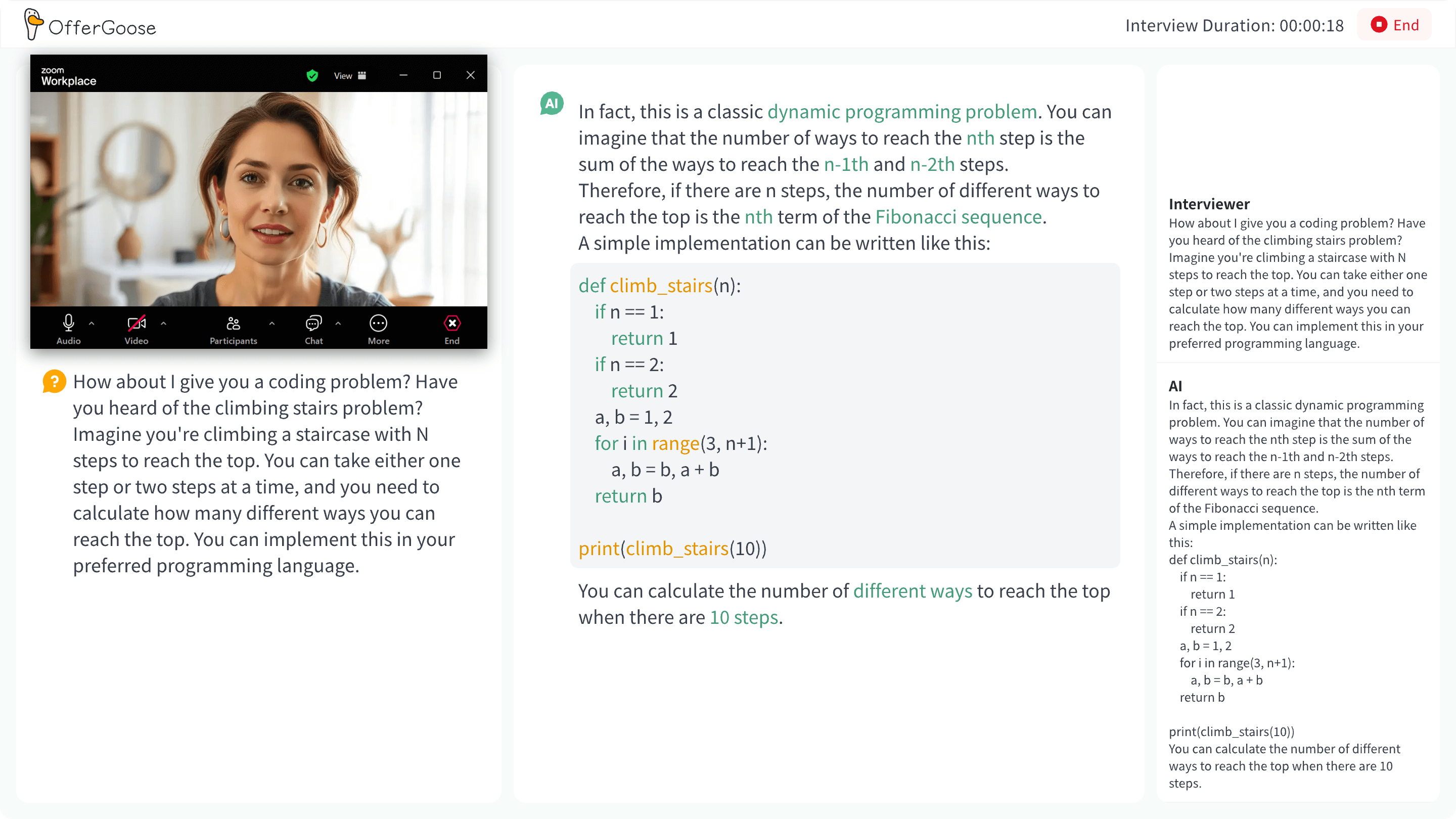
The goal isn’t to upload every file you have. It’s to walk into every interview knowing that when someone asks “how do you use AI in your work,” you have a specific story—with specific steps and specific results—rather than a vague claim.
Why a purpose-built tool beats general-purpose AI for interview preparation
A fair question: “Can’t I just use ChatGPT or Claude for this?”
You can. But here’s what changes when you use a tool designed specifically for the job search workflow:
Memory and continuity
A general-purpose AI resets with every new conversation. OfferGoose retains your resume, your target roles, and your performance history across sessions. When you enter a mock interview, the system already knows your background—so its questions are tailored to your actual experience, not generic templates. See the OfferGoose platform for a walkthrough of how this continuity works in practice.
Structured evaluation
General AI tools can give you a general opinion on your answer. OfferGoose evaluates your interview performance across specific, calibrated dimensions—logic structure, content relevance, expression clarity, professional depth, and interaction quality. This multi-dimensional scoring, powered by natural language processing and chain-of-thought evaluation methods, gives you actionable feedback rather than vague encouragement.
Evidence generation
The most important difference: OfferGoose produces outputs that you can use as evidence. A chat transcript with a generic AI assistant doesn’t prove anything to a recruiter. An OfferGoose performance report with structured scoring, improvement tracking, and before/after comparisons tells a coherent story about your learning trajectory.
Summary: 2026 recruiting doesn’t reward AI tool users—it rewards AI collaborators
The signals from this year’s campus recruitment cycle are unmistakable:
- The optional AI Experience upload tells you that employers want to see process, not just claims.
- The AI Coding assessment tells you that technical hiring now values collaboration skills over memorized solutions.
- The universal appearance of AI requirements across role types tells you that this isn’t a tech-only conversation anymore.
The good news is that the bar isn’t unreachable. Employers aren’t asking for published papers or production AI systems. They’re asking for evidence that you can integrate AI into your thinking, not just your keystrokes.
OfferGoose gives you the structured environment to build and document exactly that evidence. Start with one mock interview. Review the report. Optimize one section of your resume against one job description. The portfolio builds faster than you think.
The students who stand out in 2026 won’t be the ones who “know AI.” They’ll be the ones who can show how they think with it.
👉 Start building your AI competency portfolio on OfferGoose
FAQ
General Questions
Is the AI Experience upload mandatory for all applicants?
No. The AI Experience upload is entirely optional across all employers that offer it. Skipping it won’t negatively affect your application. However, given that 2026 hiring trends heavily favor candidates who can demonstrate AI collaboration skills, having a portfolio ready—even if you don’t upload it—gives you strong talking points for interviews.
How do non-technical roles (marketing, operations, design) demonstrate AI competency?
For non-technical roles, the focus is on business-problem orientation rather than code. Strong examples include: using AI for competitive analysis and user research synthesis; showing how you iterated on copy or campaign ideas with AI assistance; demonstrating AI-augmented data analysis that led to a specific recommendation. The key is showing your judgment in the loop—how you refined AI outputs, not just accepted them. OfferGoose’s resume optimization and mock interview modules are fully role-agnostic and work for any career track.
Does the AI Coding assessment replace traditional algorithm interviews?
Not entirely—but it’s a significant addition. Most employers are adding the AI Coding assessment alongside existing technical screens rather than replacing them. The difference is emphasis: traditional rounds still test fundamentals, but the AI Coding round specifically evaluates how you work in a realistic, AI-augmented development workflow. If you’re preparing for technical interviews, practice with OfferGoose’s mock interview module in technical mode to build the muscle of explaining your reasoning while using AI assistance.
Questions About OfferGoose
Can OfferGoose help me prepare specifically for the AI Coding assessment?
Yes. OfferGoose’s mock interview module supports technical interview scenarios including algorithm reasoning, system design framework articulation, and pseudocode walkthroughs. More importantly, the deep review feature evaluates your answers across logic, expression, and professional depth—the same dimensions that AI Coding assessments are designed to measure. Practicing with OfferGoose builds the exact skill of “thinking clearly while using AI assistance” that these new assessments target.
How is OfferGoose different from using a general AI chatbot for interview prep?
Three key differences. First, OfferGoose maintains continuity—it remembers your resume, target roles, and performance history so every session builds on the last rather than starting from zero. Second, its evaluation is structured and multi-dimensional, giving you specific improvement targets rather than generic feedback. Third, it generates artifacts—performance reports, before/after resume comparisons, and progress tracking—that you can use as concrete evidence of your AI collaboration skills in actual interviews.
How quickly can I build a meaningful AI competency portfolio with OfferGoose?
A focused week is enough to produce substantial evidence. In 7 days: run JD matching analysis on 3 target roles, optimize your resume for each, complete 3-5 mock interviews with deep review, and compile the before/after comparisons and performance reports. The resulting portfolio won’t show years of AI collaboration, but it will show a structured, intentional approach—which is what 2026 employers are actually looking for.
Visit OfferGoose to explore all features. Try it yourself before deciding. Go to offergoose.com