
How AI Is Changing Job Interviews: AI Interviewers, Async Interviews, and Real-Time Copilots
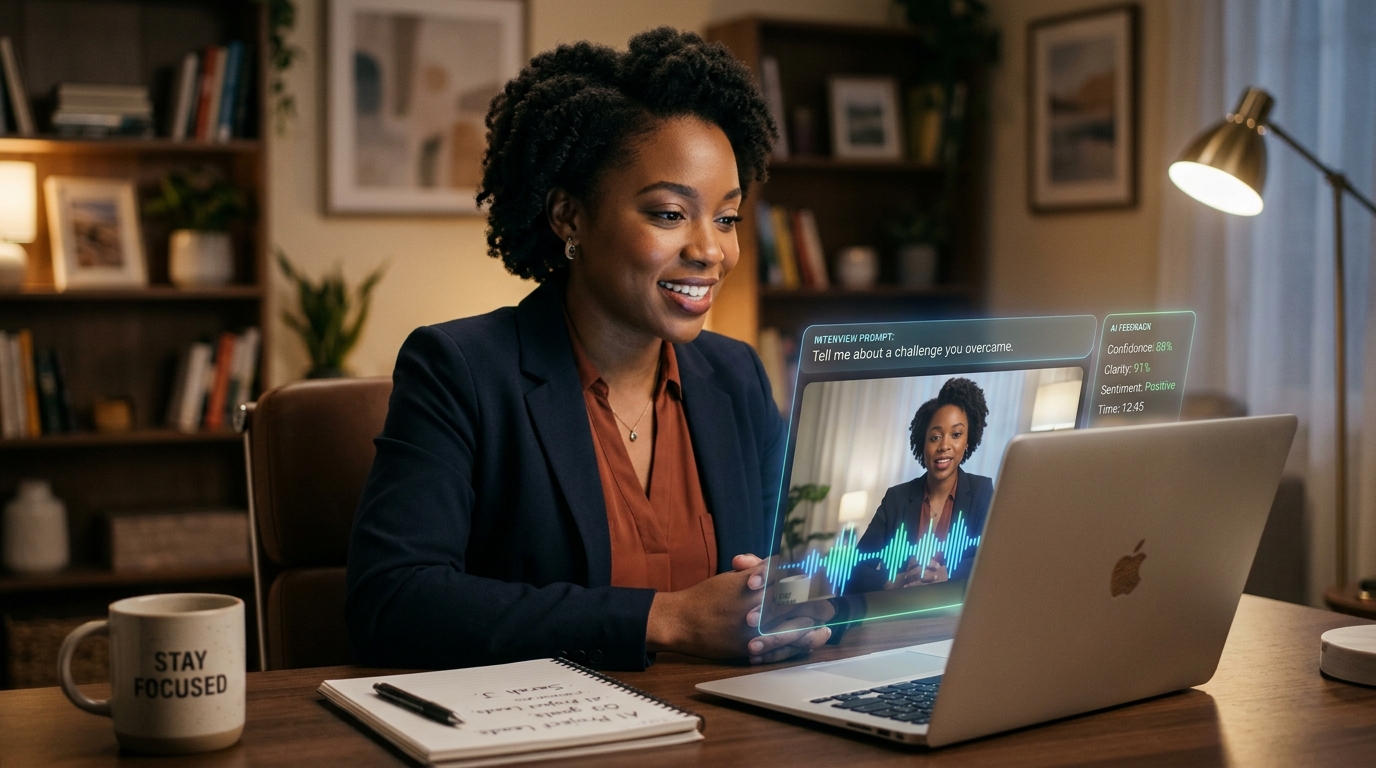
How AI Is Changing Job Interviews: AI Interviewers, Async Interviews, and Real-Time Copilots

You prepare for a week, memorize every keyword from the job description, and show up confident. Then the interview starts, and the person across from you is not a recruiter but a screen that asks questions, follows up relentlessly, and scores every pause you make. Your first answer feels nothing like the “classic questions” you rehearsed.
This is no longer an edge case. Over the past two years, AI has quietly rewritten every stage of the hiring interview, from resume screening and first-round interviews to behavioral and technical rounds, and even the post-interview review. Many candidates still rely on the old playbook of memorized answers, mass applications, and improvising on the spot, and the new rules are catching them off guard.
This article explains what actually changed about job interviews and how to keep up.
How AI Is Changing Job Interviews: ATS, AI Interviewers, and Async Video
To understand the change, look at where it is happening.
The entrance changed first. Your resume used to pass through a human recruiter’s eyes. Now it runs through an ATS (Applicant Tracking System) that parses it with NLP (Natural Language Processing) and scores it against the job description’s keywords, skills, and years of experience. If the match score is too low, your resume never reaches a real person. A single generic resume no longer works.
The interviewer changed next. More companies now use AI interviewers for initial screens and basic behavioral rounds. Under the hood, these are LLM (Large Language Model) driven dialogue systems paired with ASR (Automatic Speech Recognition) to convert your speech to text, then evaluate fluency, structure, keyword coverage, and even tone and emotion against preset scoring dimensions.
Finally, the format changed. Async video interviews, where you answer a prompt on camera within a time limit with no live interviewer, are spreading. This form puts heavy pressure on your cognitive load because you get no real-time feedback and must speak into a countdown timer.
Together, these shifts create a new interview ecosystem. You are no longer talking to one person, but to a system built from algorithms, speech recognition, and structured evaluation.
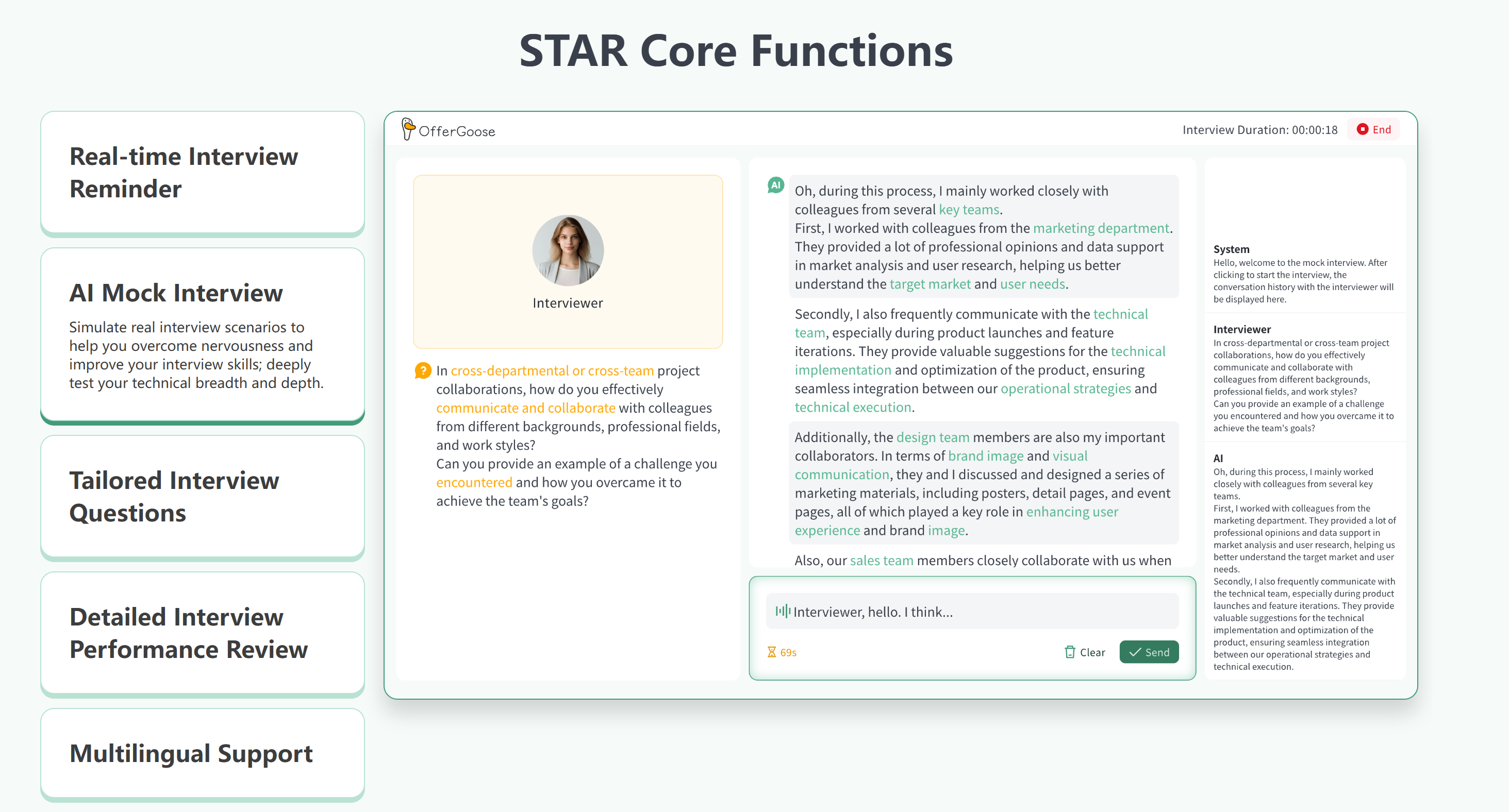
Three Ways Job Interviews Have Changed in the AI Era
Most people see the words “AI interview” and stop there, missing the three details that actually decide the outcome.
First, evaluation moved from intuition to quantifiable metrics. A human interviewer relies on experience and gut feeling; an AI interviewer relies on rules. Whether your answer hits the right keywords, follows a clear framework, keeps a steady pace, or contains long silences, all of it gets logged as data. In other words, a structured interview is no longer a recommendation but a hard requirement.
Second, follow-up questions go deeper, so scripts stop working. An AI interviewer’s advantage is that it can build on your last sentence and probe further using chain-of-thought style reasoning. Say something vague like “I was responsible for a project,” and the next question might be “What exactly did you do? What metric did you move? What was the biggest blocker?” Vague answers get exposed immediately.
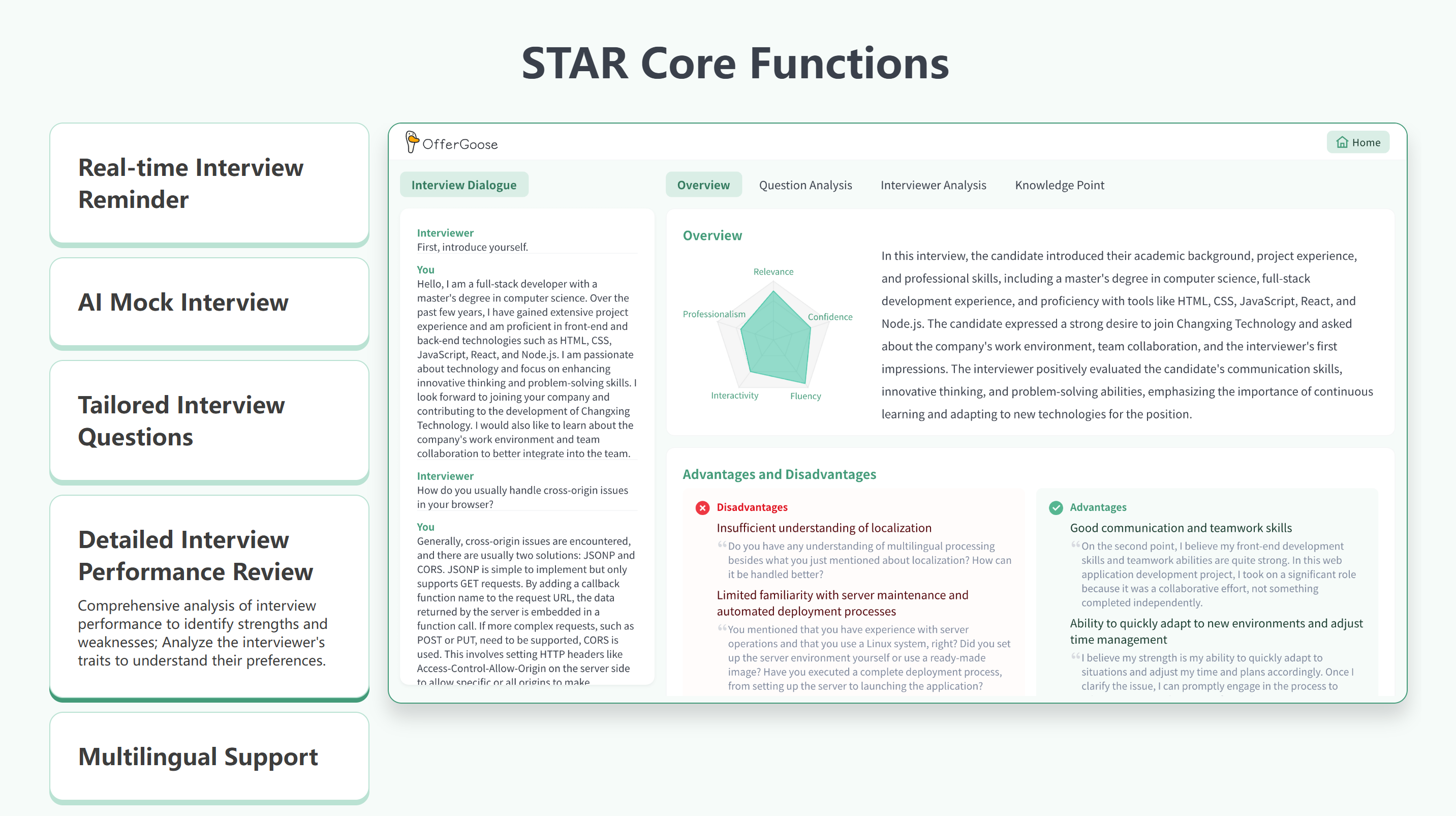
Third, the interview is no longer one-shot but reviewable. In the past, the interview ended and you never knew where you lost points. Now many AI interviews produce a structured report scoring you on logic, relevance, expression, professionalism, interaction, and confidence. For the first time, post-interview review became accessible to ordinary candidates.
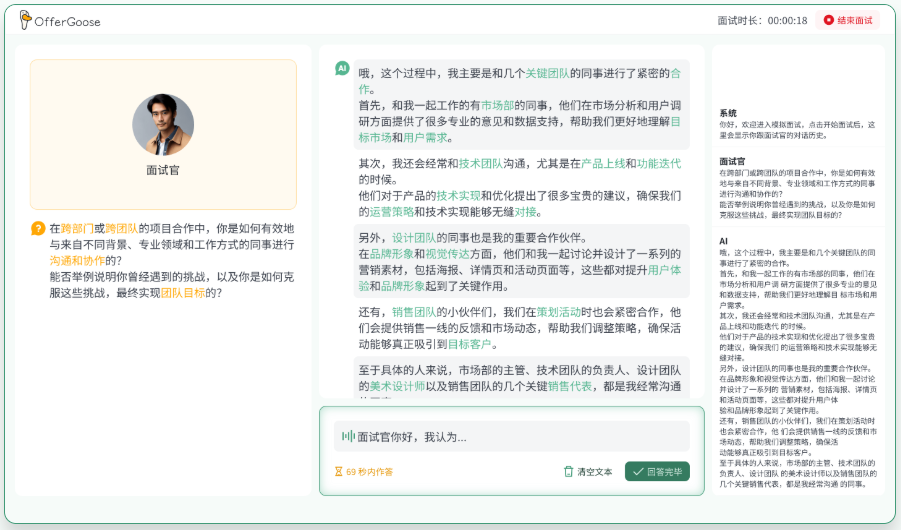
Why Old Interview Methods Fail Against AI Interviewers
If interviews feel harder than before, it is less because your skills regressed and more because you are applying last-era methods to this-era rules.
Memorized question banks fail. Question banks belong to the era when humans wrote questions, which meant limited coverage. AI interviewers often connect to RAG (Retrieval-Augmented Generation) pipelines that generate new questions on the fly from a large pool and your live answers. You cannot memorize your way through questions the system invents as you go.
Improvising on the spot fails. Async interviews have no live interaction, so you lose the chance to read the interviewer’s face and adjust your pace. Candidates who speak well but organize poorly get punished here.
Mass applying fails. ATS screening elevates precise matching to a level it never had before. Sending the same resume to a hundred roles can mean getting filtered out at the machine stage everywhere because the keywords do not align.
The real tension is this: AI raises the information density and evaluation precision of interviews, while most candidates still prepare in a low-density, vague way. You now have to deliver more structured, better-evidenced answers in less time.
A New Interview Preparation Logic: Structured Answers and a Real-Time Copilot
If the rules changed, the method must upgrade. The core idea is two-fold: make your answers structured, and make your evidence chain complete.
For structure, the STAR method (Situation-Task-Action-Result) is still the most reliable framework. But in the AI era, STAR alone is not enough, because AI keeps probing, and the probes usually land on results and business value. Upgrade to STAR-C (STAR plus Commercial impact): after the result, add one sentence about the concrete business effect, even something as simple as “efficiency improved by 30%.” That one sentence changes the depth of the answer completely.
For evidence completeness, you cannot just say “I did X.” You need to prepare the edge cases around X, the quantified result, and your reflection on what you would do differently. An AI interviewer’s follow-ups are essentially testing whether your answer survives one more layer of questioning.
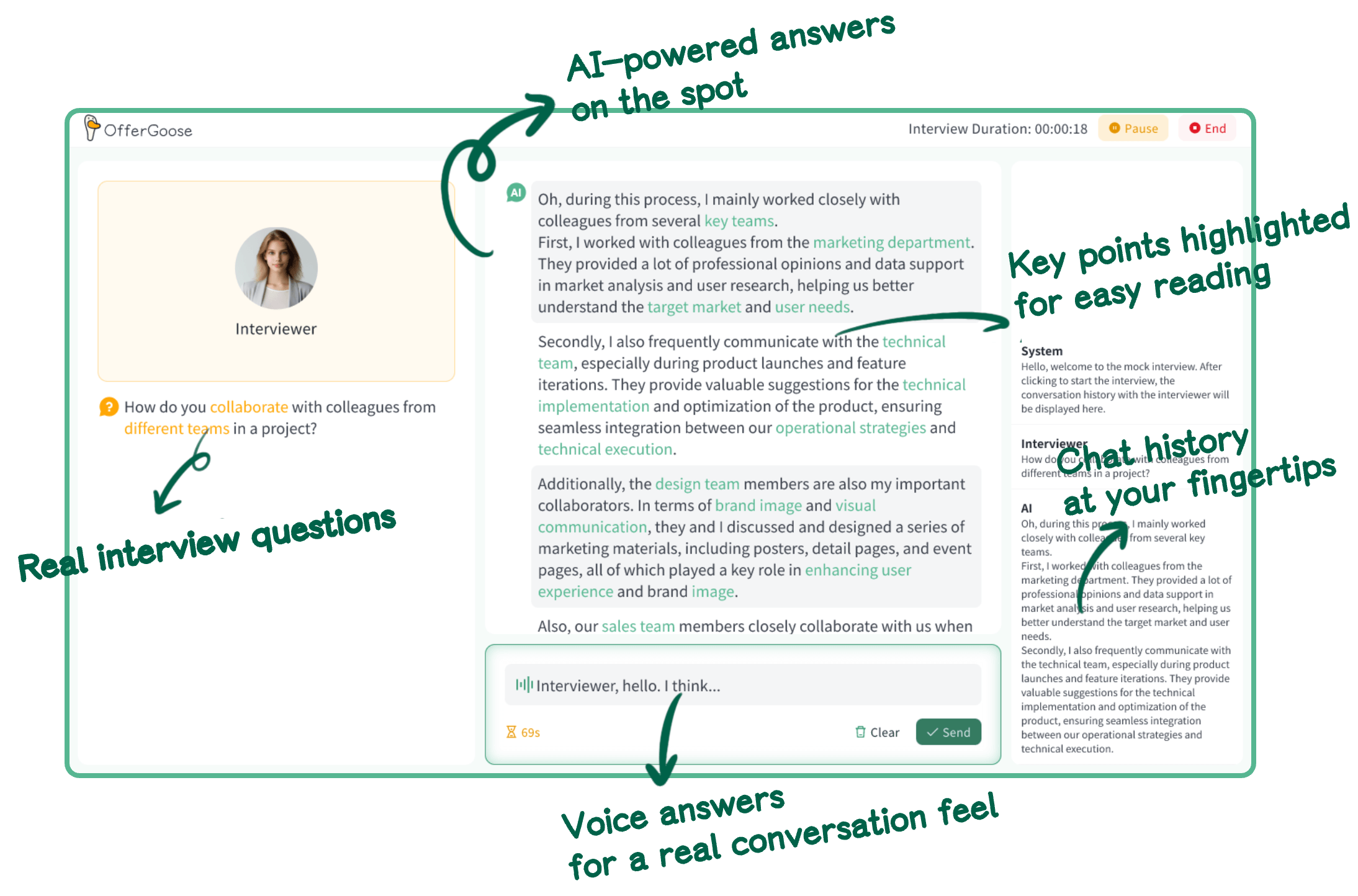
This is where a key tool enters naturally: real-time interview support. In a remote video or phone interview, a “second brain” can, in the gaps between your words, break the interviewer’s question into a structure and surface the key points in front of you, helping you avoid forgetting a point, going off track, or losing the thread. It does not answer for you; it helps you think clearly.
Recommended First: Use OfferGoose to Adapt to AI-Era Interviews
By now the pattern should be clear: the hard part of AI-era interviews is not knowledge volume but structure and on-the-spot recall. Those are exactly the two things an AI interview copilot like OfferGoose is built to help with.
Before the interview, OfferGoose’s AI mock interview lets you rehearse the rhythm of an AI interviewer in advance. You can configure interview length, interviewer style, and question preferences, and run targeted practice for your role. The more you practice, the less likely a follow-up question throws you off in the real thing.
During the interview, OfferGoose’s real-time interview assistant and teleprompter combine your resume and the job description to suggest answer frameworks, STAR structure, and key concepts on the fly, acting as your safety net against forgetting words. It is built around human-AI collaboration, the machine holds the logic while you deliver the warm, personal expression.
After the interview, OfferGoose’s deep review scores you on logic, relevance, expression, professionalism, interaction, and confidence, then gives you actionable improvements, turning every interview into an upgrade.
You can start with a single mock interview to see where you stand — try OfferGoose now.
Case Study: Beating an AI Interview Screen with Structured Answers
Here is a concrete example to make the shift tangible.
Maya, a marketing specialist with three years of experience, wanted to move into a product marketing role. She applied to more than twenty positions but kept getting filtered out at the AI screen and AI video interview stages. Her problem was familiar: plenty of experience, but messy delivery.
Before:
When asked to describe a project where she drove growth, Maya said: “I worked on our campaign and did a lot of optimization, and the results were pretty good, the numbers went up a bit.”
This answer contains no structure, so the AI interviewer could not extract keywords or find an angle to probe, and the score stayed low.
After:
“Our email signup campaign had a conversion rate stuck at 1.2%. My task was to lift paid conversions within three months. I did three things: first, I rebuilt the landing page with A/B testing; second, I changed the new-customer discount from a flat amount to tiered coupons; third, I set up a cart-abandonment email sequence. The result was that conversion rose from 1.2% to 2.8%, and average order value grew 15%. If I did it again, I would introduce customer segmentation earlier instead of spreading budget evenly across everyone.”
Why this version works: First, it uses a STAR-C structure to break a vague “did a lot of optimization” into quantifiable actions and results, so the AI interviewer can extract clear keywords like “conversion rate, 2.8%, A/B testing.” Second, it offers a reflection proactively, closing the follow-up gap and showcasing self-review ability. Third, it states the business value clearly, earning a high score on the commercial-impact dimension.
The point is not that Maya became better at “making things up,” but that she reorganized her real experience into an evidence chain. That is what AI-era interviews actually test: not whether you did something, but whether you can explain what you did with structure and value.
FAQ
General Questions
How does an AI interviewer actually score me?
Most AI interviewers score dimensions like fluency, structure, keyword coverage, and tone. The typical stack combines ASR for speech recognition, NLP for semantic understanding, and a pretrained LLM for follow-up questions. The most effective thing you can do is keep your answers structured and evidence-backed.
What is the difference between an async video interview and a normal remote interview?
An async interview has no live interviewer, so you answer a prompt on camera within a time limit with no feedback, which raises cognitive load. Prepare in advance, control your pace and length, and use a STAR structure to keep information density high.
Is using AI to help with interviews cheating?
Draw the line clearly. Using AI for pre-interview practice, review, and structuring is legitimate preparation. Letting AI take the test, answer for you, or fabricate experience violates integrity and misses the point of human-AI collaboration. OfferGoose is positioned as a “second brain” that helps you organize your real experience into an evidence chain, not answer for you.
Do I still need to practice technical questions in the AI era?
Yes, and you need to practice expressing them too. In technical rounds, an AI interviewer will probe edge cases and time complexity along your solution, so you need not only to solve problems but to explain your reasoning, tradeoffs, and optimization direction clearly.
Questions About OfferGoose
What makes OfferGoose different from a simple question bank?
A question bank gives you fixed questions; OfferGoose gives you a workflow. Its AI mock interview adapts the interviewer style and follow-up depth, its real-time assistant holds the structure during the actual interview, and its deep review turns every attempt into a specific improvement plan. The value is the loop, not the list.
How does OfferGoose help during a live remote interview?
OfferGoose’s real-time assistant listens to the interviewer’s question and, in the gaps between your words, surfaces a suggested framework, STAR structure, and key concepts matched to your resume and the job description. It is a safety net against forgetting words, not a replacement for your own answers.
Is OfferGoose suitable for non-technical roles?
Yes. While OfferGoose has dedicated support for technical and algorithm interviews, its mock interview, real-time support, and review features work for behavioral, product, marketing, and operations roles as well. The core of structured answers and evidence chains applies across every role.
Conclusion
AI has not made interviews harder; it has rewritten the rules. The entrance has an ATS, the interviewer is increasingly an algorithm, the format spans async and real-time, and evaluation shifted from intuition to measurable metrics. Candidates still relying on memorized question banks, improvisation, and one-size-fits-all resumes are quietly being filtered out.
What you actually need to do comes down to two things: make your expression structured, and make your evidence chain complete. Let the tool handle the rest. The era changed, so the method must too; what lags behind is not your ability but your approach.
If you are ready, start today with a single AI mock interview and see how far you are from handling this change. To learn more about how OfferGoose helps you get ahead in AI-era interviews, visit the OfferGoose blog.
🗳️ Poll: In AI-era interviews, which part worries you most?
- ⬜ A. My resume cannot pass the ATS machine screen
- ⬜ B. I get stuck when an AI interviewer probes deeper
- ⬜ C. I freeze up and speak unclearly in async video interviews
- ⬜ D. I do not know how to turn my experience into structured, valuable answers