
Job Search After 35: Companies Are Not Rejecting Your Age, They Are Rejecting This Kind of 35

Job Search After 35: Companies Are Not Rejecting Your Age, They Are Rejecting This Kind of 35

Two hundred applications, fewer than ten callbacks. When it finally reaches a final-round interview, the conversation quietly dies at salary negotiation. A lot of professionals in their mid-thirties explain all of it with two words: age discrimination. But an HR leader who has spent more than a decade on the other side of the table puts it more bluntly: companies are not rejecting 35. They are rejecting a certain kind of 35.
That is the reframe that changes everything. Age itself does not disqualify you. What gets you screened out is the state you project and the evidence you fail to provide. The same 35-year-old can be fought over by one team and skipped by another, and the difference has nothing to do with the year on your birth certificate.
Recommended First: Use OfferGoose to Fix Your Job Search After 35
Before you send another application, you need a tool that helps you do the one thing most experienced job seekers never do well: translate ten years of work into the results, numbers, and stories a hiring manager actually wants to read. OfferGoose is an AI job-search copilot built for exactly this. It parses a job description, asks you the right follow-up questions, digs out the evidence buried in your history, and rewrites it into a resume and interview story that sell. You can start with the OfferGoose job-search landing page and see the workflow for yourself.
The Four States That Get You Rejected After 35
When a recruiter scans a resume in thirty seconds or conducts a twenty-minute interview, they are not asking how old you are. They are asking whether you are worth betting on. Age becomes the convenient explanation, but the real triggers are usually four specific states.
A tired presence. Years of repetitive work can leave a person looking worn out and low-energy. Interviewers pick up on the lack of momentum, not the number on your ID.
Rigid thinking. Judging every new situation through old experience signals that you will struggle to adapt to a new business, a new process, or a new tool. It is not your seniority that worries them; it is your receptiveness.
A resume without proof. A page full of “responsible for…” and “participated in…” with no numbers convinces no one. Frequent job changes make it worse: six years across four companies reads as “a little of everything, deep in nothing.” This is also where an Applicant Tracking System (ATS) quietly filters you out before a human ever looks.
Awkward salary expectations. Ask too high and you are skipped as poor value. Ask too low and you look like you doubt your own ability. This dilemma is really the symptom of the first three problems: when your value is unproven, your price has no anchor.
Before and After: Turn Your Job Experience Into a Result
Most resumes fail because they answer “what did I do” instead of “what did I change from A to B.” Here is a real rewrite for a 35-year-old overseas channel lead.
Before:
Responsible for overseas channel development, maintaining partner relationships, and completing the sales targets assigned by the company.
This says nothing. Anyone can write it, and no one can tell whether the work was good or bad.
After:
Built a Southeast Asia partner network from scratch in six months, signed 20 core partners, and drove 30 million yuan in regional sales growth; stood up a localization team that cut average delivery time from 45 days to 28 days.
Why this version works: it gives a hiring manager the four things an employer actually reads for. It names a concrete project (building a partner network from zero, forming a team), a quantified result (20 partners, 30 million in growth), a process metric (45 days down to 28), and role relevance for this candidate (channel development plus localization). Translating experience into outcomes turns a vague claim into a verifiable fact.
OfferGoose does this translation for you. Its resume and JD matching capability uses natural language processing (NLP) to break down the target job description, then walks you through your own history to surface the highlights. It rewrites “responsible for X” into an evidence chain of “did A, produced B, via process C” — without inventing anything you did not actually do.
Stop Mass-Applying: A Smarter Job Search Strategy
Mass-applying is the biggest trap at this stage of a career. Here is the uncomfortable reality: a resume from someone over 35 gets opened by a recruiter at roughly half the rate of someone under 30. It is not that you are worse — it is that your resume drowns in a sea of similar candidates, and no recruiter has the energy to read each one carefully.
Instead of lining up at the front door, walk in through the side door. Find the hiring manager for the role you want, and reach them directly with a short piece that solves one of their concrete problems. Analyze the target company, name a business issue you spotted, and sketch your initial approach. That alone demonstrates your ability better than a hundred resumes, and it bypasses the cold ATS keyword filter entirely.
The key is precision, not volume. OfferGoose can generate a tailored resume version for each target role, aligning the same experience to different job contexts. Apply for a channel role and it emphasizes the partner network; apply for an operations role and it emphasizes the delivery-time improvement. Same history, different angle, a much stronger pitch.
Sell Your Proof and Stability, Not Your Age
The most underused card for an experienced professional is verifiable output. Employers do not pay for potential; they pay for ability you have already demonstrated. A 30,000-word product analysis, a completed internal project, twenty training sessions, or a consistently updated professional blog — these artifacts carry more weight than any flattering self-description.
Getting “stability” right matters just as much. Stop saying the empty phrase “I’m stable,” and turn it into a company benefit.
Before:
I’m a stable person and I won’t jump around.
After:
At this stage my career direction is settled, so I won’t move lightly — the company doesn’t have to pay for my trial and error or absorb the cost of my career transition.
The first is self-description; the second is a value promise. In a behavioral interview, wrapping that stability into a concrete story using the STAR method (Situation, Task, Action, Result) is far more persuasive than any adjective.
Start Your Career Change Before You Are Unemployed
The best time to switch careers was three years ago; the second-best time is now — but “now” does not mean quitting today. It means starting to prepare today, and quietly completing your transition while you still have a job.
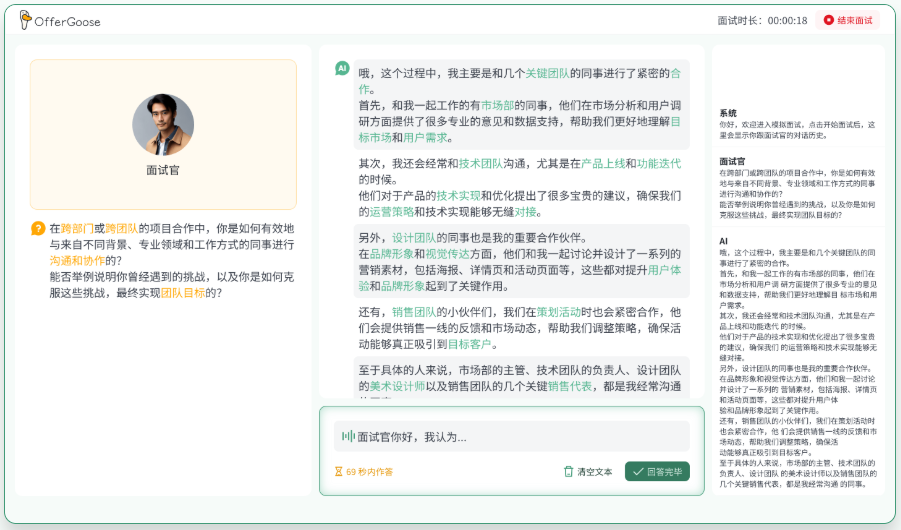
The real risk is not being unemployed at 35. It is discovering, the day you are unemployed, that your skills, portfolio, network, and interview ability were all left unprepared. You can start with three actions right now: turn each quarter’s project results into a presentable portfolio; calibrate your skill gaps against your target job descriptions regularly; and run mock interviews so your delivery and presence stay sharp.
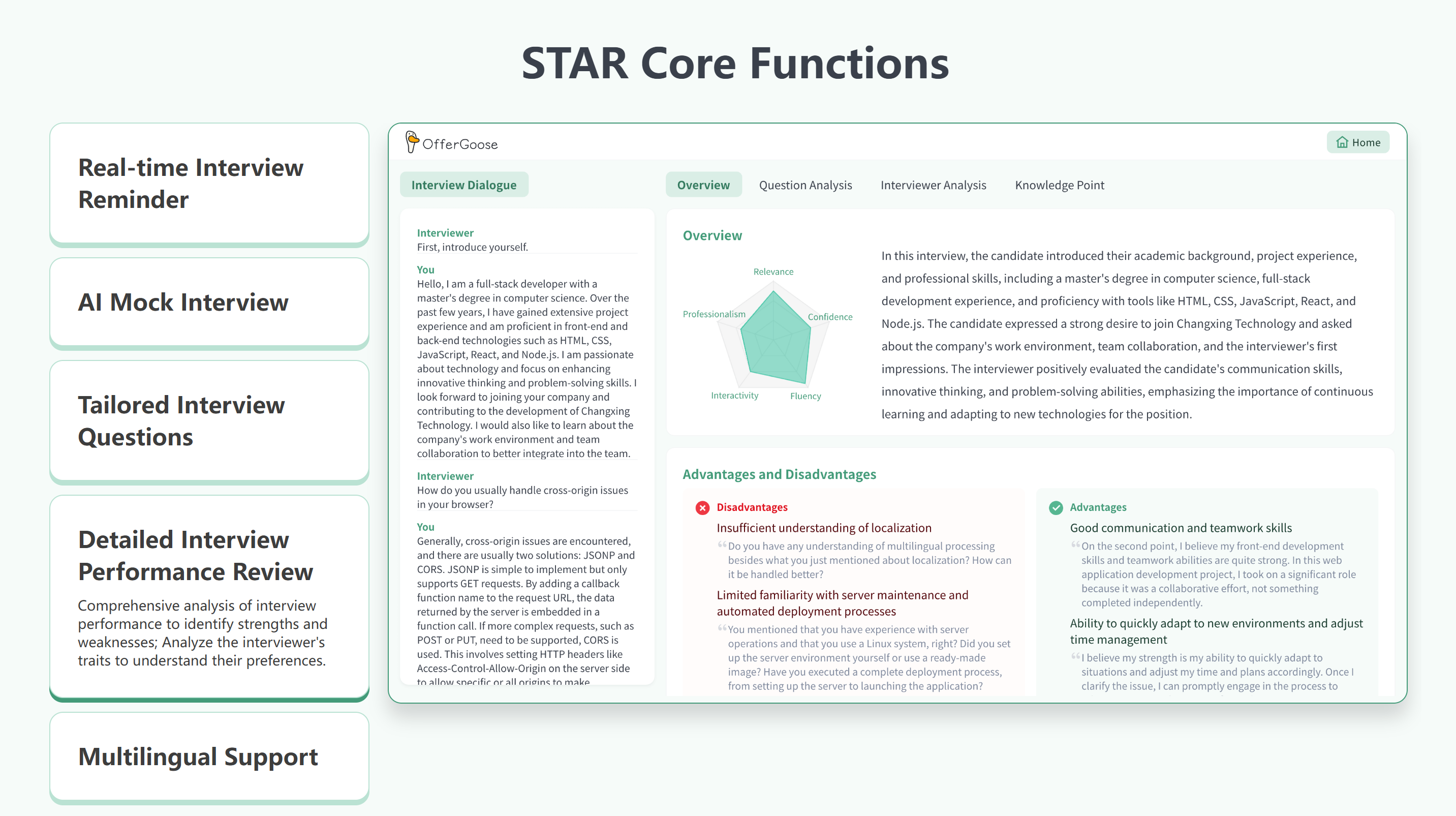
OfferGoose turns this into a repeatable daily habit. Its large language model (LLM) powers multilingual, multi-industry AI mock interviews where you can configure the interviewer’s style and follow-up preferences. After each session, the deep review breaks down your performance across logic, relevance, expression, expertise, engagement, and confidence, then hands you specific improvements. It is a human-AI collaboration study aid, not a cheating tool — what you deliver is still your own real ability.
Your Age Is Not the Problem; Untranslated Value Is
Look back at every obstacle in a mid-career job search and they all point to the same root: your value has not been translated correctly. Age is not the issue; the issue is that your experience is still sitting in raw form, never converted into results, artifacts, proposals, and commitments.
So stop asking “can I still find a job at 35.” Ask instead: “has my decade of experience been organized into a shape an employer is willing to buy?” If you have not started, now is the best time — give your resume a full upgrade, translate your history into evidence with numbers, and rehearse your interviews into structured stories.
This method does not require rare talent, only a tool willing to help you translate experience into proof. Start at the OfferGoose website to see how it matches your resume to a job description, then try the AI mock interview and deep review to feel the full “experience into results” workflow once. Thirty-five is not an ending — it is the point where you have finally gathered enough chips, and only need one good hand to play them.
FAQ
General Questions
Is age discrimination real for job seekers over 35?
It exists, but “age” is usually the surface, not the substance. What actually drives a rejection is one of four changeable factors: tired presence, rigid thinking, a resume without proof, and misaligned salary expectations. Blaming age is comfortable; fixing the changeable parts is effective.
How do I write a persuasive resume when I have no hard numbers?
You do not need a precise number. Start with process metrics: the cycle you shortened, the region you covered, the people you led, the documents you produced, the feedback you received. The point is to translate “what I did” into “what I changed from A to B.”
How should I handle a job-hopping history after 35?
Do not hide it, and do not let it read as “a little of everything, deep in nothing.” Tie every role to one consistent career thread, and explain what layer of capability each move added. That turns frequent moves from aimless drift into directional growth.
Is it too late to change careers at 35?
It is not too late, but do not wait until you are unemployed. The best path is to quietly complete the transition while still employed: build a portfolio, calibrate your gaps against target job descriptions, and run mock interviews in advance. The risk is never your age; it is your lack of preparation.
Questions About OfferGoose
Is using AI to optimize my resume and interview cheating?
No, as long as you treat it as a second brain rather than a substitute. Using AI to parse a job description, surface your real highlights, and structure your answers is just organizing your genuine ability more clearly. What is forbidden is fabricating experience, falsifying data, or letting the AI answer for you.
What does OfferGoose actually help with for a mid-career job search?
OfferGoose covers the full loop: it matches your resume to a job description and surfaces the evidence you should lead with, it runs AI mock interviews so you can rehearse, and it reviews your performance afterward with specific improvements. You can see the workflow on the OfferGoose job-search landing page.