
Why Your Interview Prep Checklist Isn't Enough — and How AI Mock Interviews Make the Difference
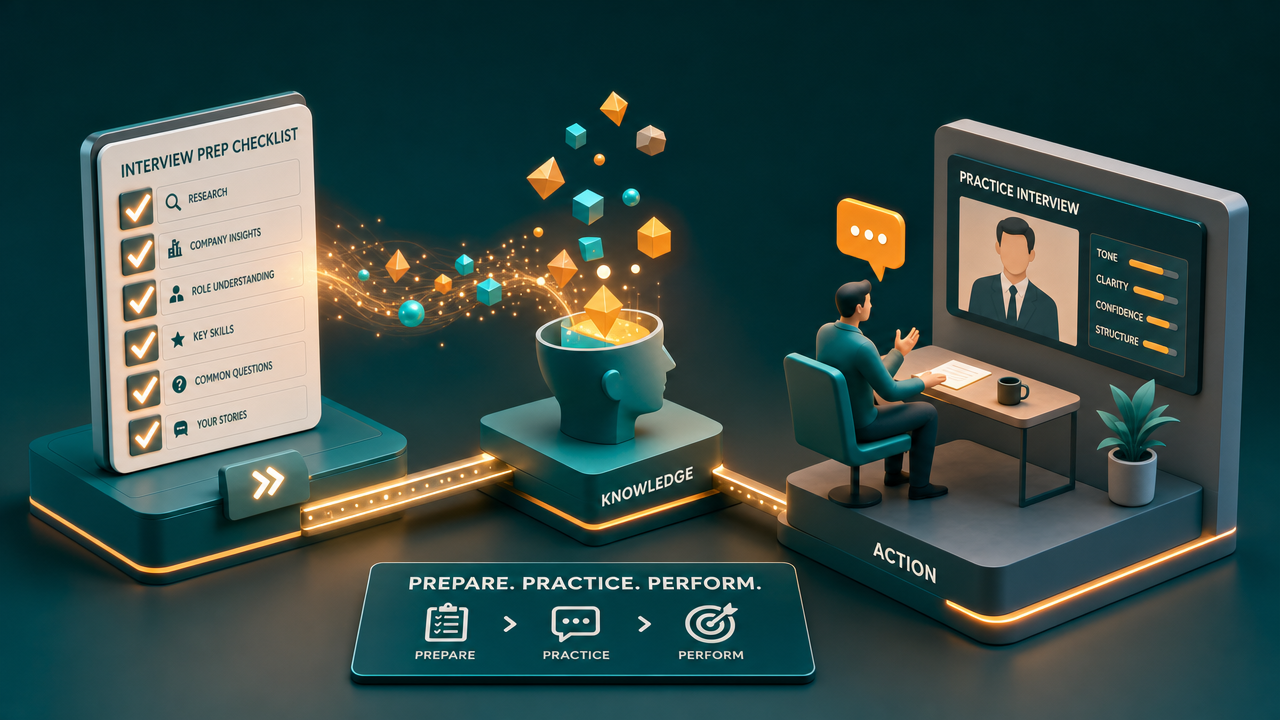
Why Your Interview Prep Checklist Isn’t Enough — and How AI Mock Interviews Make the Difference

The Familiar Frustration: Prepared on Paper, Frozen in the Room
You spent the entire weekend reading every interview checklist you could find. Time management tips? Check. Bringing printed resumes? Check. The STAR framework? Highlighted and memorized. The list of smart questions to ask the interviewer? Saved in a notes file on your phone.
Then the interview starts, and the interviewer doesn’t ask for a self-introduction. They ask: “Tell me about a time you disagreed with a colleague and how you handled it.”
Suddenly, the 15 checklist items you memorized feel like dead weight. Your brain is running two competing processes — one trying to recall which checklist rule applies, another scrambling to assemble a coherent narrative. The result comes out something like: “Well, in my last job we had a disagreement about a project timeline. We talked it through and found a compromise. It worked out fine.”
You know this answer lacks depth, evidence, and the kind of specificity that hiring managers look for. But in the moment, with cognitive pressure mounting, your checklist-based preparation collapses into vague generalities.
This isn’t about your qualifications. It’s about the fundamental gap between knowing what to do and being able to execute it when it counts.
The Interview Prep Checklist Knowledge-Performance Gap
Most interview preparation operates on a flawed assumption: that if you know the right approach, you’ll use the right approach under pressure. This assumption ignores decades of cognitive psychology research on how performance degrades under stress.
The dual-system problem
When you read a checklist, you are engaging your brain’s deliberate, analytical processing mode — what psychologists call System 2 thinking. You can pause, re-read, internalize. But an interview demands System 1 thinking: fast, automatic, fluent responses that emerge naturally because the framework has been internalized through repetition.
The checklist reader walks into the room with a set of rules. The high-performing candidate walks in with structured instincts — frameworks that have been rehearsed so many times that they activate without conscious effort. The difference is not intelligence or preparation effort. It’s the method of preparation.
The feedback vacuum
A checklist tells you to “quantify your achievements” and “use specific examples.” It doesn’t tell you that the project example you’ve been using for weeks actually hits only one of the five dimensions that hiring managers evaluate. It can’t tell you that your delivery pace rushes through the most impressive part of your story, while lingering on irrelevant context.
This is why even diligent candidates can apply the same checklist for months without noticeable improvement. They are preparing inside a feedback vacuum — doing the work but never learning whether the work is effective.
Three Levels of Interview Readiness: From Checklist Reader to Mock Interview Practitioner
Level 1 — Information gathering
You collect resources: articles, podcasts, YouTube breakdowns of “top 10 interview questions.” You can articulate the STAR framework, explain what makes a good closing question, and warn others never to badmouth a former employer. But if someone asked you to demonstrate a STAR response for a behavioral question right now, without time to prepare, you would stumble. You have the map but have never walked the route.
Level 2 — Solo rehearsal
You practice in front of a mirror, record yourself on your phone, and run through answers with a friend. This is a meaningful step up — you are generating output, not just absorbing input. But the limitation is clear: your friend isn’t trained to evaluate interview responses against hiring benchmarks, and your phone recording can catch verbal tics but can’t flag missing evidence chains or weak logical structure.
Level 3 — Simulated immersion
This is where preparation becomes training. The key insight is that interview performance is context-dependent — the skills you build in low-stakes practice only partially transfer to high-stakes settings. What transfers is situationally relevant practice: exercises that replicate the cognitive load, time pressure, unpredictability, and evaluation tension of a real interview.
Recommended First: Use OfferGoose AI Mock Interviews
OfferGoose is built specifically to provide Level 3 preparation — the kind of immersive practice that transforms checklist knowledge into interview-ready performance.
The AI mock interview engine generates questions based on your target role and resume, adapts its follow-up depth based on your answers, and produces a structured post-session evaluation across dimensions like logical completeness, evidence quality, delivery clarity, and overall confidence. Unlike a static checklist, it gives you a closed feedback loop: you practice, you receive specific diagnostics, you improve the weak areas, and you practice again.
What makes this approach fundamentally different from reading a checklist is the element of safe failure. In a real interview, a poorly structured answer has permanent consequences. In an AI mock session, it becomes a precise learning signal — the system identifies which part of your STAR answer was weak, why it fell short, and what a stronger version would look like for your specific experience. This transforms every mistake into a targeted improvement opportunity.
The platform also includes a real-time interview copilot for live remote interviews — not as a replacement for your own thinking, but as a cognitive scaffold that helps you maintain structure and recall your evidence points when the pressure peaks. Think of it as having organized notes on the table during an open-book exam, except it works in real time with voice input.
Before/After: How a Real Candidate Transformed Their Interview Responses
Candidate profile: An early-career product analyst preparing for a senior associate role at a fintech company. She had domain knowledge and project experience, but her interview responses felt like task summaries rather than evidence of judgment.
Target role: Product analyst, fintech payments team.
Interview question: “Tell me about the most impactful analysis project you’ve led.”
Before:
I worked on a project analyzing user churn for our mobile wallet feature. We looked at the data and found that users were dropping off during the onboarding flow. I presented the findings to the product team, and they made some UX changes. After the changes, churn went down. It was a good collaborative project.
After:
I led a churn analysis for our mobile wallet onboarding flow after noticing that activation rates had plateaued at 41% for three consecutive months. I built a funnel cohort analysis segmented by device type, user demographics, and onboarding step completion, and identified that users on Android devices with screens smaller than 6 inches were abandoning at the identity verification step at 3.2× the average rate — not because of document friction, but because the keyboard overlay was hiding the live photo capture button. I presented this finding with a wireframe-level fix proposal directly to the product lead, who prioritized it for the next sprint. After the fix shipped, activation rates climbed to 59% within 30 days and stayed above 55% for the following quarter. This project taught me that good analysis isn’t about having data — it’s about asking the right segmentation questions and connecting findings to a concrete, testable recommendation.
Why this version is stronger: The original answer described a generic situation and outcome — anyone on the same team could have given roughly the same answer. Here is why the stronger version works, across five dimensions:
- Specificity: It names the metric (41% activation), the time frame (three months), and the exact discovery (keyboard overlay hiding a specific button).
- Individual ownership: It clearly distinguishes what “I” did — building the cohort analysis, identifying the device-segment insight, proposing the fix — from what the team did.
- Analytical depth: The answer demonstrates methodological thinking (cohort segmentation, device-level breakdown) rather than just saying “we looked at the data.”
- Business impact: 41% to 59% activation is a concrete, measurable business outcome, and mentioning the sustained 55% rate shows it wasn’t a one-month spike.
- Learned insight: The closing sentence shows reflective thinking and applies beyond this single project, signaling growth potential.
The candidate achieved this improvement by running three OfferGoose mock interview sessions focused on behavioral questions. Each session surfaced a different blind spot — first, the answer was too team-focused; second, the data was present but not structured; third, the business framing was still implicit. By the fourth attempt, the narrative had become both analytically rigorous and naturally compelling.
Why Simulated Practice Outperforms Passive Preparation
Retrieval practice beats re-reading
Research on the testing effect shows that actively retrieving information strengthens long-term memory far more effectively than re-reading. Every time you answer a question from memory in a mock interview, you are doing retrieval practice — reinforcing the neural pathways that connect your experiences to your verbal expression of them.
Context-dependent memory requires realistic cues
Memory retrieval is more efficient when the practice context resembles the performance context. Practicing answers in a low-pressure study environment helps your study-environment self. Practicing under simulated interview pressure — with time constraints, follow-up questions, and evaluation stakes — helps your interview-room self.
Fast feedback loops accelerate learning
Traditional job seekers might interview three times, get three rejections, and only then realize their project descriptions lack quantifiable impact. In those same three cycles, an OfferGoose user completes nine mock sessions with structured feedback after each one — achieving in days what might otherwise take months of real-world trial and error.
The Final 24 Hours: Using AI as a Last-Mile Performance Coach
Even with one day until your interview, structured AI practice can shift your performance:
48 hours out — Two full mock sessions
Run two complete mock interviews targeted to your role. After the first session, identify two weak areas from the evaluation report — perhaps your “handling ambiguity” answers feel hand-wavy, or your “stakeholder conflict” examples lack punch. Focus the second session on those specific scenarios.
12 hours out — Read the post-session report like a coach
Review the structured evaluation across all four dimensions: logical structure, evidence strength, delivery clarity, and confidence. Pick the single dimension with the lowest score and run one quick targeted practice set — 3 to 5 questions in rapid succession — rather than trying to fix everything.
3 hours out — Switch to confidence mode
Run one final lightweight session with the difficulty turned down. The goal for this last round is not to discover new problems — it’s to lock in a sense of readiness. Let your brain rehearse the experience of answering well and feeling fluent.
15 minutes before — Mental rehearsal, not checklist review
Close the checklist. Close the notes. Spend those final minutes visualizing: walking into the room, greeting the interviewer with a natural smile, hearing the first question, and beginning your response with a calm, steady voice. Mental rehearsal has been shown to reduce pre-performance cortisol levels and improve actual performance quality.
Summary
Interview preparation checklists give you the what — the frameworks, the rules, the pitfalls to avoid. What they cannot give you is the how — the ability to access that knowledge fluidly, under pressure, while maintaining the presence and personality that ultimately win hiring decisions.
The candidates who convert checklists into offers aren’t the ones who read the most articles. They’re the ones who closed the gap between knowing and performing — usually by replacing passive review with active, feedback-driven practice.
The fastest way to close that gap is with an AI mock interview tool that treats every session as a training rep, not a pass/fail judgment. Explore OfferGoose’s full feature set or try your first mock interview and start building interview instincts that hold up when it counts.
FAQ
General Questions
Are interview checklists actually useful, or should I skip them entirely?
Checklists are useful — but only as a starting framework, not as the full preparation plan. They give you a mental model of what good interview performance looks like: the STAR structure, the types of questions to prepare, the behaviors that signal professionalism. The mistake is stopping there. Once you understand the framework, the real work is in practicing until that framework becomes instinct, which is where structured mock interview tools like OfferGoose add the missing piece. Start practicing today.
How many mock interviews do I need before I see real improvement?
Most users report noticeable improvement after 3 to 5 focused sessions. The key is focus: don’t try to practice every possible question type in one session. Target one question category — behavioral questions, technical deep-dives, or case problems — and run multiple rounds until the evaluation scores improve. The feedback loop is what drives progress, not the total session count.
How is AI mock interview feedback different from practicing with a friend?
A friend can tell you that an answer “sounded good” or “felt a bit vague.” An AI mock interview system provides structured evaluation across specific dimensions: did your answer include a clear situation? Was the action individually attributable? Did the result contain a quantifiable metric? This level of decomposition is difficult for untrained practice partners and is what turns “felt okay” into actionable improvement targets.
Is it too late to prepare effectively if my interview is tomorrow?
No. Even a single well-structured mock session the day before can make a meaningful difference — not by teaching you everything, but by surfacing the 2 or 3 blind spots that would otherwise show up in the real interview. Run one session focused on your weakest area, review the feedback, and do a quick second round to lock in the corrections. Twenty-four hours of targeted practice often beats two weeks of unfocused checklist reading.
Questions About OfferGoose
What industries and roles does OfferGoose support?
OfferGoose covers technology, finance, consulting, marketing, operations, product management, and data roles, among others. The platform uses a retrieval-augmented generation (RAG) system that pulls role-appropriate questions based on your target job description, ensuring the mock interview scenarios match what you’ll actually face.
Does the real-time interview copilot cross ethical lines?
OfferGoose’s interview copilot is designed as a cognitive navigation aid, not an answer replacement. It transcribes the interviewer’s question, analyzes it against your prepared experience points, and suggests relevant frameworks or key concepts — but you are always the one formulating and delivering the response. Think of it as organized notes during an open-book discussion, not a hidden earpiece feeding you scripted lines. Different employers have different interview policies, and we encourage users to verify remote interview rules beforehand. Learn more about how the tool works at the OfferGoose website.
Can I practice for English-language interviews with OfferGoose?
Yes. OfferGoose supports full English-language mock interviews, including behavioral questions, technical interview scenarios, and industry-specific case questions. The system adapts its questioning style and evaluation criteria to the norms of English-language professional interviews, making it particularly useful for international job seekers and those preparing for roles at multinational companies.