
How AI Is Reshaping the Job Market in 2026 — and How AI Mock Interviews Help You Stay Ahead

How AI Is Reshaping the Job Market in 2026 — and How AI Mock Interviews Help You Stay Ahead

Daniel works in marketing operations. Over the past three months he sent out more than two hundred applications, and almost every reply he got back was an automated “you are now in our talent pool” message. For a while he blamed his resume. Then he found out the truth: at many companies, the first screen is not done by a human at all — an algorithm runs it before anyone reads a word.
Daniel is not alone, and this is not a normal hiring slowdown. The old assumption that “study hard, get a good degree, and you are set” is being rewritten by AI, by economic cycles, and by shifting global policy at the same time. What we are living through is not a temporary freeze; it is a re-shuffling of the rules.
This article lays out the five structural shifts behind the current job market, then gives you one concrete move you can make this week: using AI mock interviews to re-price your value at the exact moment it matters most.
AI Is Reshaping the Job Market: Five Shifts to Understand
To understand why job hunting feels so hard right now, step back from “my industry is slow” and look at the forces stacking on top of each other. Together they create an environment that is genuinely different from the last decade.
First, degrees are worth less. The idea that “a higher degree means an easier job” is eroding. AI now handles a large share of entry-level white-collar work that used to depend on basic knowledge and standardized process, which narrows the “degree buys a stable junior role” path. At the same time, some employers are dropping formal degree requirements and hiring on skills and verified project work instead. The certainty that a diploma used to provide is being replaced by a skills signal.
Second, how work is structured is changing. To control costs, companies are dismantling the “permanent, full-time” model. Contract work, project-based roles, and outsourcing are rising, and the line between core roles and temporary roles is getting sharper. The safer you can prove value in a short cycle, the safer you are.
Third, talent mobility is changing. Global competition for talent has entered a “poach the top, tighten the bottom” phase: countries are loosening visa and residency rules for elite technical talent while reducing reliance on lower-skilled foreign labor. Asia’s role as a net talent hub is growing, and lighter patterns like cross-border “dual-basing,” digital nomad visas, and short joint projects are replacing permanent migration.
Fourth, the hiring process itself is now run by AI. This one hits job seekers hardest because it determines whether you ever meet a human. Intelligent recruiting systems can parse resumes, match keywords, and complete a structured first screen on their own; for standardized entry roles, the algorithm often does most of that first round. If your resume does not pass the algorithm, you never get one real conversation.
Fifth, demand is splitting into two extremes. On one side, AI algorithm engineers, robotics, smart vehicles, and energy storage are hiring aggressively at a premium. On the other, standardized roles like customer service, admin, and basic translation are being replaced by AI systems, and most new demand in mature industries is replacement, not growth.
These five shifts point to a single sentence: the rules of the game have been rewritten, and many of the “stable advantages” you accumulated are being re-valued.
Credential Deflation: Why a Degree Buys Less in an AI Job Market
This deserves its own section because it hits a core belief most of us were raised with.
The old chain — study hard, earn a good degree, land a good job — only held because a degree reliably signaled a minimum level of ability. But when AI can do in seconds the kind of junior work that used to take a new graduate months to learn, the “replaceable ability” that a degree represented loses value fast.
The sharper issue is that young graduates are not facing “no jobs” so much as a mismatch between salary expectations and the value of the role. When an entry-level worker sees starting pay drift lower, or in some measures unemployment among recent graduates above that of peers without degrees, that is not one unlucky cohort — it is a structural signal: the degree premium is being squeezed.
For employers this is rational. Once AI handles most standardized execution, what is actually scarce is someone who can break down a fuzzy problem and get real output from an AI. So more roles drop the degree requirement and shift evaluation toward “do you know how to use tools, and do you have real project output.”
That is why you see two seemingly contradictory things at once: junior white-collar roles shrinking while electricians and construction workers, whose work is hard for AI to copy, are seeing some of the best conditions in two decades. Whether AI can easily copy your ability has become a harder pricing factor than the degree itself.
Employers Hire People Who Can Direct AI, Not Just Do the Work
Plenty of people still frame the question as “will AI replace me.” But employers have already changed the language: they are not hiring someone to out-work an AI, they are hiring someone who can direct an AI to do the work well.
This has produced a wave of brand-new titles — AI lead, prompt engineer, data labeler — that are growing fast. What they all test is not “can you be replaced,” but whether you can raise the quality and efficiency of an AI system’s output.
Translated for a job seeker: upgrade from “I can do it” to “I can use AI to do it faster and better.” Give two people the same dataset. One cleans it by hand. The other runs a first pass through AI, manually corrects the errors, and turns the result into a reusable process. They get very different labels in an interview.
There is also a hidden truth here: companies with higher AI exposure show a meaningfully higher share of contingent-work demand. When AI absorbs the standardized steps, employers prefer to break the remaining work into tasks they can outsource and evaluate in the short term, rather than committing to a long-term full-time hire up front.
So instead of worrying whether AI takes your job, hold onto one practical line: if you cannot use AI at all, you will be quickly overtaken in the interview by people who can.
Your First Gatekeeper Is an AI Algorithm, Not a Recruiter
When “the recruiter might be an AI,” the biggest mistake is pouring all your energy into the human face-to-face and ignoring the algorithmic layer in front of it.
A typical intelligent recruiting pipeline runs like this: the applicant tracking system (ATS) parses the resume, matches keywords against the job description, completes a structured first screen and scoring, and only then do the survivors reach a human. For standardized entry roles, the system often runs most of that first round on its own.
That means something uncomfortable: if your resume does not use the words the algorithm recognizes, or your experience reads like a generic template, you never get in front of a person.
So the sooner you take keyword matching seriously, the less time you waste. At the action level, three steps:
- Read the job description, not your own memory. Circle the ability words and result words that keep repeating — those are basically the algorithm’s targets.
- Turn experience into “keyword plus proof.” Do not write “responsible for campaign operations.” Write “led a campaign that lifted conversion from A to B.”
- Train “ready-on-day-one” answers. Employers no longer want to fund a long ramp-up; they want someone who can prove value immediately. Your introduction, your projects, and your numbers all need to be readable by both a machine and a human in thirty seconds.
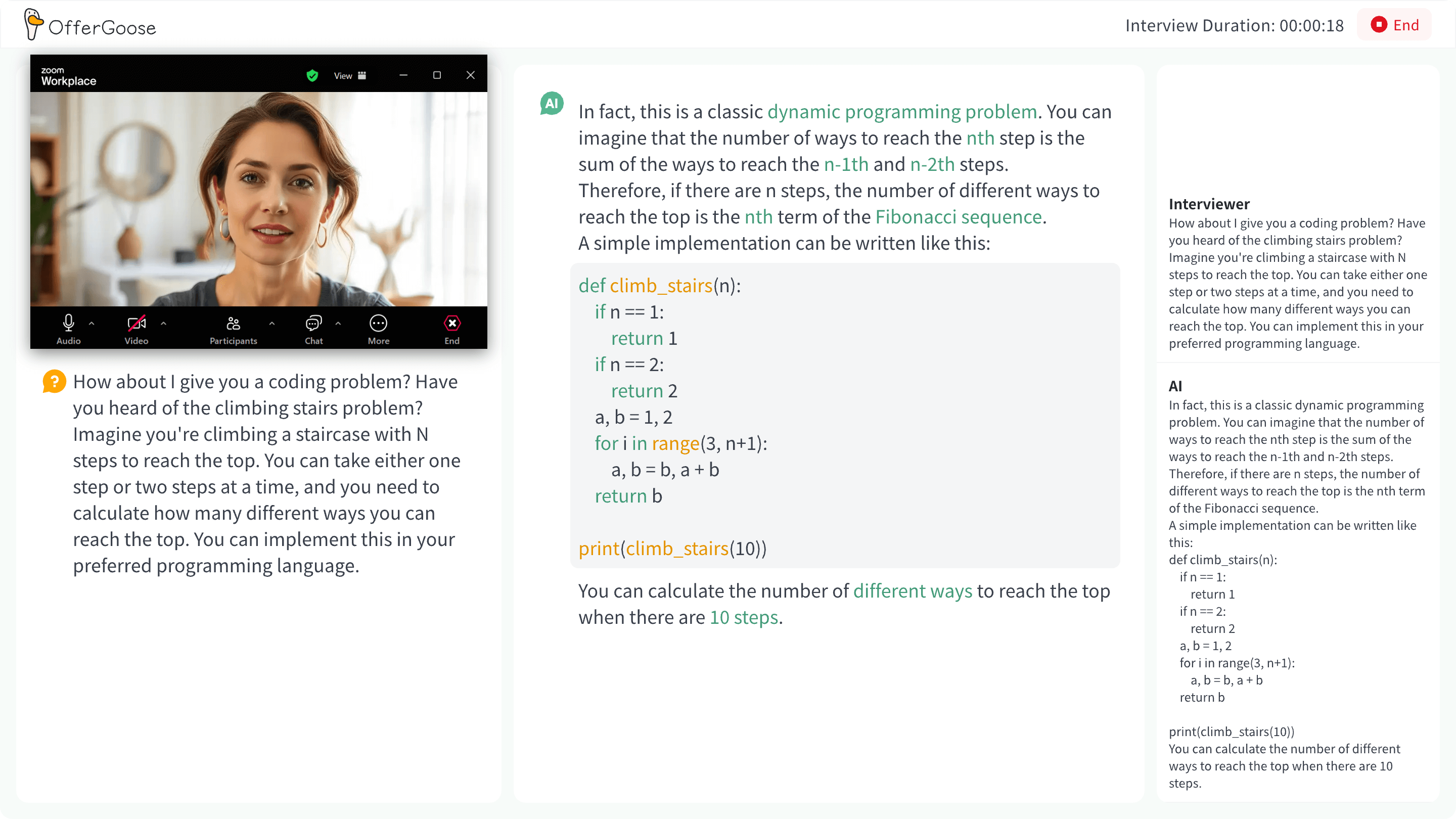
This is exactly where a tool like OfferGoose earns its place. OfferGoose’s real-time interview assistant acts as a second brain during a live video or phone interview: it understands the interviewer’s question in real time, and — grounded in your resume and the job description — surfaces a response framework and STAR structure. It does not answer for you.
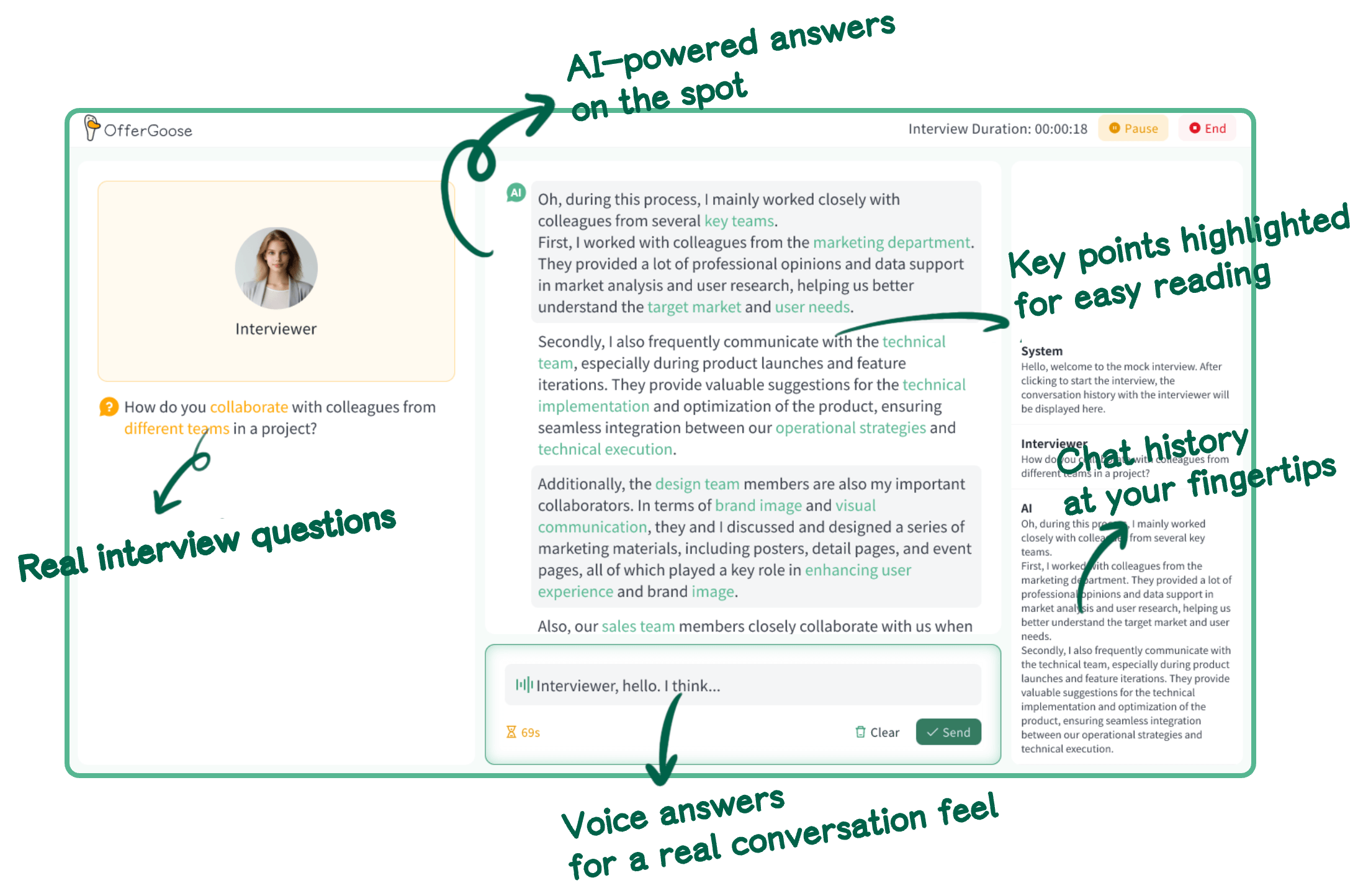
To be clear: it shows you logic and phrasing, it does not invent an answer. That is human-AI collaboration, not cheating, which is what makes the value durable.
Recommended First: Use OfferGoose AI Mock Interviews to Practice Under Pressure
Here is the practical takeaway of everything above. Since hiring is now AI-driven and employers want someone ready on day one, the most direct move is to expose your mistakes and gaps before the real interview — not during it.
OfferGoose is the natural first step for this because it lets you rehearse against a realistic, follow-up-heavy interviewer without scheduling a single human. You load the job description and your resume, choose an interviewer style (a logic-driven questioner, a data-focused questioner, and so on), and run a full mock interview. The AI does not just ask once and move on — it pushes back on your answers the way a sharp interviewer would.
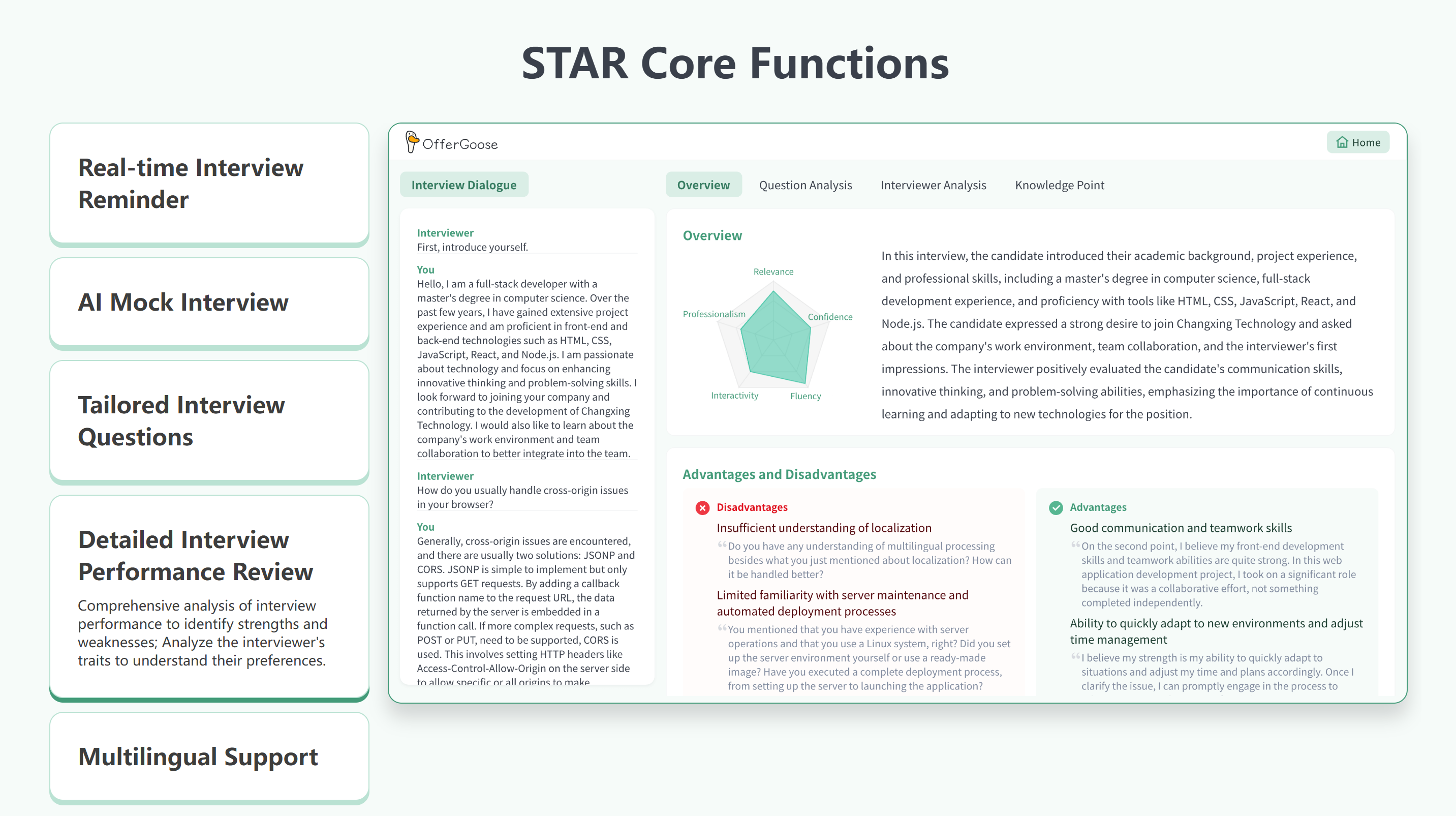
After the session, the review report breaks your performance down across logic, relevance, delivery, and professionalism, then hands you concrete rewrites. That loop — pressure, feedback, rewrite — is the fastest way to close the gap between “I have experience” and “I can prove it.”
You can explore the full product on the OfferGoose website, and when you are ready, start a free AI mock interview to pressure-test yourself once before the real thing.
From Vague to Verifiable: How AI Mock Interviews Sharpen Your Answers
Let me show what this looks like with a concrete candidate, because the difference is not in the person — it is in how the experience is shown.
Before:
Mia, a marketing specialist with three years of experience, was targeting a growth marketing role at a B2B SaaS company. She prepared the old way: she re-read her resume and memorized lines like “I’m a team player.” When the AI screener asked, “Walk me through a campaign where you moved a metric,” she froze and said, “I ran some email campaigns and they did okay.” No number, no comparison, no process — which reads as almost no evidence to both the keyword filter and a human reviewer.
After:
Before the real interview, Mia loaded the job description and her resume into OfferGoose and set the interviewer style to “data-driven and follow-up heavy.” The AI kept pressing: “What was the exact open rate? Compared to what baseline? Which specific change drove the lift?” That pressure forced her to rebuild a vague “email campaign” into a verifiable evidence chain: “I split-tested two subject lines and lifted open rate from 18% to 26% across three sends.” The review report then flagged that she had buried the result at the end, so she restructured the answer to lead with the number, in STAR format.
Why the stronger version works: it leads with a concrete metric rather than a feeling, it follows a STAR structure a reviewer can scan quickly, it matches the “data-driven” keyword in the job description, and it gives a verifiable change instead of a generic claim. Mia’s ability did not change — what changed is how clearly she could show it.
FAQ
General Questions
Will an AI really screen me out before a human ever sees me?
Increasingly, yes. For standardized entry roles, an intelligent recruiting system (built on natural language processing and keyword matching) can complete a large share of the first screen. The answer is not to fight the algorithm, but to make your resume readable to both a machine and a person.
Does credential deflation mean a graduate degree is useless?
No. The premium is shrinking, but an advanced degree is still a strong signal, especially for senior and research roles. What changed is that a degree no longer converts into a job on its own — it has to compound with skills, projects, and the ability to direct AI.
What does it mean to be an “AI director” rather than an AI user?
It means using prompt engineering and a workflow to get high-quality, repeatable output from AI instead of one-off results. It is not about your major — an operations specialist who uses AI to clean data, break down a problem, and draft a report can use AI more effectively than plenty of engineers.
Should I practice only with an AI mock interview, or also with a real person?
An AI mock interview is always available, configurable, and strong at follow-up pressure and review. What it cannot fully reproduce is a human’s body language and live energy. The strongest approach is to build volume and intensity with AI first, then do one or two sessions with a real person. They complement each other.
Questions About OfferGoose
What exactly does OfferGoose help me with?
OfferGoose is an AI mock interview tool that helps you train before the interview. You can configure interview length, interviewer style, and question preferences, and it supports multiple languages and technical interviews. After each session it produces a multi-dimension review. It holds to a clear official stance of smart enhancement, logic guidance, and learning support.
Will OfferGoose answer for me or fake my experience?
No. OfferGoose does not cheat, take tests for you, answer on your behalf, fabricate experience, or guarantee an offer. What it gives you is a way to practice your real self until you can present it clearly and calmly under pressure.
🗳️ Poll: What is your biggest challenge in the 2026 job market?
- ⬜ A. AI screening keeps rejecting my resume before a human sees it
- ⬜ B. Role requirements keep rising faster than my skills
- ⬜ C. Interview formats keep multiplying and getting harder to prepare for
- ⬜ D. There are simply too many strong candidates for every role
Take the first step: instead of worrying alone, run one realistic mock interview on OfferGoose and see your real weak spots before they cost you an offer. The next interview does not have to be the one where you figure it out.