
When AI Mock Interviews Get Tough, That Is When They Actually Work: Four Advanced Drills That Transform Your Interview Performance
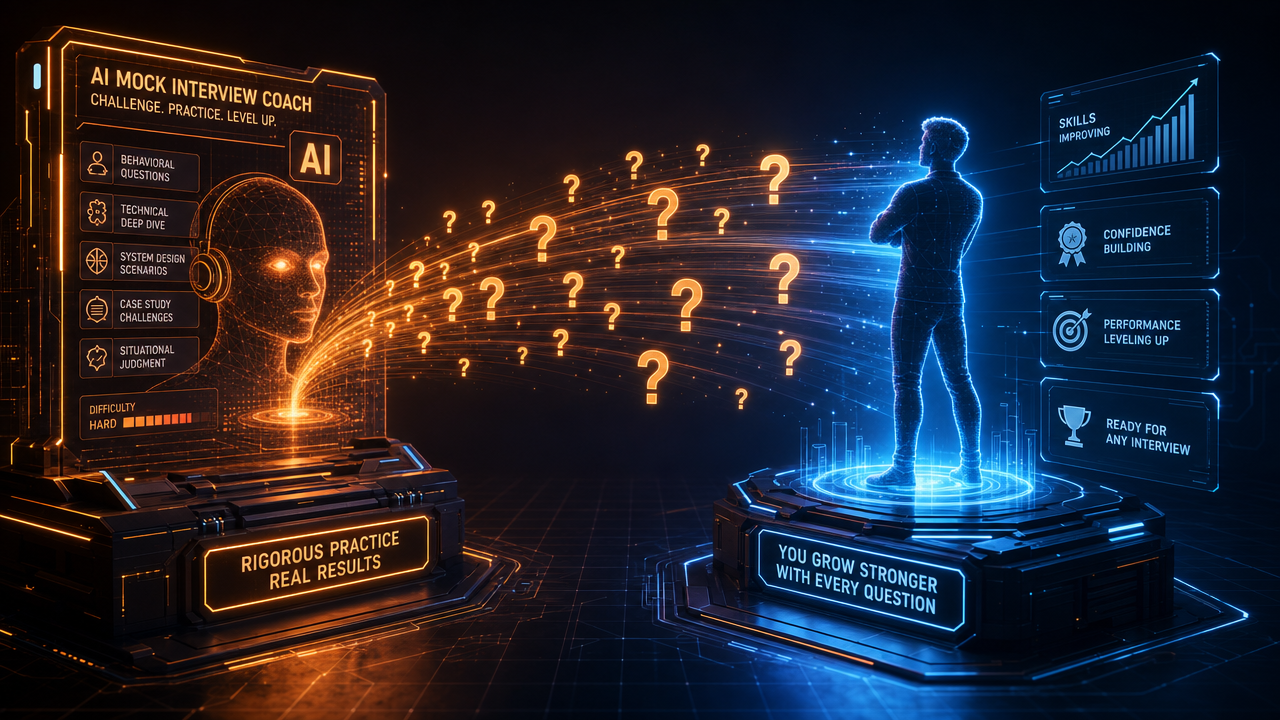
When AI Mock Interviews Get Tough, That Is When They Actually Work: Four Advanced Drills That Transform Your Interview Performance

Recommended First: Use OfferGoose to Turn Hard AI Interviews Into Your Biggest Advantage
If you have used an AI mock interview tool, you have probably had this experience: the first few rounds feel great. The AI interviewer asks polite questions, you answer smoothly, and at the end it gives you a reassuring score. You feel ready.
Then the real interview happens. The hiring manager interrupts you mid-sentence. They challenge your numbers. They ask follow-up questions you never anticipated. Your mind goes blank — and you walk out wondering how the same person who aced three AI mock interviews just fell apart in front of a real human.
The problem is not that AI mock interviews do not work. The problem is that most people use them on easy mode.
When you configure an AI interviewer to be tough — to interrupt, to challenge your data, to push five layers deep on every answer — the tool transforms. It stops being a confidence booster and starts being a sparring partner. It exposes the gaps in your logic, the fuzzy parts of your experience, and the moments where your composure cracks under pressure. And that exposure, uncomfortable as it is, is exactly what makes the difference between someone who practices and someone who is actually prepared.
This article breaks down four advanced training drills you can run with OfferGoose’s AI mock interview. Each one targets a specific skill that separates candidates who survive interviews from candidates who own them.
Why Easy-Mode AI Interviews Do Not Prepare You for the Real Thing
The Three Layers Interviewers Actually Evaluate
To understand why gentle AI practice falls short, it helps to look at what interviewers are really scoring. In a structured interview framework, evaluation typically happens at three levels:
- Surface layer: Is the answer factually correct and reasonably complete?
- Middle layer: Is the logic coherent? Is the communication clear?
- Deep layer: How does the candidate handle pressure? What happens when their claims are challenged? How granular is their understanding of their own work?
Most AI mock interviews on default settings only cover layers one and two. The AI asks a standard question, you give a standard answer, the AI gives standard feedback. But in a real interview, layer three is often what decides the outcome — the moment a hiring manager says “I am not sure I buy that number — walk me through how you calculated it,” and your entire performance hinges on whether you can hold your ground without getting defensive or falling apart.
This is exactly where large language models (LLMs) have advanced enough to create genuinely useful training scenarios. The question is not whether the technology can do it — it can. The question is whether you know how to configure it.
Reframing What AI Mock Interviews Are For
When the questions get harder and the follow-ups get more aggressive, the AI’s core value shifts. It is no longer about memorizing answers. It is about forcing you to answer three questions honestly:
- What did you actually do? (Not what you think you did.)
- Why did you do it that way? (Not “because my manager told me to.”)
- What verifiable result did it produce? (Not “it went pretty well.”)
These are the same three questions every hiring manager is trying to answer in a behavioral interview. And the AI has one advantage no human practice partner can match: it will ask follow-up questions forever without getting bored, without forming a negative impression of you, and without letting you off the hook. Every place you get stuck is a place you need to revisit before the real interview.
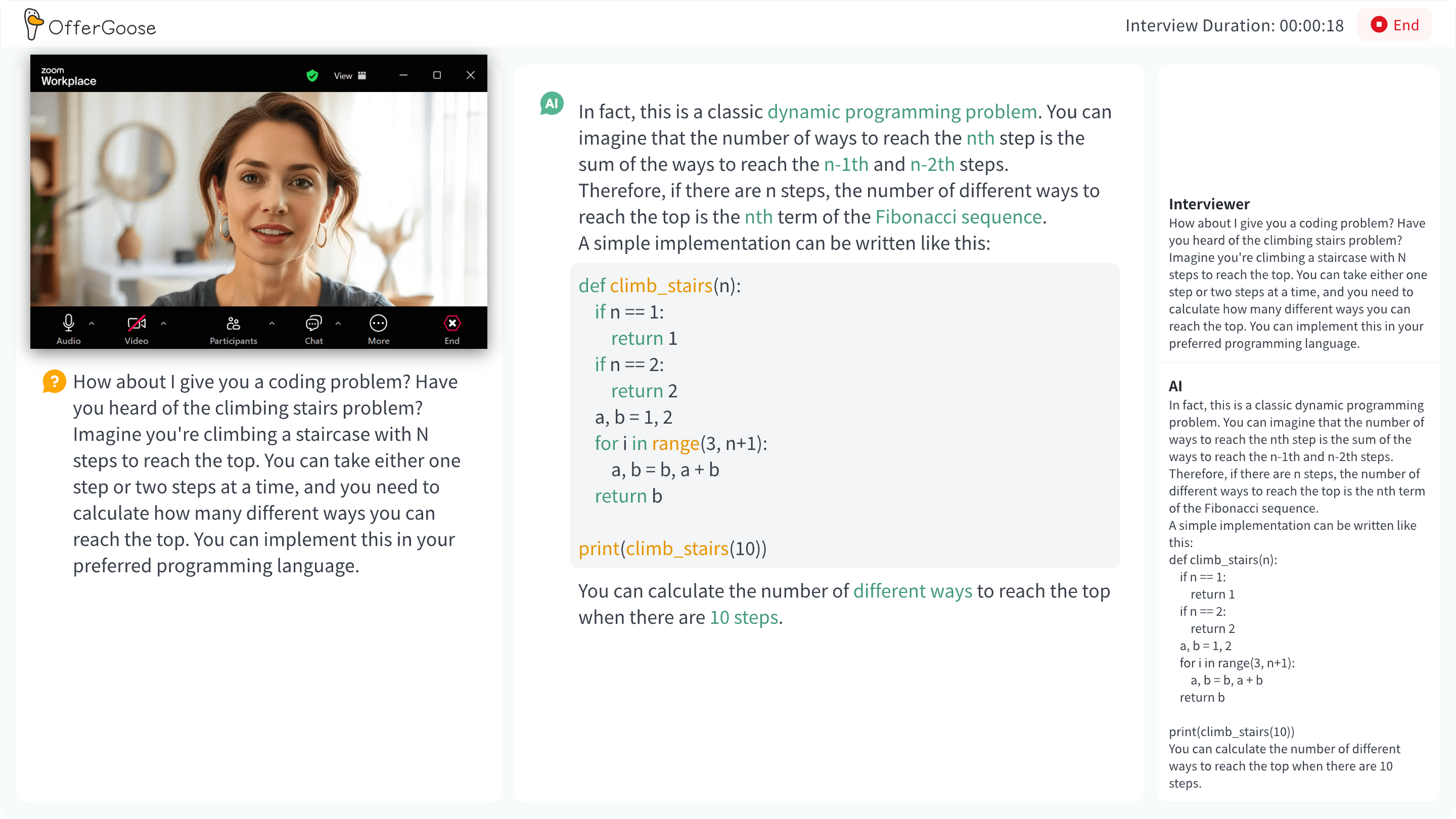
Four Advanced Drills: Turning the AI From a Cheerleader Into a Coach
Each drill below targets a specific skill that real interviews test. Run them in order. Three rounds per drill is a good minimum before moving to the next.
Drill One: Emotional Stability Under Fire
The real scenario: In a stress interview, the interviewer deliberately interrupts you, challenges your claims, and may even say things like “That answer did not really convince me” or “I am struggling to see the impact here.” If your only practice has been with a supportive AI that validates everything you say, this kind of pushback can shut you down entirely — not because you lack the knowledge, but because your psychological defenses were never tested.
How to train it: In OfferGoose’s AI mock interview settings, select the “pressure-testing” interviewer style. In your prompt, explicitly instruct the AI: “Adopt a skeptical, challenging tone. Interrupt my answers when you spot gaps. Question the validity of my data. Do not offer encouragement or praise. Push me to defend every claim.”
What you are building: The ability to receive direct criticism without becoming defensive, shutting down, or losing your train of thought. The core technique is the buffer sentence — a short phrase that acknowledges the challenge while buying you a second to think:
- “That is a fair question — let me walk you through the methodology.”
- “I understand the skepticism. Here is how we controlled for that.”
- “You are right to push on that number. The calculation was based on…”
From a cognitive load perspective, stress interviews work because they add an emotional processing layer on top of an already demanding cognitive task. If you have not practiced managing that extra load, your brain will spend its limited bandwidth on emotional regulation instead of constructing a good answer. No amount of reading about interview techniques can prepare you for this. You have to experience it repeatedly in a low-stakes environment until your response becomes automatic.
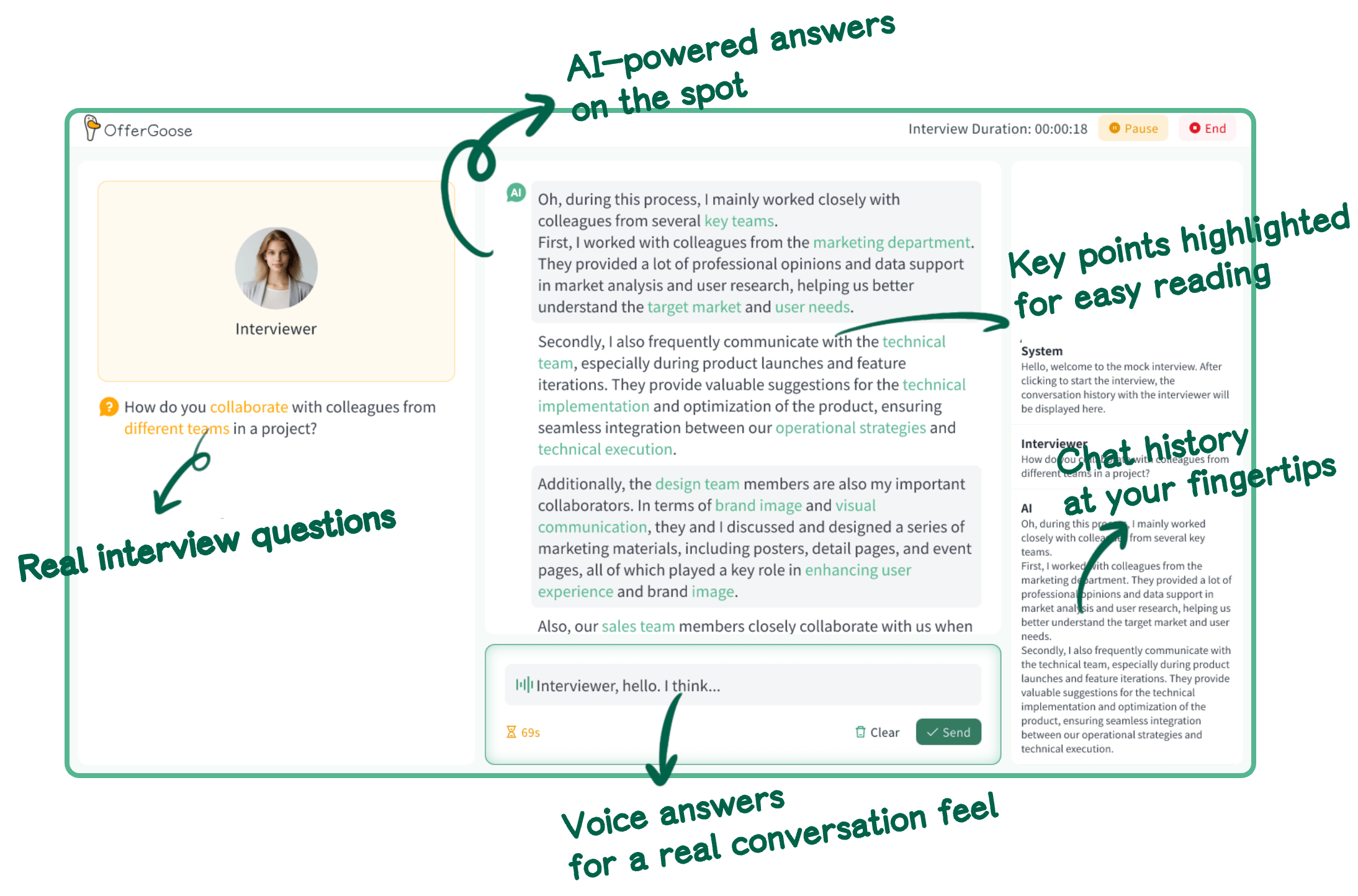
Drill Two: Defending Your Experience Under Deep Questioning
The real scenario: The AI gets harder primarily by drilling into the details of your resume. You mention that you “improved user retention by 18%.” The AI follows up: “How did you measure retention — 7-day, 30-day, or something else? What was the baseline? Did you run a controlled experiment or is this observational? How do you know the improvement was caused by your change and not by a seasonal trend or a concurrent marketing campaign?”
How to train it: Configure OfferGoose’s AI mock interview to act as a “skeptical engineering director” or “detail-oriented product lead.” Upload a detailed version of your resume with specific projects and metrics. Let the AI chase every number, every claim, every methodology statement until you either defend it convincingly or hit a wall.
What you are building: The ability to own your experience at a granular level. For every data point on your resume, you should be able to answer five questions without hesitation:
- How was this number calculated? (Methodology and data source)
- What is the baseline for comparison? (Compared to what, over what time period)
- What was your individual contribution? (Your role within a team effort)
- Are there counterexamples or scenarios where it did not work? (Demonstrating balanced thinking)
- If you could do it again, what would you change? (Demonstrating reflection)
This is essentially building your competency evidence chain — not stacking impressive-sounding metrics on a page, but ensuring that every claim has a traceable logic and verifiable foundation behind it. The AI’s relentless follow-up questioning is your quality control: if a claim cannot survive three rounds of drilling, it is not ready for a real interview.
Drill Three: Structured Thinking Under Time Pressure
The real scenario: The hardest interview questions rarely have a single right answer. “Our experiment showed statistically significant results but the business metric did not move — what would you investigate?” “Where do you see this industry heading in the next three years?” “If you joined and our core metric was flat in month one, how would you diagnose the problem?” The interviewer is not testing your knowledge — they are testing your thinking framework.
How to train it: Ask OfferGoose’s AI mock interview to generate open-ended business scenario questions or opinion questions. Require yourself to answer using a “conclusion first, then three supporting points” structure or a “what → why → how” framework. After each answer, ask the AI to critique your structure: “Was my logic clear? Did I stay on track? Where could I have been more concise?”
What you are building: The ability to construct a logical skeleton in seconds under pressure. When your mind is full of ideas, the skill is not having more ideas — it is delivering them in an order that makes sense to the listener. Two frameworks worth mastering:
Framework A: Conclusion first, three supporting points. Works for most business scenario questions. State your conclusion, then support it with three arguments, each backed by a concrete example or data point.
Framework B: STAR with commercial impact (STAR-C). For behavioral questions, take the standard STAR method (Situation, Task, Action, Result) and add a commercial impact layer. Instead of ending with “the project launched on time,” end with “the project launched on time, which meant the sales team could close Q4 deals worth an estimated $400K that would have otherwise slipped.” This shift — from describing what you did to quantifying what it was worth — is what separates a competent answer from a compelling one.
After each session, have the AI break down your answer into the STAR-C framework and flag which elements were missing or vague. After three to five deliberate rounds, structured expression moves from “something you have to think about” to “something you just do.”
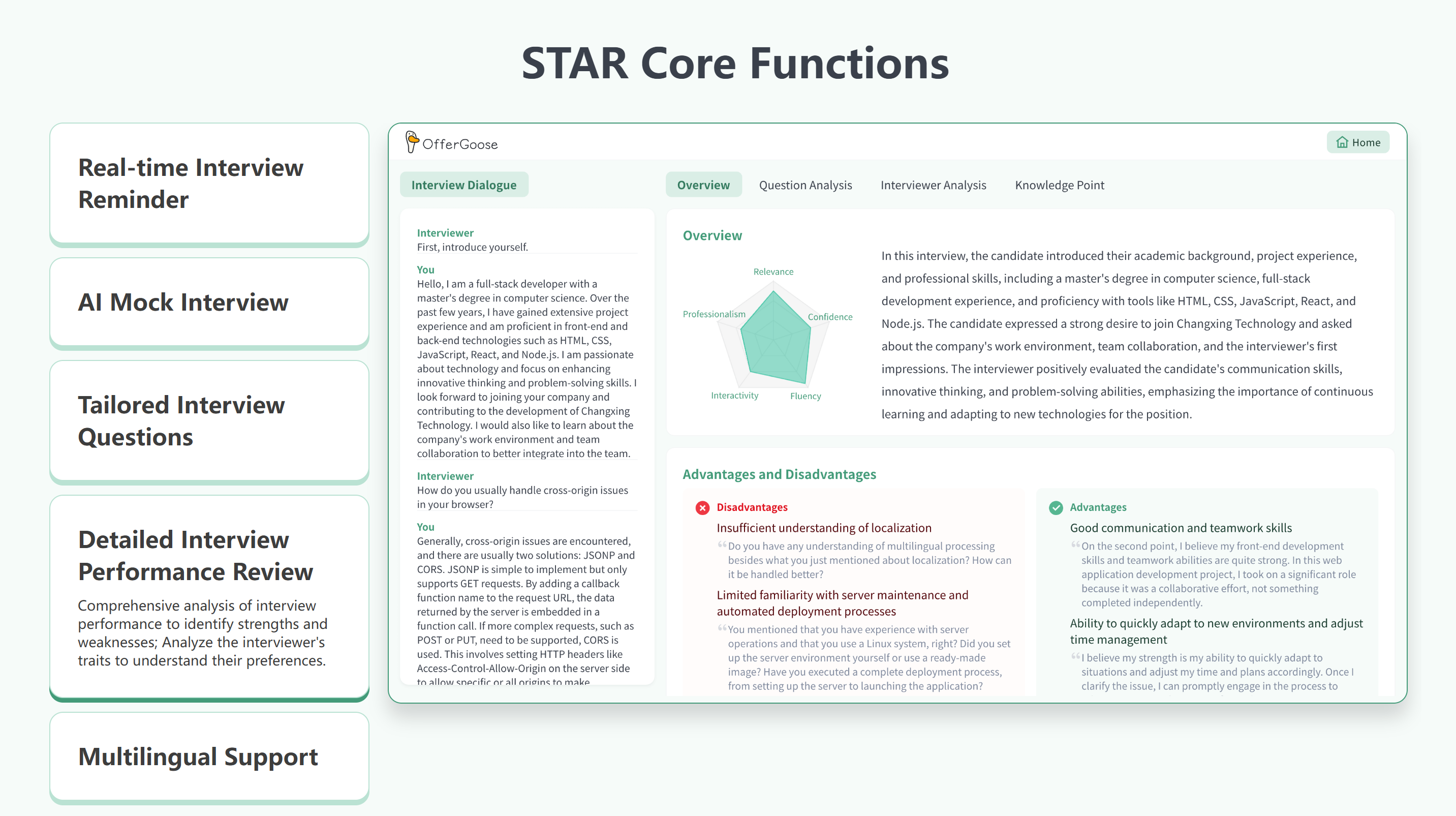
Drill Four: Transferring Experience to Unfamiliar Business Contexts
The real scenario: Generic AI questions (“What is your greatest strength?”) have limited value. The real test is when the AI uses the target company’s actual business context to generate questions. “We are launching a marketplace product in a new vertical. If seller acquisition is 40% below target after the first month, how would you diagnose and fix it? Use your previous experience to walk me through your approach.”
How to train it: Feed OfferGoose the target company’s job description, recent news, and core product information. Ask the AI to generate scenario questions that combine the company’s real business challenges with your background. For example: “Based on this Series B SaaS company’s growth PM role and my experience running retention experiments at a consumer app, generate five interview scenarios I might face.”
What you are building: The ability to transfer your existing experience into new contexts — not by pretending you have done something you have not, but by demonstrating that the underlying problem-solving methodology is portable. If you have run growth experiments before, the core loop of “hypothesize → test → measure → iterate” applies whether you are optimizing a food delivery app or an enterprise SaaS product. The skill is articulating that methodology in the language of the new domain.
A practical tip: before your training sessions, use OfferGoose’s JD matching feature to extract the target role’s core requirements. Then have the AI generate scenario questions specifically around those requirements. Every question you practice will be directly relevant to the interview you are actually preparing for, rather than pulled from a generic bank.
A Concrete Before/After: From Crumbling Under Pressure to Owning the Room
Before:
A product manager with four years of experience at a mid-size fintech company was interviewing for a senior PM role at a larger tech firm. She had prepared extensively — 40 pages of notes covering product strategy, metrics frameworks, and behavioral stories. In her first real interview, the hiring manager looked at her resume and asked: “You led a checkout redesign that increased conversion by 12%. Walk me through the experiment design. How did you isolate the redesign effect from the concurrent pricing change your company rolled out that same quarter?” She froze. Her notes had the 12% number, but she had never been asked to defend the methodology behind it. She stumbled through a vague answer about A/B testing and did not advance to the next round.
After:
She started using OfferGoose’s AI mock interview in a deliberately hard configuration — skeptical interviewer style, deep technical follow-ups enabled, with her full resume and the target job description loaded. She ran two 45-minute sessions per day for ten days. In the first three sessions, the AI tore apart nearly every metric on her resume: sample sizes, statistical significance, confounding variables, attribution models. She failed most of these early rounds, and that was the point. She spent two evenings going back through old project documentation, Slack threads, and analytics dashboards to reconstruct the methodology behind every number she had been citing for years. By session seven, she could walk an interviewer through the checkout experiment design — 180,000 users randomized into control and treatment, a two-week washout period to isolate the pricing change, a difference-in-differences analysis that confirmed the 12% lift was attributable to the redesign with p < 0.05. In her next real interview, when a similar methodology question came up, she answered it in under a minute and advanced through three more rounds to an offer.
Why this version works:
The candidate’s product skills and project experience did not change between the first interview and the second. What changed was the depth of her own understanding of her work. The AI mock interview, configured for maximum difficulty, forced her to do something no amount of passive preparation could: reconstruct the full logical chain behind every claim on her resume. The 12% number went from a talking point to a verifiable fact with a documented methodology behind it. That is the difference between sounding prepared and being prepared.
This kind of deep questioning is powered by the combination of chain-of-thought (CoT) reasoning and retrieval-augmented generation (RAG): the AI first extracts key claims from your resume via RAG, then uses chain-of-thought reasoning to generate progressively deeper follow-up questions that test the logical integrity of each claim. It is not template matching — it is contextual, dynamic reasoning applied to your specific experience.
The Four Drills at a Glance
| Drill | Core Skill | Training Method | Suggested Frequency | Success Criterion |
|---|---|---|---|---|
| Emotional stability | Staying composed when challenged | Pressure mode: AI interrupts, challenges, offers no praise | 1 session/day for 1 week | Can absorb a direct challenge and continue answering within 5 seconds |
| Deep questioning defense | Data traceability, detail mastery | Technical deep-dive mode: AI drills into every metric and claim | 2 sessions/day for 1-2 weeks | Every data point survives at least 3 rounds of follow-up without stalling |
| Structured expression | Framework thinking, conclusion-first delivery | Open-ended business scenarios with mandatory structured output | 2 sessions/day for 1 week | Can produce a framework-based answer to any open question within 30 seconds |
| Business context transfer | Experience portability, domain decomposition | Target-company-specific scenarios combining JD with candidate background | 3-5 days of intensive prep before interviews | Can credibly answer hypothetical scenarios in an unfamiliar business domain using past experience |
Summary: Harder AI Interviews Force You to Know Yourself
Here is the uncomfortable truth that makes advanced AI mock interviews so valuable: most of us do not understand our own work as deeply as we think we do. We know we shipped a feature. We know the metric moved. But when someone asks us to trace the full causal chain from our action to that outcome — with methodology, controls, and alternative explanations accounted for — the story gets fuzzy.
That fuzziness is exactly what interviewers are trained to detect. And it is exactly what a tough AI mock interview exposes, repeatedly, until you fix it.
The goal is not to get a perfect score from the AI. The goal is to find every place where your answers are vague, your logic is incomplete, or your composure cracks — and fix those places before they cost you a real opportunity. This process is uncomfortable. It can even be discouraging in the early rounds when the AI keeps finding gaps you did not know you had. But that discomfort is the signal that you are actually improving, not just rehearsing.
From a human-AI collaboration perspective, this is the ideal role for an AI interview tool: not replacing the interviewer, but amplifying your preparation efficiency. It uses unlimited patience and precise questioning to surface, in two or three simulated sessions, the weaknesses that might otherwise take ten real interviews — and ten real rejections — to discover.
If you have only used OfferGoose on its default settings, try cranking up the difficulty. Stop caring about the AI’s score and start caring about one thing: “What did the AI catch that I could not defend?” The speed of your improvement will surprise you.
👉 Start Advanced AI Mock Interview Training With OfferGoose
FAQ
General Questions
Can an AI really simulate the pressure of a real interview?
Not 100% — and that is an honest answer. An AI cannot replicate the visceral stakes of a real interview where a job offer is on the line. What it can do, and do well, is train your automatic responses to being challenged, interrupted, and pushed beyond your prepared talking points. When you have been drilled by an AI that asks five layers of follow-up on every answer, a real interviewer asking two layers feels manageable. The training builds neural pathways for composure under questioning, which is the part of interview pressure you can actually prepare for.
Will training with a tough AI interviewer make me sound defensive in real interviews?
It can — if you practice the wrong thing. The goal is not to become combative. The goal is to become unflappable. A good buffer sentence (“That is a fair question, let me walk you through it”) signals confidence and openness, not defensiveness. If you find yourself getting argumentative during AI practice, adjust your approach: focus on acknowledging the question’s validity first, then delivering your answer calmly. Have the AI flag moments where your tone shifted from collaborative to defensive.
How many rounds of hard-mode AI practice do I need before a real interview?
For most candidates, 10-15 focused sessions over two weeks produces a noticeable difference. The key is not volume — it is that you actually fix the gaps the AI exposes between sessions. If the AI points out that you cannot defend a specific metric on your resume, spend the time between sessions reconstructing that metric’s methodology rather than just doing another round. Each session should be harder to fail than the last because you have actually closed the gaps from the previous one.
Questions About OfferGoose
How do I configure OfferGoose for high-difficulty practice?
In OfferGoose’s AI mock interview settings, select the “pressure-testing” or “technical deep-dive” interviewer style depending on your focus area. You can also add custom instructions in the prompt field — for example, “Challenge every quantitative claim I make. Ask me to explain my methodology, sample sizes, and how I controlled for confounding variables. Do not let me move on until I have provided a complete answer.” The more specific your instructions, the more targeted the training. Start with one difficulty dimension (e.g., just methodology questions) before combining multiple dimensions.
Does OfferGoose support industry-specific and company-specific question generation?
Yes. You can upload a target company’s job description, and OfferGoose’s AI will analyze the role requirements, required skills, and business context to generate relevant interview questions. For even more specificity, you can paste information about the company’s products, recent news, or industry position into the session context. The AI will then create scenario questions that combine the company’s actual business challenges with your background — for example, a growth-stage startup’s PM interview will generate very different questions than a big-tech equivalent, even for the same job title.
Can I use OfferGoose to practice for technical interviews, not just behavioral ones?
Yes. OfferGoose supports technical interview preparation including system design discussions, algorithm reasoning, and architecture decision walkthroughs. In technical deep-dive mode, the AI interviewer can ask you to explain a system design choice, justify a database schema decision, discuss the trade-offs in a distributed system architecture, or walk through how you would debug a production issue. The real-time assistance can also surface relevant technical concepts and framework prompts during live technical interviews.
How does the deep interview review help with the four drills in this article?
OfferGoose’s deep interview review evaluates your performance across five dimensions: logical completeness, clarity of expression, professional depth, interaction quality, and confidence. For the drills in this article, the review is most useful as a progress tracker: after each drill phase, review the report to see whether your scores in the targeted dimension are actually improving. For example, if you are working on Drill Two (defending experience under questioning), you should see your “professional depth” and “logical completeness” scores rise as you close the gaps in your methodology explanations.
This article is based on publicly available user feedback and product documentation. Features and pricing are subject to change — please refer to the OfferGoose website for the most current information. AI mock interviews are a preparation tool and do not guarantee specific interview outcomes.